

391
F. Contour Integration
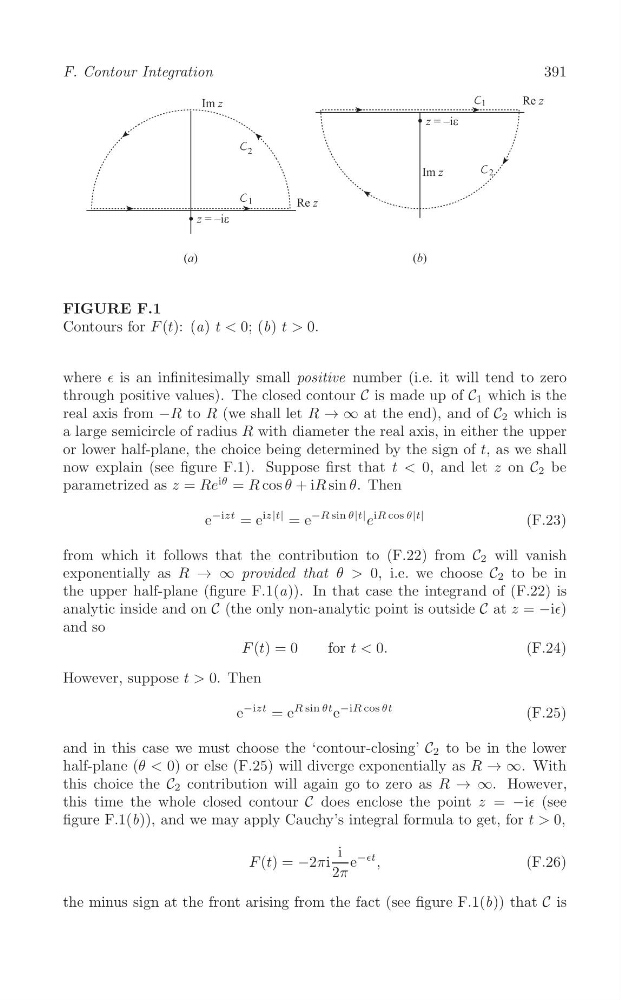
FIGURE F.1
Contours for F (t): (a) t < 0; (b) t > 0.
where ∈ is an infinitesimally small positive number (i.e. it will tend to zero
through positive values). The closed contour C is made up of C 1 which is the
real axis from −R to R (we shall let R → ∞ at the end), and of C 2 which is
a large semicircle of radius R with diameter the real axis, in either the upper
or lower half-plane, the choice being determined by the sign of t, as we shall
now explain (see figure F.1). Suppose first that t < 0, and let z on C 2 be
iθ
parametrized as z = Re = R cos θ + iR sin θ. Then
−izt
iz|t|
−R sin θ|t| iR cos θ|t|
e
= e
= e
e
(F.23)
from which it follows that the contribution to (F.22) from C 2 will vanish
exponentially as R → ∞ provided that θ > 0, i.e. we choose C 2 to be in
the upper half-plane (figure F.1(a)). In that case the integrand of (F.22) is
analytic inside and on C (the only non-analytic point is outside C at z = −i∈)
and so
F (t) = 0
for t < 0.
(F.24)
However, suppose t > 0. Then
−izt
R sin θt −iR cos θt
e
= e
e
(F.25)
and in this case we must choose the ‘contour-closing’ C 2 to be in the lower
half-plane (θ < 0) or else (F.25) will diverge exponentially as R → ∞. With
this choice the C 2 contribution will again go to zero as R → ∞. However,
this time the whole closed contour C does enclose the point z = −i∈ (see
figure F.1(b)), and we may apply Cauchy’s integral formula to get, for t > 0,
i −∊t
F (t) = −2πi e ,
(F.26)
2π
the minus sign at the front arising from the fact (see figure F.1(b)) that C is
F. Contour Integration
FIGURE F.1
Contours for F (t): (a) t < 0; (b) t > 0.
where ∈ is an infinitesimally small positive number (i.e. it will tend to zero
through positive values). The closed contour C is made up of C 1 which is the
real axis from −R to R (we shall let R → ∞ at the end), and of C 2 which is
a large semicircle of radius R with diameter the real axis, in either the upper
or lower half-plane, the choice being determined by the sign of t, as we shall
now explain (see figure F.1). Suppose first that t < 0, and let z on C 2 be
iθ
parametrized as z = Re = R cos θ + iR sin θ. Then
−izt
iz|t|
−R sin θ|t| iR cos θ|t|
e
= e
= e
e
(F.23)
from which it follows that the contribution to (F.22) from C 2 will vanish
exponentially as R → ∞ provided that θ > 0, i.e. we choose C 2 to be in
the upper half-plane (figure F.1(a)). In that case the integrand of (F.22) is
analytic inside and on C (the only non-analytic point is outside C at z = −i∈)
and so
F (t) = 0
for t < 0.
(F.24)
However, suppose t > 0. Then
−izt
R sin θt −iR cos θt
e
= e
e
(F.25)
and in this case we must choose the ‘contour-closing’ C 2 to be in the lower
half-plane (θ < 0) or else (F.25) will diverge exponentially as R → ∞. With
this choice the C 2 contribution will again go to zero as R → ∞. However,
this time the whole closed contour C does enclose the point z = −i∈ (see
figure F.1(b)), and we may apply Cauchy’s integral formula to get, for t > 0,
i −∊t
F (t) = −2πi e ,
(F.26)
2π
the minus sign at the front arising from the fact (see figure F.1(b)) that C is