

22
1. The Particles and Forces of the Standard Model
N
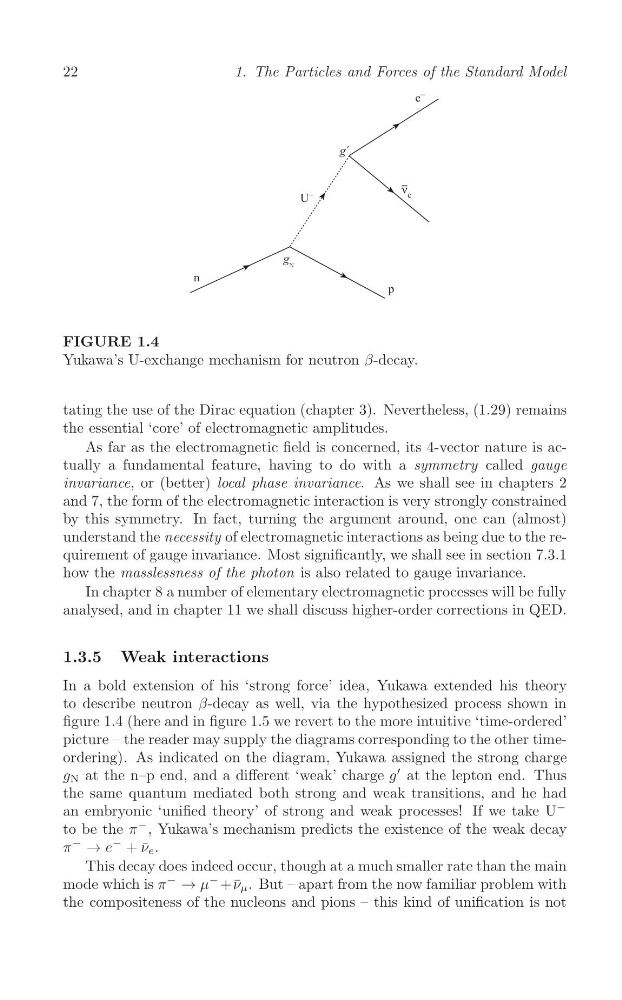
FIGURE 1.4
Yukawa’s U-exchange mechanism for neutron β-decay.
tating the use of the Dirac equation (chapter 3). Nevertheless, (1.29) remains
the essential ‘core’ of electromagnetic amplitudes.
As far as the electromagnetic field is concerned, its 4-vector nature is actually a fundamental feature, having to do with a symmetry called gauge
invariance, or (better) local phase invariance. As we shall see in chapters 2
and 7, the form of the electromagnetic interaction is very strongly constrained
by this symmetry. In fact, turning the argument around, one can (almost)
understand the necessity of electromagnetic interactions as being due to the requirement of gauge invariance. Most significantly, we shall see in section 7.3.1
how the masslessness of the photon is also related to gauge invariance.
In chapter 8 a number of elementary electromagnetic processes will be fully
analysed, and in chapter 11 we shall discuss higher-order corrections in QED.
1.3.5 Weak interactions
In a bold extension of his ‘strong force’ idea, Yukawa extended his theory
to describe neutron β-decay as well, via the hypothesized process shown in
figure 1.4 (here and in figure 1.5 we revert to the more intuitive ‘time-ordered’
picture – the reader may supply the diagrams corresponding to the other timeordering). As indicated on the diagram, Yukawa assigned the strong charge
′
g N at the n–p end, and a different ‘weak’ charge g at the lepton end. Thus
the same quantum mediated both strong and weak transitions, and he had
an embryonic ‘unified theory’ of strong and weak processes! If we take U
−
to be the π
− , Yukawa’s mechanism predicts the existence of the weak decay
π
−
→ e
− + ¯
ν e .
This decay does indeed occur, though at a much smaller rate than the main
mode which is π
−
→ μ
− + ¯
ν μ . But – apart from the now familiar problem with
the compositeness of the nucleons and pions – this kind of unification is not
1. The Particles and Forces of the Standard Model
N
FIGURE 1.4
Yukawa’s U-exchange mechanism for neutron β-decay.
tating the use of the Dirac equation (chapter 3). Nevertheless, (1.29) remains
the essential ‘core’ of electromagnetic amplitudes.
As far as the electromagnetic field is concerned, its 4-vector nature is actually a fundamental feature, having to do with a symmetry called gauge
invariance, or (better) local phase invariance. As we shall see in chapters 2
and 7, the form of the electromagnetic interaction is very strongly constrained
by this symmetry. In fact, turning the argument around, one can (almost)
understand the necessity of electromagnetic interactions as being due to the requirement of gauge invariance. Most significantly, we shall see in section 7.3.1
how the masslessness of the photon is also related to gauge invariance.
In chapter 8 a number of elementary electromagnetic processes will be fully
analysed, and in chapter 11 we shall discuss higher-order corrections in QED.
1.3.5 Weak interactions
In a bold extension of his ‘strong force’ idea, Yukawa extended his theory
to describe neutron β-decay as well, via the hypothesized process shown in
figure 1.4 (here and in figure 1.5 we revert to the more intuitive ‘time-ordered’
picture – the reader may supply the diagrams corresponding to the other timeordering). As indicated on the diagram, Yukawa assigned the strong charge
′
g N at the n–p end, and a different ‘weak’ charge g at the lepton end. Thus
the same quantum mediated both strong and weak transitions, and he had
an embryonic ‘unified theory’ of strong and weak processes! If we take U
−
to be the π
− , Yukawa’s mechanism predicts the existence of the weak decay
π
−
→ e
− + ¯
ν e .
This decay does indeed occur, though at a much smaller rate than the main
mode which is π
−
→ μ
− + ¯
ν μ . But – apart from the now familiar problem with
the compositeness of the nucleons and pions – this kind of unification is not