

23
1.3. Particle interactions in the Standard Model
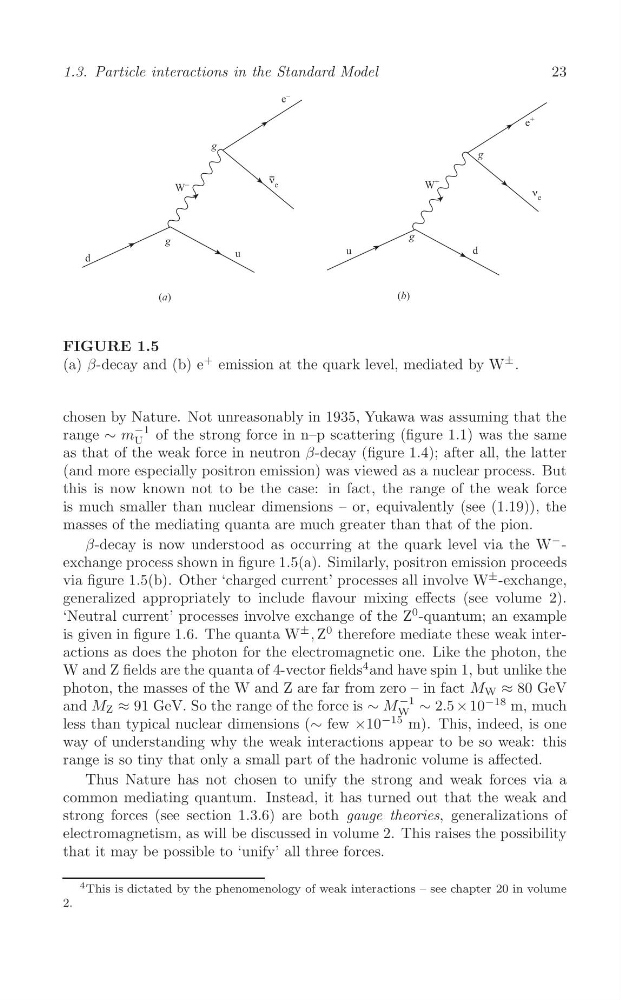
FIGURE 1.5
(a) β-decay and (b) e
+ emission at the quark level, mediated by W
± .
chosen by Nature. Not unreasonably in 1935, Yukawa was assuming that the
−1
range ∼ m of the strong force in n–p scattering (figure 1.1) was the same
U
as that of the weak force in neutron β-decay (figure 1.4); after all, the latter
(and more especially positron emission) was viewed as a nuclear process. But
this is now known not to be the case: in fact, the range of the weak force
is much smaller than nuclear dimensions – or, equivalently (see (1.19)), the
masses of the mediating quanta are much greater than that of the pion.
β-decay is now understood as occurring at the quark level via the W
−
exchange process shown in figure 1.5(a). Similarly, positron emission proceeds
via figure 1.5(b). Other ‘charged current’ processes all involve W
± -exchange,
generalized appropriately to include flavour mixing effects (see volume 2).
‘Neutral current’ processes involve exchange of the Z
0 -quantum; an example
is given in figure 1.6. The quanta W
± , Z
0 therefore mediate these weak interactions as does the photon for the electromagnetic one. Like the photon, the
W and Z fields are the quanta of 4-vector fields
4 and have spin 1, but unlike the
photon, the masses of the W and Z are far from zero – in fact M W ≈ 80 GeV
and M Z ≈ 91 GeV. So the range of the force is ∼ M
−1
∼ 2.5 × 10
−18 m, much
W
less than typical nuclear dimensions (∼ few ×10
−15 m). This, indeed, is one
way of understanding why the weak interactions appear to be so weak: this
range is so tiny that only a small part of the hadronic volume is affected.
Thus Nature has not chosen to unify the strong and weak forces via a
common mediating quantum. Instead, it has turned out that the weak and
strong forces (see section 1.3.6) are both gauge theories, generalizations of
electromagnetism, as will be discussed in volume 2. This raises the possibility
that it may be possible to ‘unify’ all three forces.
4 This is dictated by the phenomenology of weak interactions – see chapter 20 in volume
2.
1.3. Particle interactions in the Standard Model
FIGURE 1.5
(a) β-decay and (b) e
+ emission at the quark level, mediated by W
± .
chosen by Nature. Not unreasonably in 1935, Yukawa was assuming that the
−1
range ∼ m of the strong force in n–p scattering (figure 1.1) was the same
U
as that of the weak force in neutron β-decay (figure 1.4); after all, the latter
(and more especially positron emission) was viewed as a nuclear process. But
this is now known not to be the case: in fact, the range of the weak force
is much smaller than nuclear dimensions – or, equivalently (see (1.19)), the
masses of the mediating quanta are much greater than that of the pion.
β-decay is now understood as occurring at the quark level via the W
−
exchange process shown in figure 1.5(a). Similarly, positron emission proceeds
via figure 1.5(b). Other ‘charged current’ processes all involve W
± -exchange,
generalized appropriately to include flavour mixing effects (see volume 2).
‘Neutral current’ processes involve exchange of the Z
0 -quantum; an example
is given in figure 1.6. The quanta W
± , Z
0 therefore mediate these weak interactions as does the photon for the electromagnetic one. Like the photon, the
W and Z fields are the quanta of 4-vector fields
4 and have spin 1, but unlike the
photon, the masses of the W and Z are far from zero – in fact M W ≈ 80 GeV
and M Z ≈ 91 GeV. So the range of the force is ∼ M
−1
∼ 2.5 × 10
−18 m, much
W
less than typical nuclear dimensions (∼ few ×10
−15 m). This, indeed, is one
way of understanding why the weak interactions appear to be so weak: this
range is so tiny that only a small part of the hadronic volume is affected.
Thus Nature has not chosen to unify the strong and weak forces via a
common mediating quantum. Instead, it has turned out that the weak and
strong forces (see section 1.3.6) are both gauge theories, generalizations of
electromagnetism, as will be discussed in volume 2. This raises the possibility
that it may be possible to ‘unify’ all three forces.
4 This is dictated by the phenomenology of weak interactions – see chapter 20 in volume
2.