

321
10.4. Bare and renormalized perturbation theory
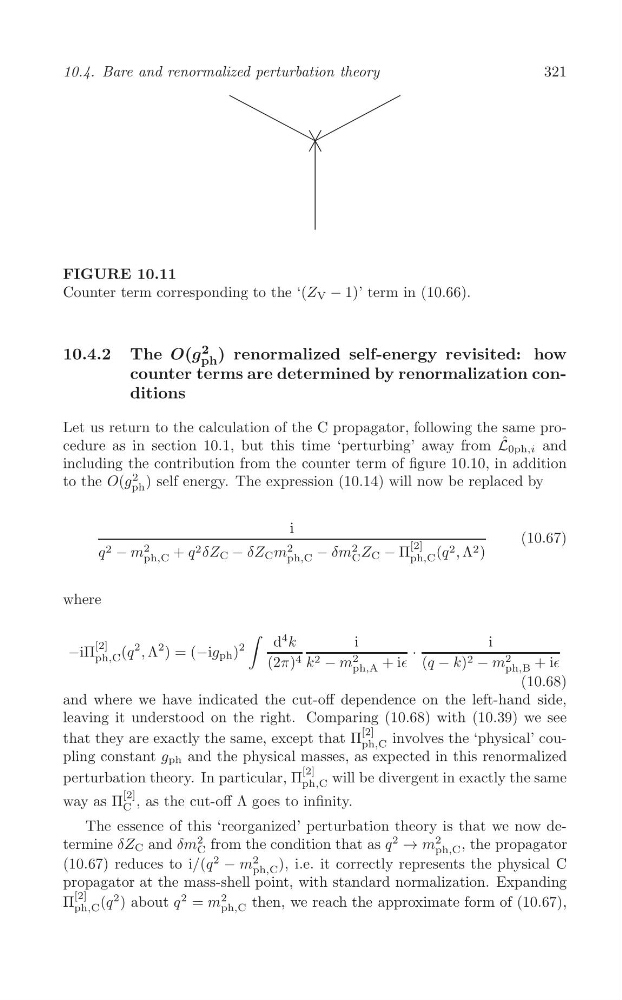
FIGURE 10.11
Counter term corresponding to the ‘(Z V − 1)’ term in (10.66).
10.4.2 The O(g 2 ) renormalized self-energy revisited: how
ph
counter terms are determined by renormalization conditions
Let us return to the calculation of the C propagator, following the same procedure as in section 10.1, but this time ‘perturbing’ away from L ˆ 0ph,i and
including the contribution from the counter term of figure 10.10, in addition
2
to the O(g ) self energy. The expression (10.14) will now be replaced by
ph
i
(10.67)
2
2
q 2 − m
+ q 2 δZ C − δZ C m
− δm 2
[2] (q 2 , Λ 2 )
ph,C
ph,C
C Z C − Π ph,C
where
∫
[2]
2
d
4 k
i
i
−iΠ
(q , Λ
2 ) = (−ig ph )
2
·
ph,C
2
2
(2π) 4 k 2 − m
+ i∈ (q − k) 2 − m
+ i∈
ph,A
ph,B
(10.68)
and where we have indicated the cut-off dependence on the left-hand side,
leaving it understood on the right. Comparing (10.68) with (10.39) we see
[2]
that they are exactly the same, except that Π
involves the ‘physical’ couph,C
pling constant g ph and the physical masses, as expected in this renormalized
[2]
perturbation theory. In particular, Π
will be divergent in exactly the same
ph,C
[2]
way as Π , as the cut-off Λ goes to infinity.
C
The essence of this ‘reorganized’ perturbation theory is that we now de2
→
2
termine δZ C and δm
2 from the condition that as q
m
the propagator
C
ph,C ,
2
(10.67) reduces to i/(q
2
− m
), i.e. it correctly represents the physical C
ph,C
propagator at the mass-shell point, with standard normalization. Expanding
2
2
Π
[2] (q
2 ) about q = m
then, we reach the approximate form of (10.67),
ph,C
ph,C
10.4. Bare and renormalized perturbation theory
FIGURE 10.11
Counter term corresponding to the ‘(Z V − 1)’ term in (10.66).
10.4.2 The O(g 2 ) renormalized self-energy revisited: how
ph
counter terms are determined by renormalization conditions
Let us return to the calculation of the C propagator, following the same procedure as in section 10.1, but this time ‘perturbing’ away from L ˆ 0ph,i and
including the contribution from the counter term of figure 10.10, in addition
2
to the O(g ) self energy. The expression (10.14) will now be replaced by
ph
i
(10.67)
2
2
q 2 − m
+ q 2 δZ C − δZ C m
− δm 2
[2] (q 2 , Λ 2 )
ph,C
ph,C
C Z C − Π ph,C
where
∫
[2]
2
d
4 k
i
i
−iΠ
(q , Λ
2 ) = (−ig ph )
2
·
ph,C
2
2
(2π) 4 k 2 − m
+ i∈ (q − k) 2 − m
+ i∈
ph,A
ph,B
(10.68)
and where we have indicated the cut-off dependence on the left-hand side,
leaving it understood on the right. Comparing (10.68) with (10.39) we see
[2]
that they are exactly the same, except that Π
involves the ‘physical’ couph,C
pling constant g ph and the physical masses, as expected in this renormalized
[2]
perturbation theory. In particular, Π
will be divergent in exactly the same
ph,C
[2]
way as Π , as the cut-off Λ goes to infinity.
C
The essence of this ‘reorganized’ perturbation theory is that we now de2
→
2
termine δZ C and δm
2 from the condition that as q
m
the propagator
C
ph,C ,
2
(10.67) reduces to i/(q
2
− m
), i.e. it correctly represents the physical C
ph,C
propagator at the mass-shell point, with standard normalization. Expanding
2
2
Π
[2] (q
2 ) about q = m
then, we reach the approximate form of (10.67),
ph,C
ph,C