

322
10. Loops and Renormalization I: The ABC Theory
valid for q
2
≈ m
2
:
ph,C
i
.
[2]
dΠ
[2]
ph,C
2
2
2
(q
2
− m
δm
2
Π
(m
(q
2
− m
ph,C )Z C − C Z C − ph,C ph,C , Λ
2 )−
ph,C )
|
|
|
|
dq 2
2
2
q =m ph,C
(10.69)
2
Requiring that this has the form i/(q
2
− m
) gives
ph,C
Z
−1 [2]
2
condition (a)
δm
2 = −
Π
(m
C
C
ph,C
ph,C , Λ
2 )
[2]
dΠ ph,C
condition (b)
Z C = 1 +
.
(10.70)
|
|
|
|
dq 2
q 2 =m 2
ph,C
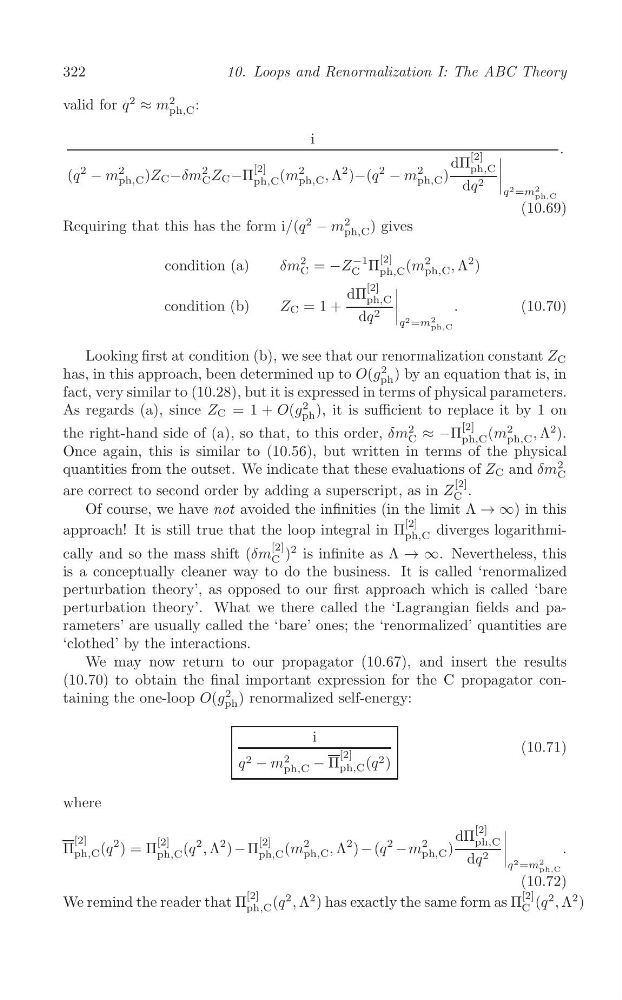
Looking first at condition (b), we see that our renormalization constant Z C
2
has, in this approach, been determined up to O(g ) by an equation that is, in
ph
fact, very similar to (10.28), but it is expressed in terms of physical parameters.
2
As regards (a), since Z C = 1 + O(g ), it is sufficient to replace it by 1 on
ph
[2]
2
the right-hand side of (a), so that, to this order, δm
2
≈ −Π
(m ph,C , Λ
2 ).
C
ph,C
Once again, this is similar to (10.56), but written in terms of the physical
quantities from the outset. We indicate that these evaluations of Z C and δm
2
C
[2]
are correct to second order by adding a superscript, as in Z .
C
Of course, we have not avoided the infinities (in the limit Λ → ∞) in this
[2]
approach! It is still true that the loop integral in Π
diverges logarithmiph,C
[2] )
2
is a conceptually cleaner way to do the business. It is called ‘renormalized
perturbation theory’, as opposed to our first approach which is called ‘bare
perturbation theory’. What we there called the ‘Lagrangian fields and parameters’ are usually called the ‘bare’ ones; the ‘renormalized’ quantities are
‘clothed’ by the interactions.
We may now return to our propagator (10.67), and insert the results
cally and so the mass shift (δm C
is infinite as Λ → ∞. Nevertheless, this
(10.70) to obtain the final important expression for the C propagator con2
taining the one-loop O(g ) renormalized self-energy:
ph
i
(10.71)
q 2 − m 2
− Π
[2]
ph,C
ph,C (q 2 )
where
[2]
dΠ
[2]
[2]
[2]
ph,C
2
2
2
Π
2 ) = Π
(q , Λ
2 ) − Π
(m
2
− m
.
ph,C (q
ph,C
ph,C
ph,C , Λ
2 ) − (q
ph,C )
|
|
|
|
dq 2
2
2
q =m ph,C
(10.72)
[2]
[2]
2
2
We remind the reader that Π
(q , Λ
2 ) has exactly the same form as Π (q , Λ
2 )
ph,C
C
10. Loops and Renormalization I: The ABC Theory
valid for q
2
≈ m
2
:
ph,C
i
.
[2]
dΠ
[2]
ph,C
2
2
2
(q
2
− m
δm
2
Π
(m
(q
2
− m
ph,C )Z C − C Z C − ph,C ph,C , Λ
2 )−
ph,C )
|
|
|
|
dq 2
2
2
q =m ph,C
(10.69)
2
Requiring that this has the form i/(q
2
− m
) gives
ph,C
Z
−1 [2]
2
condition (a)
δm
2 = −
Π
(m
C
C
ph,C
ph,C , Λ
2 )
[2]
dΠ ph,C
condition (b)
Z C = 1 +
.
(10.70)
|
|
|
|
dq 2
q 2 =m 2
ph,C
Looking first at condition (b), we see that our renormalization constant Z C
2
has, in this approach, been determined up to O(g ) by an equation that is, in
ph
fact, very similar to (10.28), but it is expressed in terms of physical parameters.
2
As regards (a), since Z C = 1 + O(g ), it is sufficient to replace it by 1 on
ph
[2]
2
the right-hand side of (a), so that, to this order, δm
2
≈ −Π
(m ph,C , Λ
2 ).
C
ph,C
Once again, this is similar to (10.56), but written in terms of the physical
quantities from the outset. We indicate that these evaluations of Z C and δm
2
C
[2]
are correct to second order by adding a superscript, as in Z .
C
Of course, we have not avoided the infinities (in the limit Λ → ∞) in this
[2]
approach! It is still true that the loop integral in Π
diverges logarithmiph,C
[2] )
2
is a conceptually cleaner way to do the business. It is called ‘renormalized
perturbation theory’, as opposed to our first approach which is called ‘bare
perturbation theory’. What we there called the ‘Lagrangian fields and parameters’ are usually called the ‘bare’ ones; the ‘renormalized’ quantities are
‘clothed’ by the interactions.
We may now return to our propagator (10.67), and insert the results
cally and so the mass shift (δm C
is infinite as Λ → ∞. Nevertheless, this
(10.70) to obtain the final important expression for the C propagator con2
taining the one-loop O(g ) renormalized self-energy:
ph
i
(10.71)
q 2 − m 2
− Π
[2]
ph,C
ph,C (q 2 )
where
[2]
dΠ
[2]
[2]
[2]
ph,C
2
2
2
Π
2 ) = Π
(q , Λ
2 ) − Π
(m
2
− m
.
ph,C (q
ph,C
ph,C
ph,C , Λ
2 ) − (q
ph,C )
|
|
|
|
dq 2
2
2
q =m ph,C
(10.72)
[2]
[2]
2
2
We remind the reader that Π
(q , Λ
2 ) has exactly the same form as Π (q , Λ
2 )
ph,C
C