

307
10.1. The propagator correction in ABC theory
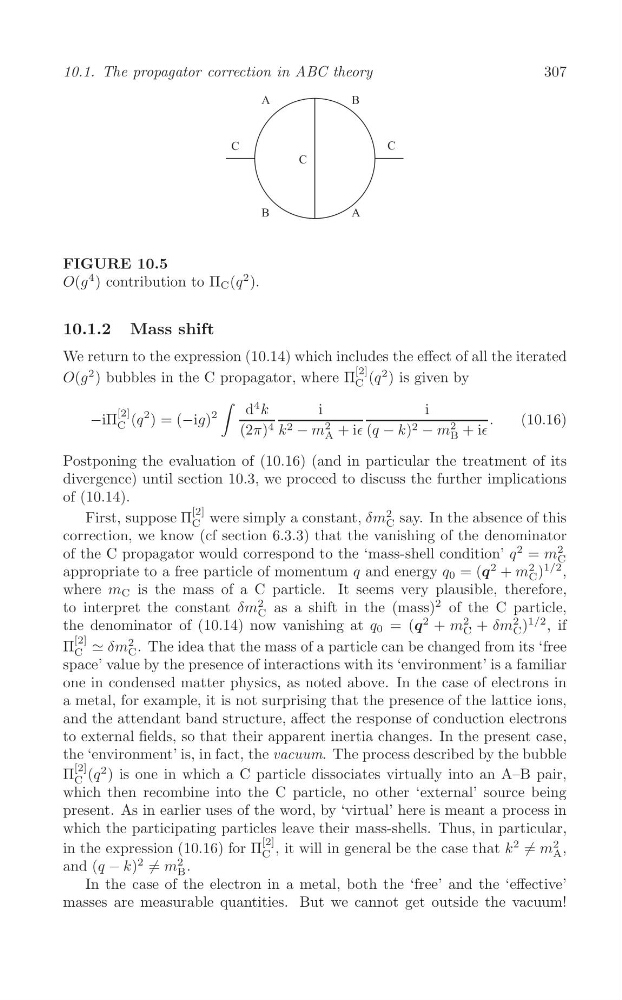
FIGURE 10.5
O(g
4 ) contribution to Π C (q
2 ).
10.1.2 Mass shift
We return to the expression (10.14) which includes the effect of all the iterated
O(g
2 ) bubbles in the C propagator, where Π
[2] (q
2 ) is given by
C
∫
[2]
d
4 k
i
i
−iΠ (q
2 ) = (−ig)
2
.
(10.16)
C
2
2
(2π) 4 k 2 − m + i∈ (q − k) 2 − m + i∈
A
B
Postponing the evaluation of (10.16) (and in particular the treatment of its
divergence) until section 10.3, we proceed to discuss the further implications
of (10.14).
First, suppose Π
[2] were simply a constant, δm
2 say. In the absence of this
C
C
correction, we know (cf section 6.3.3) that the vanishing of the denominator
2
2
of the C propagator would correspond to the ‘mass-shell condition’ q = m C
2
2 )
1/2
appropriate to a free particle of momentum q and energy q 0 = (q + m
,
C
where m C is the mass of a C particle. It seems very plausible, therefore,
to interpret the constant δm
2 as a shift in the (mass)
2 of the C particle,
C
2
2
the denominator of (10.14) now vanishing at q 0 = (q + m C + δm
2 )
1/2 , if
C
Π
[2] ≃ δm
2 . The idea that the mass of a particle can be changed from its ‘free
C
C
space’ value by the presence of interactions with its ‘environment’ is a familiar
one in condensed matter physics, as noted above. In the case of electrons in
a metal, for example, it is not surprising that the presence of the lattice ions,
and the attendant band structure, affect the response of conduction electrons
to external fields, so that their apparent inertia changes. In the present case,
the ‘environment’ is, in fact, the vacuum. The process described by the bubble
Π
[2] (q
2 ) is one in which a C particle dissociates virtually into an A–B pair,
C
which then recombine into the C particle, no other ‘external’ source being
present. As in earlier uses of the word, by ‘virtual’ here is meant a process in
which the participating particles leave their mass-shells. Thus, in particular,
[2]
2
in the expression (10.16) for Π , it will in general be the case that k
2
/ = m A ,
C
2
and (q − k)
2
/ m B .
=
In the case of the electron in a metal, both the ‘free’ and the ‘effective’
masses are measurable quantities. But we cannot get outside the vacuum!
10.1. The propagator correction in ABC theory
FIGURE 10.5
O(g
4 ) contribution to Π C (q
2 ).
10.1.2 Mass shift
We return to the expression (10.14) which includes the effect of all the iterated
O(g
2 ) bubbles in the C propagator, where Π
[2] (q
2 ) is given by
C
∫
[2]
d
4 k
i
i
−iΠ (q
2 ) = (−ig)
2
.
(10.16)
C
2
2
(2π) 4 k 2 − m + i∈ (q − k) 2 − m + i∈
A
B
Postponing the evaluation of (10.16) (and in particular the treatment of its
divergence) until section 10.3, we proceed to discuss the further implications
of (10.14).
First, suppose Π
[2] were simply a constant, δm
2 say. In the absence of this
C
C
correction, we know (cf section 6.3.3) that the vanishing of the denominator
2
2
of the C propagator would correspond to the ‘mass-shell condition’ q = m C
2
2 )
1/2
appropriate to a free particle of momentum q and energy q 0 = (q + m
,
C
where m C is the mass of a C particle. It seems very plausible, therefore,
to interpret the constant δm
2 as a shift in the (mass)
2 of the C particle,
C
2
2
the denominator of (10.14) now vanishing at q 0 = (q + m C + δm
2 )
1/2 , if
C
Π
[2] ≃ δm
2 . The idea that the mass of a particle can be changed from its ‘free
C
C
space’ value by the presence of interactions with its ‘environment’ is a familiar
one in condensed matter physics, as noted above. In the case of electrons in
a metal, for example, it is not surprising that the presence of the lattice ions,
and the attendant band structure, affect the response of conduction electrons
to external fields, so that their apparent inertia changes. In the present case,
the ‘environment’ is, in fact, the vacuum. The process described by the bubble
Π
[2] (q
2 ) is one in which a C particle dissociates virtually into an A–B pair,
C
which then recombine into the C particle, no other ‘external’ source being
present. As in earlier uses of the word, by ‘virtual’ here is meant a process in
which the participating particles leave their mass-shells. Thus, in particular,
[2]
2
in the expression (10.16) for Π , it will in general be the case that k
2
/ = m A ,
C
2
and (q − k)
2
/ m B .
=
In the case of the electron in a metal, both the ‘free’ and the ‘effective’
masses are measurable quantities. But we cannot get outside the vacuum!