

308
10. Loops and Renormalization I: The ABC Theory
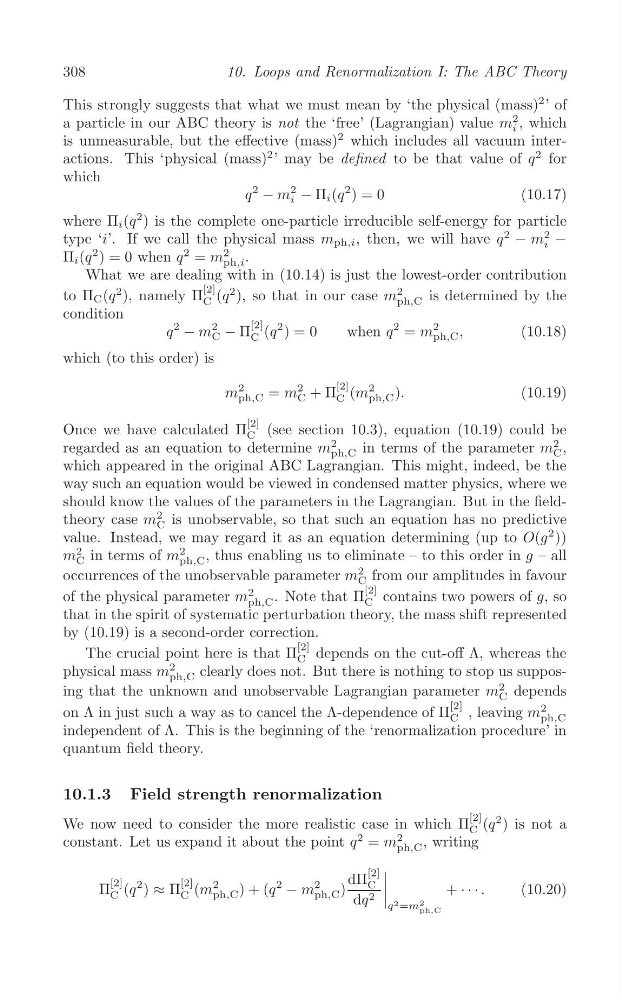
This strongly suggests that what we must mean by ‘the physical (mass)
2 ’ of
2
a particle in our ABC theory is not the ‘free’ (Lagrangian) value m i , which
is unmeasurable, but the effective (mass)
2 which includes all vacuum inter2
actions. This ‘physical (mass)
2 ’ may be defined to be that value of q for
which
2
q
2
− m − Π i (q
2 ) = 0
(10.17)
i
where Π i (q
2 ) is the complete one-particle irreducible self-energy for particle
2
− m
2
type ‘i’. If we call the physical mass m ph,i , then, we will have q
−
i
2
2
Π i (q
2 ) = 0 when q = m ph,i .
What we are dealing with in (10.14) is just the lowest-order contribution
2
to Π C (q
2 ), namely Π
[2] (q
2 ), so that in our case m
is determined by the
C
ph,C
Once we have calculated Π (see section 10.3), equation (10.19) could be
condition
q
2
− m C − Π (q
2 ) = 0
2
[2]
C
when q = m
2
2
ph,C ,
(10.18)
which (to this order) is
2
2
[2]
2
ph,C
C
ph,C ).
m
= m C + Π (m
(10.19)
[2]
C
2
2
regarded as an equation to determine m
in terms of the parameter m C ,
ph,C
which appeared in the original ABC Lagrangian. This might, indeed, be the
way such an equation would be viewed in condensed matter physics, where we
should know the values of the parameters in the Lagrangian. But in the field2
theory case m is unobservable, so that such an equation has no predictive
C
value. Instead, we may regard it as an equation determining (up to O(g
2 ))
2
2
m in terms of m
, thus enabling us to eliminate – to this order in g – all
C
ph,C
2
occurrences of the unobservable parameter m from our amplitudes in favour
C
[2]
2
of the physical parameter m
. Note that Π contains two powers of g, so
ph,C
C
that in the spirit of systematic perturbation theory, the mass shift represented
by (10.19) is a second-order correction.
[2]
The crucial point here is that Π depends on the cut-off Λ, whereas the
C
2
physical mass m
clearly does not. But there is nothing to stop us supposph,C
2
ing that the unknown and unobservable Lagrangian parameter m depends
C
[2]
2
on Λ in just such a way as to cancel the Λ-dependence of Π , leaving m
C
ph,C
independent of Λ. This is the beginning of the ‘renormalization procedure’ in
quantum field theory.
10.1.3 Field strength renormalization
We now need to consider the more realistic case in which Π
[2] (q
2 ) is not a
C
2
2
constant. Let us expand it about the point q = m
, writing
ph,C
[2]
dΠ
[2]
[2]
2
2
C
Π (q
2 ) ≈ Π (m ph,C ) + (q
2
− m
+ · · · .
(10.20)
C
C
ph,C )
|
|
|
|
dq 2
2
q 2 =m ph,C
10. Loops and Renormalization I: The ABC Theory
This strongly suggests that what we must mean by ‘the physical (mass)
2 ’ of
2
a particle in our ABC theory is not the ‘free’ (Lagrangian) value m i , which
is unmeasurable, but the effective (mass)
2 which includes all vacuum inter2
actions. This ‘physical (mass)
2 ’ may be defined to be that value of q for
which
2
q
2
− m − Π i (q
2 ) = 0
(10.17)
i
where Π i (q
2 ) is the complete one-particle irreducible self-energy for particle
2
− m
2
type ‘i’. If we call the physical mass m ph,i , then, we will have q
−
i
2
2
Π i (q
2 ) = 0 when q = m ph,i .
What we are dealing with in (10.14) is just the lowest-order contribution
2
to Π C (q
2 ), namely Π
[2] (q
2 ), so that in our case m
is determined by the
C
ph,C
Once we have calculated Π (see section 10.3), equation (10.19) could be
condition
q
2
− m C − Π (q
2 ) = 0
2
[2]
C
when q = m
2
2
ph,C ,
(10.18)
which (to this order) is
2
2
[2]
2
ph,C
C
ph,C ).
m
= m C + Π (m
(10.19)
[2]
C
2
2
regarded as an equation to determine m
in terms of the parameter m C ,
ph,C
which appeared in the original ABC Lagrangian. This might, indeed, be the
way such an equation would be viewed in condensed matter physics, where we
should know the values of the parameters in the Lagrangian. But in the field2
theory case m is unobservable, so that such an equation has no predictive
C
value. Instead, we may regard it as an equation determining (up to O(g
2 ))
2
2
m in terms of m
, thus enabling us to eliminate – to this order in g – all
C
ph,C
2
occurrences of the unobservable parameter m from our amplitudes in favour
C
[2]
2
of the physical parameter m
. Note that Π contains two powers of g, so
ph,C
C
that in the spirit of systematic perturbation theory, the mass shift represented
by (10.19) is a second-order correction.
[2]
The crucial point here is that Π depends on the cut-off Λ, whereas the
C
2
physical mass m
clearly does not. But there is nothing to stop us supposph,C
2
ing that the unknown and unobservable Lagrangian parameter m depends
C
[2]
2
on Λ in just such a way as to cancel the Λ-dependence of Π , leaving m
C
ph,C
independent of Λ. This is the beginning of the ‘renormalization procedure’ in
quantum field theory.
10.1.3 Field strength renormalization
We now need to consider the more realistic case in which Π
[2] (q
2 ) is not a
C
2
2
constant. Let us expand it about the point q = m
, writing
ph,C
[2]
dΠ
[2]
[2]
2
2
C
Π (q
2 ) ≈ Π (m ph,C ) + (q
2
− m
+ · · · .
(10.20)
C
C
ph,C )
|
|
|
|
dq 2
2
q 2 =m ph,C