

284
9. Deep Inelastic Electron–Nucleon Scattering and the Parton Model
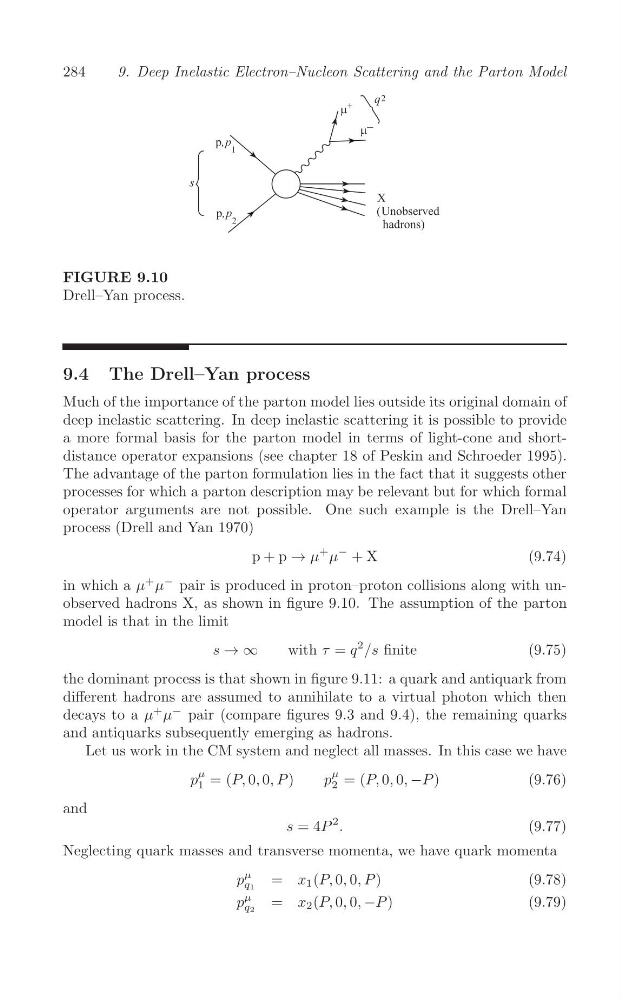
FIGURE 9.10
Drell–Yan process.
9.4 The Drell–Yan process
Much of the importance of the parton model lies outside its original domain of
deep inelastic scattering. In deep inelastic scattering it is possible to provide
a more formal basis for the parton model in terms of light-cone and shortdistance operator expansions (see chapter 18 of Peskin and Schroeder 1995).
The advantage of the parton formulation lies in the fact that it suggests other
processes for which a parton description may be relevant but for which formal
operator arguments are not possible. One such example is the Drell–Yan
process (Drell and Yan 1970)
p + p → μ
+ μ
− + X
(9.74)
in which a μ
+ μ
− pair is produced in proton–proton collisions along with unobserved hadrons X, as shown in figure 9.10. The assumption of the parton
model is that in the limit
s → ∞
with τ = q
2 /s finite
(9.75)
the dominant process is that shown in figure 9.11: a quark and antiquark from
different hadrons are assumed to annihilate to a virtual photon which then
decays to a μ
+ μ
− pair (compare figures 9.3 and 9.4), the remaining quarks
and antiquarks subsequently emerging as hadrons.
Let us work in the CM system and neglect all masses. In this case we have
μ
μ
p = (P, 0, 0, P )
p = (P, 0, 0, −P )
(9.76)
1
2
and
s = 4P
2 .
(9.77)
Neglecting quark masses and transverse momenta, we have quark momenta
μ
p q1 = x 1 (P, 0, 0, P )
(9.78)
μ
p q2 = x 2 (P, 0, 0, −P )
(9.79)
9. Deep Inelastic Electron–Nucleon Scattering and the Parton Model
FIGURE 9.10
Drell–Yan process.
9.4 The Drell–Yan process
Much of the importance of the parton model lies outside its original domain of
deep inelastic scattering. In deep inelastic scattering it is possible to provide
a more formal basis for the parton model in terms of light-cone and shortdistance operator expansions (see chapter 18 of Peskin and Schroeder 1995).
The advantage of the parton formulation lies in the fact that it suggests other
processes for which a parton description may be relevant but for which formal
operator arguments are not possible. One such example is the Drell–Yan
process (Drell and Yan 1970)
p + p → μ
+ μ
− + X
(9.74)
in which a μ
+ μ
− pair is produced in proton–proton collisions along with unobserved hadrons X, as shown in figure 9.10. The assumption of the parton
model is that in the limit
s → ∞
with τ = q
2 /s finite
(9.75)
the dominant process is that shown in figure 9.11: a quark and antiquark from
different hadrons are assumed to annihilate to a virtual photon which then
decays to a μ
+ μ
− pair (compare figures 9.3 and 9.4), the remaining quarks
and antiquarks subsequently emerging as hadrons.
Let us work in the CM system and neglect all masses. In this case we have
μ
μ
p = (P, 0, 0, P )
p = (P, 0, 0, −P )
(9.76)
1
2
and
s = 4P
2 .
(9.77)
Neglecting quark masses and transverse momenta, we have quark momenta
μ
p q1 = x 1 (P, 0, 0, P )
(9.78)
μ
p q2 = x 2 (P, 0, 0, −P )
(9.79)