

285
9.4. The Drell–Yan process
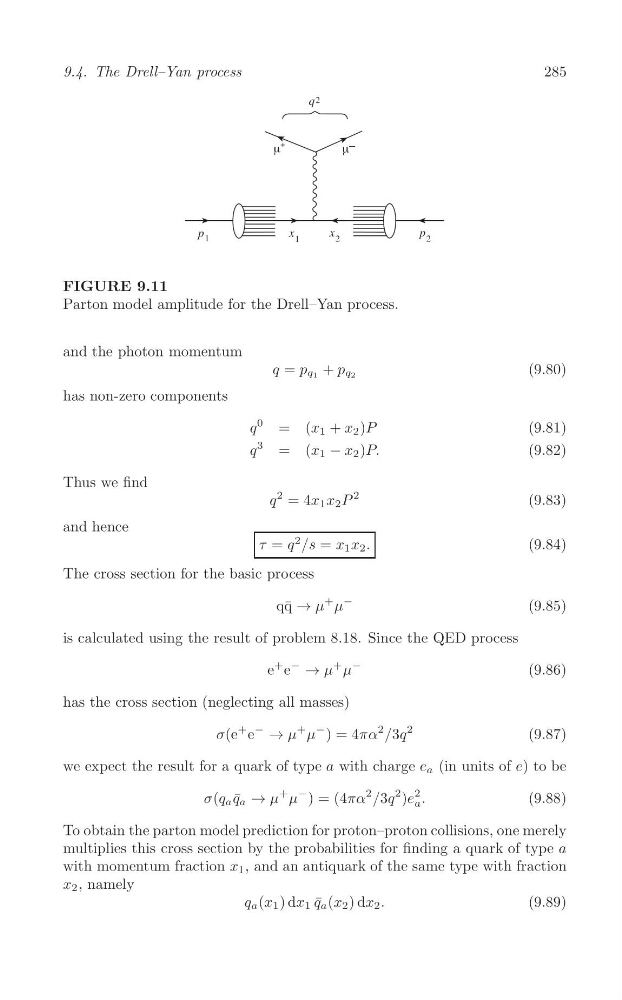
FIGURE 9.11
Parton model amplitude for the Drell–Yan process.
and the photon momentum
q = p q1 + p q2
(9.80)
has non-zero components
0
q = (x 1 + x 2 )P
(9.81)
3
q = (x 1 − x 2 )P.
(9.82)
Thus we find
q
2 = 4x 1 x 2 P
2
(9.83)
and hence
τ = q
2 /s = x 1 x 2 .
(9.84)
The cross section for the basic process
q¯ q → μ
+ μ
−
(9.85)
is calculated using the result of problem 8.18. Since the QED process
+ −
→ μ
+ μ
−
e e
(9.86)
has the cross section (neglecting all masses)
2
σ(e
+ e
−
→ μ
+ μ
− ) = 4πα
2 /3q
(9.87)
we expect the result for a quark of type a with charge e a (in units of e) to be
2
σ(q a q ¯ a → μ
+ μ
− ) = (4πα
2 /3q
2 )e .
(9.88)
a
To obtain the parton model prediction for proton–proton collisions, one merely
multiplies this cross section by the probabilities for finding a quark of type a
with momentum fraction x 1 , and an antiquark of the same type with fraction
x 2 , namely
q a (x 1 ) dx 1 q ¯ a (x 2 ) dx 2 .
(9.89)
9.4. The Drell–Yan process
FIGURE 9.11
Parton model amplitude for the Drell–Yan process.
and the photon momentum
q = p q1 + p q2
(9.80)
has non-zero components
0
q = (x 1 + x 2 )P
(9.81)
3
q = (x 1 − x 2 )P.
(9.82)
Thus we find
q
2 = 4x 1 x 2 P
2
(9.83)
and hence
τ = q
2 /s = x 1 x 2 .
(9.84)
The cross section for the basic process
q¯ q → μ
+ μ
−
(9.85)
is calculated using the result of problem 8.18. Since the QED process
+ −
→ μ
+ μ
−
e e
(9.86)
has the cross section (neglecting all masses)
2
σ(e
+ e
−
→ μ
+ μ
− ) = 4πα
2 /3q
(9.87)
we expect the result for a quark of type a with charge e a (in units of e) to be
2
σ(q a q ¯ a → μ
+ μ
− ) = (4πα
2 /3q
2 )e .
(9.88)
a
To obtain the parton model prediction for proton–proton collisions, one merely
multiplies this cross section by the probabilities for finding a quark of type a
with momentum fraction x 1 , and an antiquark of the same type with fraction
x 2 , namely
q a (x 1 ) dx 1 q ¯ a (x 2 ) dx 2 .
(9.89)