

275
9.2. Bjorken scaling and the parton model
e
− , k
e
− , k
′
q
fp
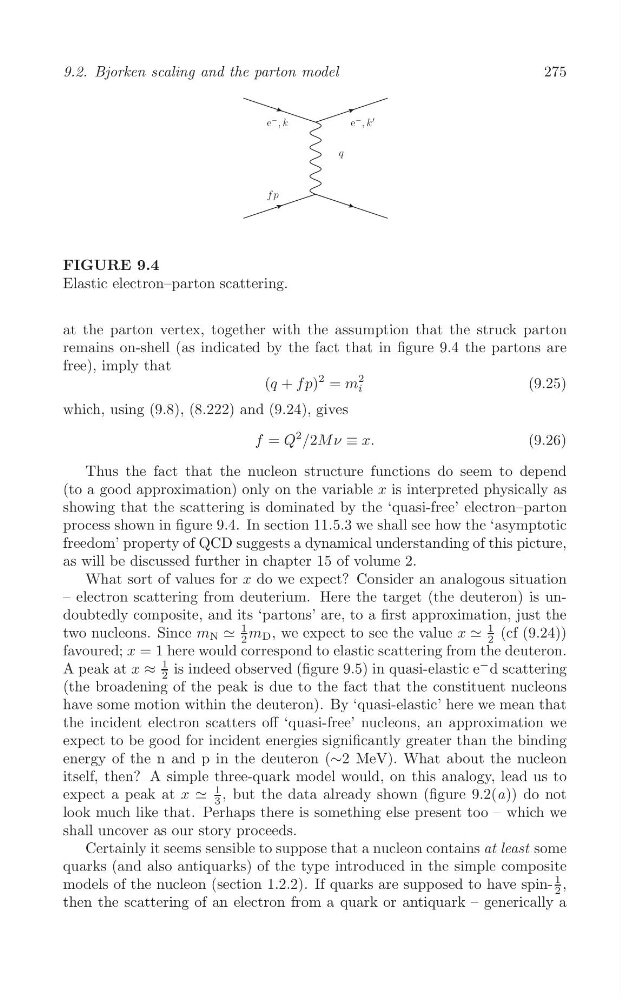
FIGURE 9.4
Elastic electron–parton scattering.
at the parton vertex, together with the assumption that the struck parton
remains on-shell (as indicated by the fact that in figure 9.4 the partons are
free), imply that
2
(q + f p)
2 = m
(9.25)
i
which, using (9.8), (8.222) and (9.24), gives
f = Q
2 /2M ν ≡ x.
(9.26)
Thus the fact that the nucleon structure functions do seem to depend
(to a good approximation) only on the variable x is interpreted physically as
showing that the scattering is dominated by the ‘quasi-free’ electron–parton
process shown in figure 9.4. In section 11.5.3 we shall see how the ‘asymptotic
freedom’ property of QCD suggests a dynamical understanding of this picture,
as will be discussed further in chapter 15 of volume 2.
What sort of values for x do we expect? Consider an analogous situation
– electron scattering from deuterium. Here the target (the deuteron) is undoubtedly composite, and its ‘partons’ are, to a first approximation, just the
two nucleons. Since m N ≃
1 m D , we expect to see the value x ≃
1 (cf (9.24))
2
2
favoured; x = 1 here would correspond to elastic scattering from the deuteron.
A peak at x ≈
1 is indeed observed (figure 9.5) in quasi-elastic e
− d scattering
2
(the broadening of the peak is due to the fact that the constituent nucleons
have some motion within the deuteron). By ‘quasi-elastic’ here we mean that
the incident electron scatters off ‘quasi-free’ nucleons, an approximation we
expect to be good for incident energies significantly greater than the binding
energy of the n and p in the deuteron (∼2 MeV). What about the nucleon
itself, then? A simple three-quark model would, on this analogy, lead us to
expect a peak at x
, but the data already shown (figure 9.2(a)) do not
≃
1
3
look much like that. Perhaps there is something else present too – which we
shall uncover as our story proceeds.
Certainly it seems sensible to suppose that a nucleon contains at least some
quarks (and also antiquarks) of the type introduced in the simple composite
models of the nucleon (section 1.2.2). If quarks are supposed to have spin1
2 ,
then the scattering of an electron from a quark or antiquark – generically a
9.2. Bjorken scaling and the parton model
e
− , k
e
− , k
′
q
fp
FIGURE 9.4
Elastic electron–parton scattering.
at the parton vertex, together with the assumption that the struck parton
remains on-shell (as indicated by the fact that in figure 9.4 the partons are
free), imply that
2
(q + f p)
2 = m
(9.25)
i
which, using (9.8), (8.222) and (9.24), gives
f = Q
2 /2M ν ≡ x.
(9.26)
Thus the fact that the nucleon structure functions do seem to depend
(to a good approximation) only on the variable x is interpreted physically as
showing that the scattering is dominated by the ‘quasi-free’ electron–parton
process shown in figure 9.4. In section 11.5.3 we shall see how the ‘asymptotic
freedom’ property of QCD suggests a dynamical understanding of this picture,
as will be discussed further in chapter 15 of volume 2.
What sort of values for x do we expect? Consider an analogous situation
– electron scattering from deuterium. Here the target (the deuteron) is undoubtedly composite, and its ‘partons’ are, to a first approximation, just the
two nucleons. Since m N ≃
1 m D , we expect to see the value x ≃
1 (cf (9.24))
2
2
favoured; x = 1 here would correspond to elastic scattering from the deuteron.
A peak at x ≈
1 is indeed observed (figure 9.5) in quasi-elastic e
− d scattering
2
(the broadening of the peak is due to the fact that the constituent nucleons
have some motion within the deuteron). By ‘quasi-elastic’ here we mean that
the incident electron scatters off ‘quasi-free’ nucleons, an approximation we
expect to be good for incident energies significantly greater than the binding
energy of the n and p in the deuteron (∼2 MeV). What about the nucleon
itself, then? A simple three-quark model would, on this analogy, lead us to
expect a peak at x
, but the data already shown (figure 9.2(a)) do not
≃
1
3
look much like that. Perhaps there is something else present too – which we
shall uncover as our story proceeds.
Certainly it seems sensible to suppose that a nucleon contains at least some
quarks (and also antiquarks) of the type introduced in the simple composite
models of the nucleon (section 1.2.2). If quarks are supposed to have spin1
2 ,
then the scattering of an electron from a quark or antiquark – generically a