

274
9. Deep Inelastic Electron–Nucleon Scattering and the Parton Model
p, p
e
− , k
q
e
− , k
′
fp
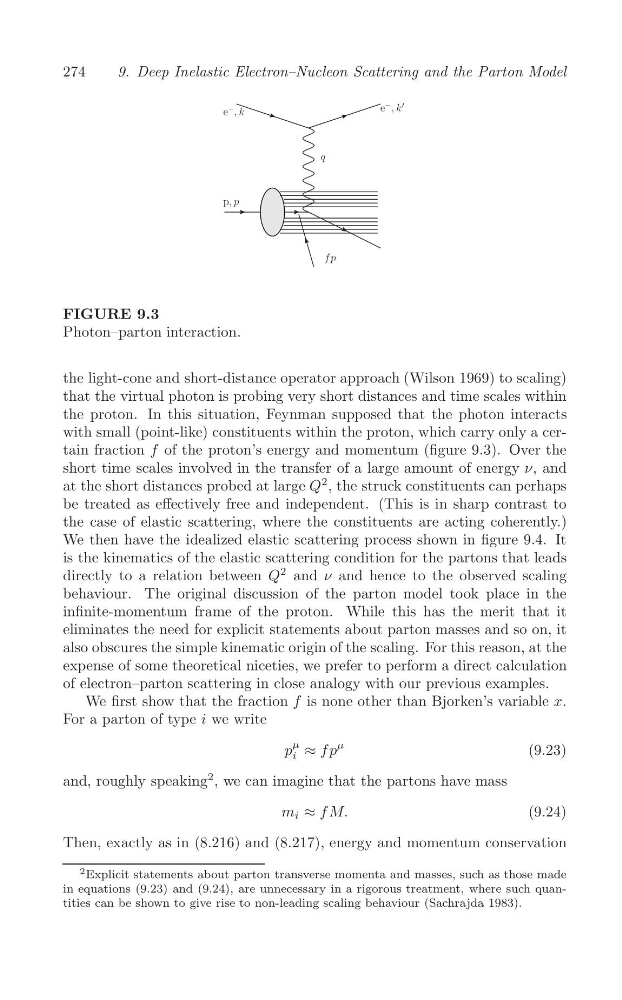
FIGURE 9.3
Photon–parton interaction.
the light-cone and short-distance operator approach (Wilson 1969) to scaling)
that the virtual photon is probing very short distances and time scales within
the proton. In this situation, Feynman supposed that the photon interacts
with small (point-like) constituents within the proton, which carry only a certain fraction f of the proton’s energy and momentum (figure 9.3). Over the
short time scales involved in the transfer of a large amount of energy ν, and
at the short distances probed at large Q
2 , the struck constituents can perhaps
be treated as effectively free and independent. (This is in sharp contrast to
the case of elastic scattering, where the constituents are acting coherently.)
We then have the idealized elastic scattering process shown in figure 9.4. It
is the kinematics of the elastic scattering condition for the partons that leads
directly to a relation between Q
2 and ν and hence to the observed scaling
behaviour. The original discussion of the parton model took place in the
infinite-momentum frame of the proton. While this has the merit that it
eliminates the need for explicit statements about parton masses and so on, it
also obscures the simple kinematic origin of the scaling. For this reason, at the
expense of some theoretical niceties, we prefer to perform a direct calculation
of electron–parton scattering in close analogy with our previous examples.
We first show that the fraction f is none other than Bjorken’s variable x.
For a parton of type i we write
μ
p ≈ f p
μ
(9.23)
i
and, roughly speaking
2 , we can imagine that the partons have mass
m i ≈ f M.
(9.24)
Then, exactly as in (8.216) and (8.217), energy and momentum conservation
2 Explicit statements about parton transverse momenta and masses, such as those made
in equations (9.23) and (9.24), are unnecessary in a rigorous treatment, where such quantities can be shown to give rise to non-leading scaling behaviour (Sachrajda 1983).
9. Deep Inelastic Electron–Nucleon Scattering and the Parton Model
p, p
e
− , k
q
e
− , k
′
fp
FIGURE 9.3
Photon–parton interaction.
the light-cone and short-distance operator approach (Wilson 1969) to scaling)
that the virtual photon is probing very short distances and time scales within
the proton. In this situation, Feynman supposed that the photon interacts
with small (point-like) constituents within the proton, which carry only a certain fraction f of the proton’s energy and momentum (figure 9.3). Over the
short time scales involved in the transfer of a large amount of energy ν, and
at the short distances probed at large Q
2 , the struck constituents can perhaps
be treated as effectively free and independent. (This is in sharp contrast to
the case of elastic scattering, where the constituents are acting coherently.)
We then have the idealized elastic scattering process shown in figure 9.4. It
is the kinematics of the elastic scattering condition for the partons that leads
directly to a relation between Q
2 and ν and hence to the observed scaling
behaviour. The original discussion of the parton model took place in the
infinite-momentum frame of the proton. While this has the merit that it
eliminates the need for explicit statements about parton masses and so on, it
also obscures the simple kinematic origin of the scaling. For this reason, at the
expense of some theoretical niceties, we prefer to perform a direct calculation
of electron–parton scattering in close analogy with our previous examples.
We first show that the fraction f is none other than Bjorken’s variable x.
For a parton of type i we write
μ
p ≈ f p
μ
(9.23)
i
and, roughly speaking
2 , we can imagine that the partons have mass
m i ≈ f M.
(9.24)
Then, exactly as in (8.216) and (8.217), energy and momentum conservation
2 Explicit statements about parton transverse momenta and masses, such as those made
in equations (9.23) and (9.24), are unnecessary in a rigorous treatment, where such quantities can be shown to give rise to non-leading scaling behaviour (Sachrajda 1983).