

273
9.2. Bjorken scaling and the parton model
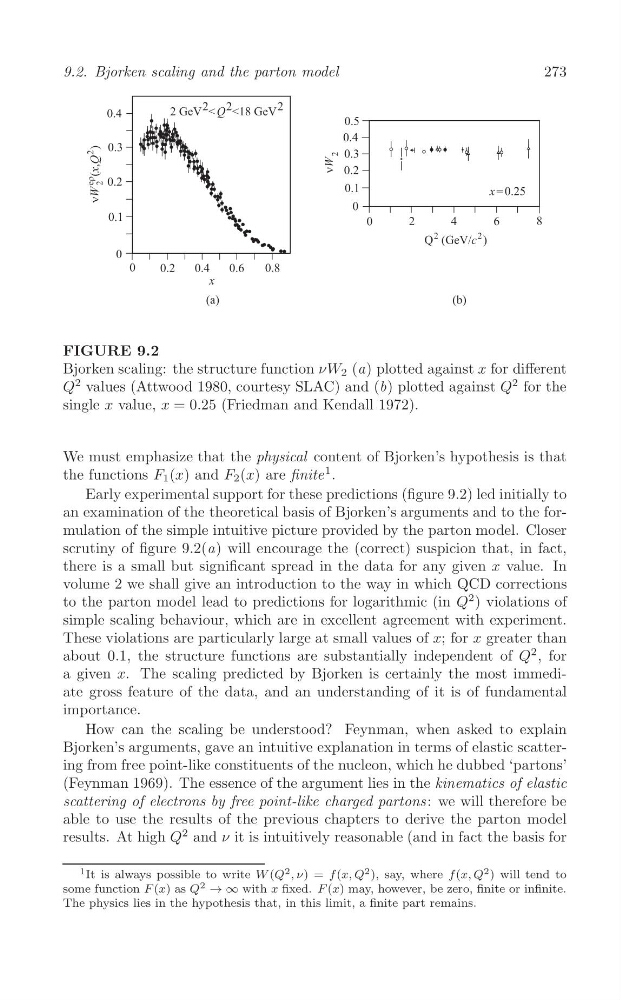
FIGURE 9.2
Bjorken scaling: the structure function νW 2 (a) plotted against x for different
Q
2 values (Attwood 1980, courtesy SLAC) and (b) plotted against Q
2 for the
single x value, x = 0.25 (Friedman and Kendall 1972).
We must emphasize that the physical content of Bjorken’s hypothesis is that
the functions F 1 (x) and F 2 (x) are finite
1 .
Early experimental support for these predictions (figure 9.2) led initially to
an examination of the theoretical basis of Bjorken’s arguments and to the formulation of the simple intuitive picture provided by the parton model. Closer
scrutiny of figure 9.2(a) will encourage the (correct) suspicion that, in fact,
there is a small but significant spread in the data for any given x value. In
volume 2 we shall give an introduction to the way in which QCD corrections
to the parton model lead to predictions for logarithmic (in Q
2 ) violations of
simple scaling behaviour, which are in excellent agreement with experiment.
These violations are particularly large at small values of x; for x greater than
about 0.1, the structure functions are substantially independent of Q
2 , for
a given x. The scaling predicted by Bjorken is certainly the most immediate gross feature of the data, and an understanding of it is of fundamental
importance.
How can the scaling be understood? Feynman, when asked to explain
Bjorken’s arguments, gave an intuitive explanation in terms of elastic scattering from free point-like constituents of the nucleon, which he dubbed ‘partons’
(Feynman 1969). The essence of the argument lies in the kinematics of elastic
scattering of electrons by free point-like charged partons: we will therefore be
able to use the results of the previous chapters to derive the parton model
results. At high Q
2 and ν it is intuitively reasonable (and in fact the basis for
1 It is always possible to write W (Q 2 , ν) = f (x, Q 2 ), say, where f (x, Q 2 ) will tend to
some function F (x) as Q 2 → ∞ with x fixed. F (x) may, however, be zero, finite or infinite.
The physics lies in the hypothesis that, in this limit, a finite part remains.
9.2. Bjorken scaling and the parton model
FIGURE 9.2
Bjorken scaling: the structure function νW 2 (a) plotted against x for different
Q
2 values (Attwood 1980, courtesy SLAC) and (b) plotted against Q
2 for the
single x value, x = 0.25 (Friedman and Kendall 1972).
We must emphasize that the physical content of Bjorken’s hypothesis is that
the functions F 1 (x) and F 2 (x) are finite
1 .
Early experimental support for these predictions (figure 9.2) led initially to
an examination of the theoretical basis of Bjorken’s arguments and to the formulation of the simple intuitive picture provided by the parton model. Closer
scrutiny of figure 9.2(a) will encourage the (correct) suspicion that, in fact,
there is a small but significant spread in the data for any given x value. In
volume 2 we shall give an introduction to the way in which QCD corrections
to the parton model lead to predictions for logarithmic (in Q
2 ) violations of
simple scaling behaviour, which are in excellent agreement with experiment.
These violations are particularly large at small values of x; for x greater than
about 0.1, the structure functions are substantially independent of Q
2 , for
a given x. The scaling predicted by Bjorken is certainly the most immediate gross feature of the data, and an understanding of it is of fundamental
importance.
How can the scaling be understood? Feynman, when asked to explain
Bjorken’s arguments, gave an intuitive explanation in terms of elastic scattering from free point-like constituents of the nucleon, which he dubbed ‘partons’
(Feynman 1969). The essence of the argument lies in the kinematics of elastic
scattering of electrons by free point-like charged partons: we will therefore be
able to use the results of the previous chapters to derive the parton model
results. At high Q
2 and ν it is intuitively reasonable (and in fact the basis for
1 It is always possible to write W (Q 2 , ν) = f (x, Q 2 ), say, where f (x, Q 2 ) will tend to
some function F (x) as Q 2 → ∞ with x fixed. F (x) may, however, be zero, finite or infinite.
The physics lies in the hypothesis that, in this limit, a finite part remains.