

276
9. Deep Inelastic Electron–Nucleon Scattering and the Parton Model
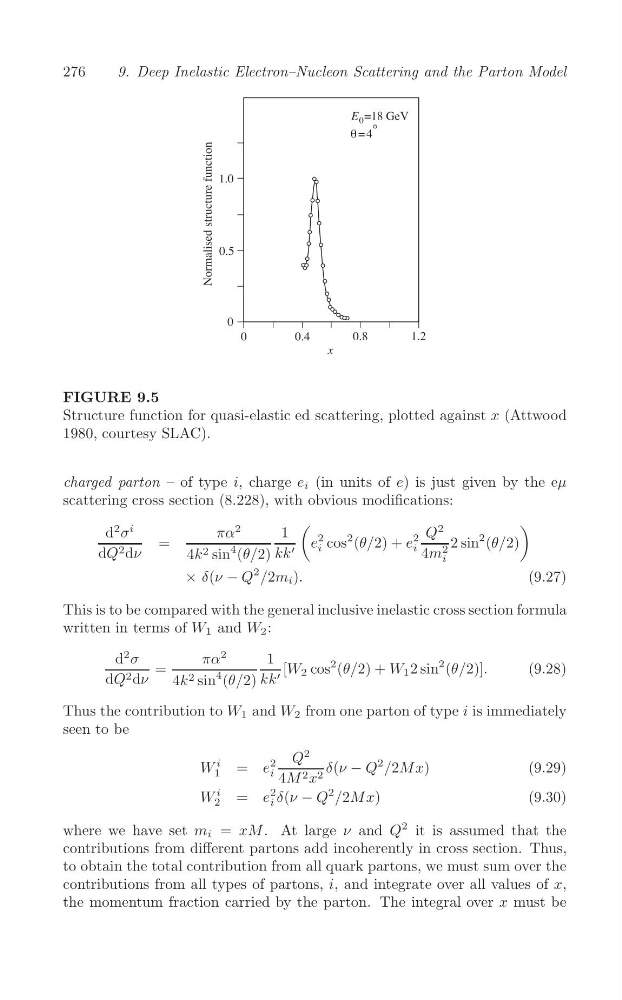
FIGURE 9.5
Structure function for quasi-elastic ed scattering, plotted against x (Attwood
1980, courtesy SLAC).
charged parton – of type i, charge e i (in units of e) is just given by the eμ
scattering cross section (8.228), with obvious modifications:
(
)
d
2 σ
i
πα
2
1
2
2 Q
2
=
e i cos
2 (θ/2) + e
2 sin
2 (θ/2)
i
2
dQ 2 dν
4k 2 sin
4 (θ/2) kk ′
4m i
× δ(ν − Q
2 /2m i ).
(9.27)
This is to be compared with the general inclusive inelastic cross section formula
written in terms of W 1 and W 2 :
d
2 σ
πα
2
1
=
[W 2 cos
2 (θ/2) + W 1 2 sin
2 (θ/2)].
(9.28)
dQ 2 dν
4k 2 sin
4 (θ/2) kk ′
Thus the contribution to W 1 and W 2 from one parton of type i is immediately
seen to be
2
W 1
i = e i 4M
Q
2
2
x 2 δ(ν − Q
2 /2M x)
(9.29)
2
W
i = e i δ(ν − Q
2 /2M x)
(9.30)
2
where we have set m i = xM . At large ν and Q
2 it is assumed that the
contributions from different partons add incoherently in cross section. Thus,
to obtain the total contribution from all quark partons, we must sum over the
contributions from all types of partons, i, and integrate over all values of x,
the momentum fraction carried by the parton. The integral over x must be
9. Deep Inelastic Electron–Nucleon Scattering and the Parton Model
FIGURE 9.5
Structure function for quasi-elastic ed scattering, plotted against x (Attwood
1980, courtesy SLAC).
charged parton – of type i, charge e i (in units of e) is just given by the eμ
scattering cross section (8.228), with obvious modifications:
(
)
d
2 σ
i
πα
2
1
2
2 Q
2
=
e i cos
2 (θ/2) + e
2 sin
2 (θ/2)
i
2
dQ 2 dν
4k 2 sin
4 (θ/2) kk ′
4m i
× δ(ν − Q
2 /2m i ).
(9.27)
This is to be compared with the general inclusive inelastic cross section formula
written in terms of W 1 and W 2 :
d
2 σ
πα
2
1
=
[W 2 cos
2 (θ/2) + W 1 2 sin
2 (θ/2)].
(9.28)
dQ 2 dν
4k 2 sin
4 (θ/2) kk ′
Thus the contribution to W 1 and W 2 from one parton of type i is immediately
seen to be
2
W 1
i = e i 4M
Q
2
2
x 2 δ(ν − Q
2 /2M x)
(9.29)
2
W
i = e i δ(ν − Q
2 /2M x)
(9.30)
2
where we have set m i = xM . At large ν and Q
2 it is assumed that the
contributions from different partons add incoherently in cross section. Thus,
to obtain the total contribution from all quark partons, we must sum over the
contributions from all types of partons, i, and integrate over all values of x,
the momentum fraction carried by the parton. The integral over x must be