

252
8. Elementary Processes in Scalar and Spinor Electrodynamics
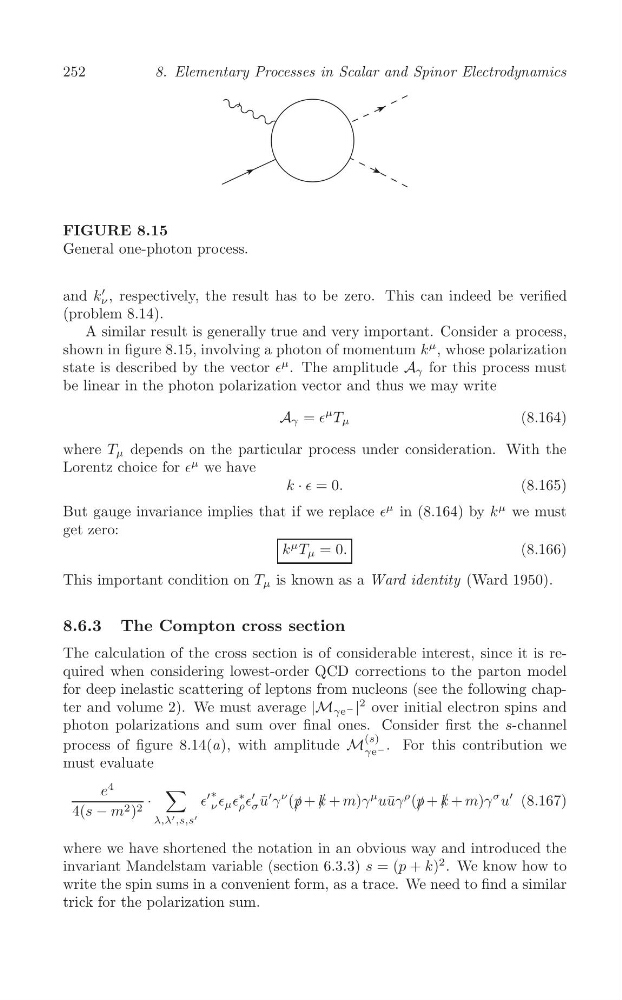
FIGURE 8.15
General one-photon process.
and k ν
′ , respectively, the result has to be zero. This can indeed be verified
(problem 8.14).
A similar result is generally true and very important. Consider a process,
shown in figure 8.15, involving a photon of momentum k
μ , whose polarization
state is described by the vector ∈
μ . The amplitude A γ for this process must
be linear in the photon polarization vector and thus we may write
A γ = ∈
μ T μ
(8.164)
where T μ depends on the particular process under consideration. With the
Lorentz choice for ∈
μ we have
k · ∈ = 0.
(8.165)
But gauge invariance implies that if we replace ∈
μ in (8.164) by k
μ we must
get zero:
k
μ T μ = 0.
(8.166)
This important condition on T μ is known as a Ward identity (Ward 1950).
8.6.3 The Compton cross section
The calculation of the cross section is of considerable interest, since it is required when considering lowest-order QCD corrections to the parton model
for deep inelastic scattering of leptons from nucleons (see the following chapter and volume 2). We must average |M γe − |
2 over initial electron spins and
photon polarizations and sum over final ones. Consider first the s-channel
(s)
process of figure 8.14(a), with amplitude M − . For this contribution we
γe
must evaluate
4
∑
e
′
·
∈
′
ν
∗ ∈ μ ∈
∗
ρ ∈
′
σ u ¯
p + k / + m)γ
μ uγ
ρ ( / k + m)γ
σ u (8.167)
′ γ
ν ( /
u¯ p + /
4(s − m 2 ) 2
'
λ,λ ' ,s,s
where we have shortened the notation in an obvious way and introduced the
invariant Mandelstam variable (section 6.3.3) s = (p + k)
2 . We know how to
write the spin sums in a convenient form, as a trace. We need to find a similar
trick for the polarization sum.
8. Elementary Processes in Scalar and Spinor Electrodynamics
FIGURE 8.15
General one-photon process.
and k ν
′ , respectively, the result has to be zero. This can indeed be verified
(problem 8.14).
A similar result is generally true and very important. Consider a process,
shown in figure 8.15, involving a photon of momentum k
μ , whose polarization
state is described by the vector ∈
μ . The amplitude A γ for this process must
be linear in the photon polarization vector and thus we may write
A γ = ∈
μ T μ
(8.164)
where T μ depends on the particular process under consideration. With the
Lorentz choice for ∈
μ we have
k · ∈ = 0.
(8.165)
But gauge invariance implies that if we replace ∈
μ in (8.164) by k
μ we must
get zero:
k
μ T μ = 0.
(8.166)
This important condition on T μ is known as a Ward identity (Ward 1950).
8.6.3 The Compton cross section
The calculation of the cross section is of considerable interest, since it is required when considering lowest-order QCD corrections to the parton model
for deep inelastic scattering of leptons from nucleons (see the following chapter and volume 2). We must average |M γe − |
2 over initial electron spins and
photon polarizations and sum over final ones. Consider first the s-channel
(s)
process of figure 8.14(a), with amplitude M − . For this contribution we
γe
must evaluate
4
∑
e
′
·
∈
′
ν
∗ ∈ μ ∈
∗
ρ ∈
′
σ u ¯
p + k / + m)γ
μ uγ
ρ ( / k + m)γ
σ u (8.167)
′ γ
ν ( /
u¯ p + /
4(s − m 2 ) 2
'
λ,λ ' ,s,s
where we have shortened the notation in an obvious way and introduced the
invariant Mandelstam variable (section 6.3.3) s = (p + k)
2 . We know how to
write the spin sums in a convenient form, as a trace. We need to find a similar
trick for the polarization sum.