

242
8. Elementary Processes in Scalar and Spinor Electrodynamics
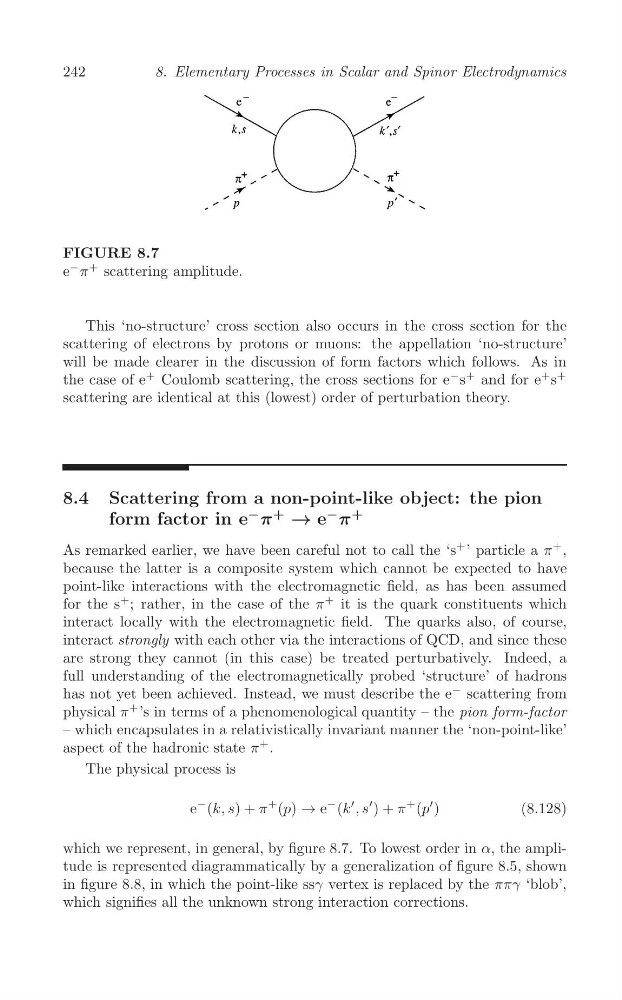
FIGURE 8.7
− π
+
e
scattering amplitude.
This ‘no-structure’ cross section also occurs in the cross section for the
scattering of electrons by protons or muons: the appellation ‘no-structure’
will be made clearer in the discussion of form factors which follows. As in
+
+
the case of e
+ Coulomb scattering, the cross sections for e
− s and for e
+ s
scattering are identical at this (lowest) order of perturbation theory.
8.4 Scattering from a non-point-like object: the pion
−
π
+
form factor in e
−
π
+
→ e
As remarked earlier, we have been careful not to call the ‘s
+ ’ particle a π
+ ,
because the latter is a composite system which cannot be expected to have
point-like interactions with the electromagnetic field, as has been assumed
for the s
+ ; rather, in the case of the π
+ it is the quark constituents which
interact locally with the electromagnetic field. The quarks also, of course,
interact strongly with each other via the interactions of QCD, and since these
are strong they cannot (in this case) be treated perturbatively. Indeed, a
full understanding of the electromagnetically probed ‘structure’ of hadrons
has not yet been achieved. Instead, we must describe the e
− scattering from
physical π
+ ’s in terms of a phenomenological quantity – the pion form-factor
– which encapsulates in a relativistically invariant manner the ‘non-point-like’
aspect of the hadronic state π
+ .
The physical process is
e
− (k, s) + π
+ (p) → e
− (k
′ , s
′ ) + π
+ (p
′ )
(8.128)
which we represent, in general, by figure 8.7. To lowest order in α, the amplitude is represented diagrammatically by a generalization of figure 8.5, shown
in figure 8.8, in which the point-like ssγ vertex is replaced by the ππγ ‘blob’,
which signifies all the unknown strong interaction corrections.
8. Elementary Processes in Scalar and Spinor Electrodynamics
FIGURE 8.7
− π
+
e
scattering amplitude.
This ‘no-structure’ cross section also occurs in the cross section for the
scattering of electrons by protons or muons: the appellation ‘no-structure’
will be made clearer in the discussion of form factors which follows. As in
+
+
the case of e
+ Coulomb scattering, the cross sections for e
− s and for e
+ s
scattering are identical at this (lowest) order of perturbation theory.
8.4 Scattering from a non-point-like object: the pion
−
π
+
form factor in e
−
π
+
→ e
As remarked earlier, we have been careful not to call the ‘s
+ ’ particle a π
+ ,
because the latter is a composite system which cannot be expected to have
point-like interactions with the electromagnetic field, as has been assumed
for the s
+ ; rather, in the case of the π
+ it is the quark constituents which
interact locally with the electromagnetic field. The quarks also, of course,
interact strongly with each other via the interactions of QCD, and since these
are strong they cannot (in this case) be treated perturbatively. Indeed, a
full understanding of the electromagnetically probed ‘structure’ of hadrons
has not yet been achieved. Instead, we must describe the e
− scattering from
physical π
+ ’s in terms of a phenomenological quantity – the pion form-factor
– which encapsulates in a relativistically invariant manner the ‘non-point-like’
aspect of the hadronic state π
+ .
The physical process is
e
− (k, s) + π
+ (p) → e
− (k
′ , s
′ ) + π
+ (p
′ )
(8.128)
which we represent, in general, by figure 8.7. To lowest order in α, the amplitude is represented diagrammatically by a generalization of figure 8.5, shown
in figure 8.8, in which the point-like ssγ vertex is replaced by the ππγ ‘blob’,
which signifies all the unknown strong interaction corrections.