

8.3. e
− s
+ scattering
241
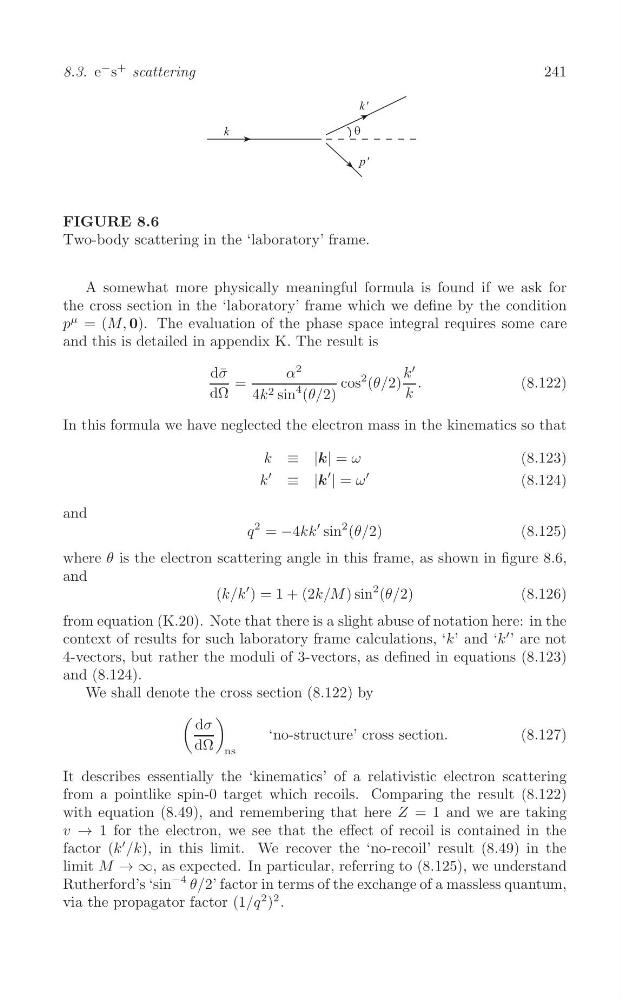
FIGURE 8.6
Two-body scattering in the ‘laboratory’ frame.
A somewhat more physically meaningful formula is found if we ask for
the cross section in the ‘laboratory’ frame which we define by the condition
μ
p = (M, 0). The evaluation of the phase space integral requires some care
and this is detailed in appendix K. The result is
d¯ σ
α
2
k
′
=
cos
2 (θ/2) .
(8.122)
dΩ
4k 2 sin
4 (θ/2)
k
In this formula we have neglected the electron mass in the kinematics so that
k ≡ |k| = ω
(8.123)
k
′
≡ |k
′
| = ω
′
(8.124)
and
2
q = −4kk
′ sin
2 (θ/2)
(8.125)
where θ is the electron scattering angle in this frame, as shown in figure 8.6,
and
(k/k
′ ) = 1 + (2k/M ) sin
2 (θ/2)
(8.126)
from equation (K.20). Note that there is a slight abuse of notation here: in the
context of results for such laboratory frame calculations, ‘k’ and ‘k
′ ’ are not
4-vectors, but rather the moduli of 3-vectors, as defined in equations (8.123)
and (8.124).
We shall denote the cross section (8.122) by
(
)
dσ
‘no-structure’ cross section.
(8.127)
dΩ ns
It describes essentially the ‘kinematics’ of a relativistic electron scattering
from a pointlike spin-0 target which recoils. Comparing the result (8.122)
with equation (8.49), and remembering that here Z = 1 and we are taking
v → 1 for the electron, we see that the effect of recoil is contained in the
factor (k
′ /k), in this limit. We recover the ‘no-recoil’ result (8.49) in the
limit M → ∞, as expected. In particular, referring to (8.125), we understand
Rutherford’s ‘sin
−4 θ/2’ factor in terms of the exchange of a massless quantum,
via the propagator factor (1/q
2 )
2 .
− s
+ scattering
241
FIGURE 8.6
Two-body scattering in the ‘laboratory’ frame.
A somewhat more physically meaningful formula is found if we ask for
the cross section in the ‘laboratory’ frame which we define by the condition
μ
p = (M, 0). The evaluation of the phase space integral requires some care
and this is detailed in appendix K. The result is
d¯ σ
α
2
k
′
=
cos
2 (θ/2) .
(8.122)
dΩ
4k 2 sin
4 (θ/2)
k
In this formula we have neglected the electron mass in the kinematics so that
k ≡ |k| = ω
(8.123)
k
′
≡ |k
′
| = ω
′
(8.124)
and
2
q = −4kk
′ sin
2 (θ/2)
(8.125)
where θ is the electron scattering angle in this frame, as shown in figure 8.6,
and
(k/k
′ ) = 1 + (2k/M ) sin
2 (θ/2)
(8.126)
from equation (K.20). Note that there is a slight abuse of notation here: in the
context of results for such laboratory frame calculations, ‘k’ and ‘k
′ ’ are not
4-vectors, but rather the moduli of 3-vectors, as defined in equations (8.123)
and (8.124).
We shall denote the cross section (8.122) by
(
)
dσ
‘no-structure’ cross section.
(8.127)
dΩ ns
It describes essentially the ‘kinematics’ of a relativistic electron scattering
from a pointlike spin-0 target which recoils. Comparing the result (8.122)
with equation (8.49), and remembering that here Z = 1 and we are taking
v → 1 for the electron, we see that the effect of recoil is contained in the
factor (k
′ /k), in this limit. We recover the ‘no-recoil’ result (8.49) in the
limit M → ∞, as expected. In particular, referring to (8.125), we understand
Rutherford’s ‘sin
−4 θ/2’ factor in terms of the exchange of a massless quantum,
via the propagator factor (1/q
2 )
2 .