

238
8. Elementary Processes in Scalar and Spinor Electrodynamics
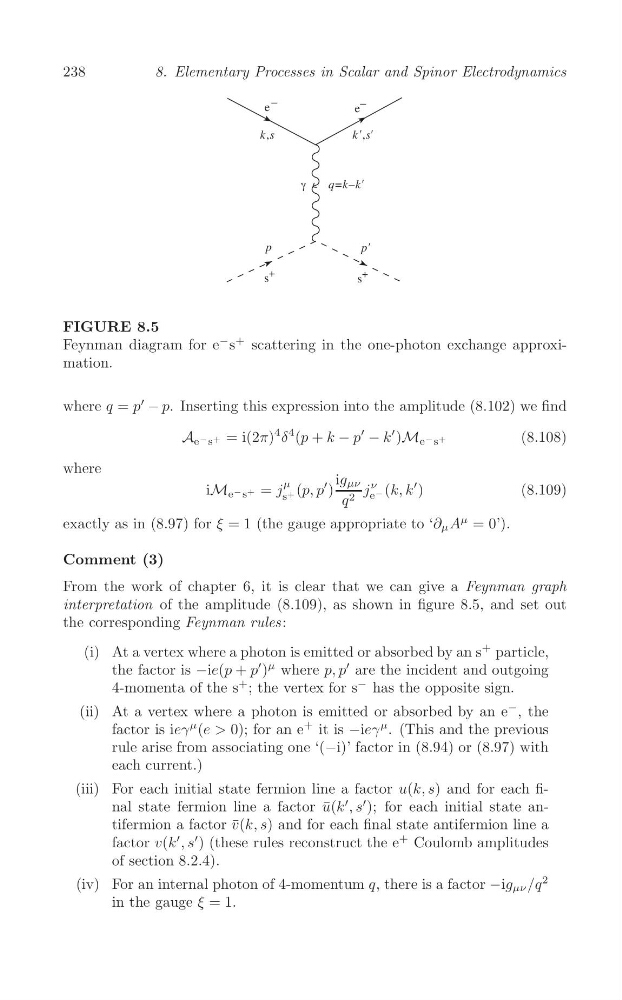
FIGURE 8.5
+
Feynman diagram for e
− s scattering in the one-photon exchange approximation.
where q = p
′
− p. Inserting this expression into the amplitude (8.102) we find
′
A e − s + = i(2π)
4 δ
4 (p + k − p − k
′ )M e − s +
(8.108)
where
μ
ig μν
iM e − s + = j (p, p
′ )
j
ν
− (k, k
′ )
(8.109)
s +
e
q 2
exactly as in (8.97) for ξ = 1 (the gauge appropriate to ‘∂ μ A
μ = 0’).
Comment (3)
From the work of chapter 6, it is clear that we can give a Feynman graph
interpretation of the amplitude (8.109), as shown in figure 8.5, and set out
the corresponding Feynman rules:
(i) At a vertex where a photon is emitted or absorbed by an s
+ particle,
′
the factor is −ie(p + p
′ )
μ where p, p are the incident and outgoing
4-momenta of the s
+ ; the vertex for s
− has the opposite sign.
(ii) At a vertex where a photon is emitted or absorbed by an e
− , the
factor is ieγ
μ (e > 0); for an e
+ it is −ieγ
μ . (This and the previous
rule arise from associating one ‘(−i)’ factor in (8.94) or (8.97) with
each current.)
(iii) For each initial state fermion line a factor u(k, s) and for each final state fermion line a factor ¯
u(k
′ , s
′ ); for each initial state antifermion a factor ¯
v(k, s) and for each final state antifermion line a
factor v(k
′ , s
′ ) (these rules reconstruct the e
+ Coulomb amplitudes
of section 8.2.4).
(iv) For an internal photon of 4-momentum q, there is a factor −ig μν /q
2
in the gauge ξ = 1.
8. Elementary Processes in Scalar and Spinor Electrodynamics
FIGURE 8.5
+
Feynman diagram for e
− s scattering in the one-photon exchange approximation.
where q = p
′
− p. Inserting this expression into the amplitude (8.102) we find
′
A e − s + = i(2π)
4 δ
4 (p + k − p − k
′ )M e − s +
(8.108)
where
μ
ig μν
iM e − s + = j (p, p
′ )
j
ν
− (k, k
′ )
(8.109)
s +
e
q 2
exactly as in (8.97) for ξ = 1 (the gauge appropriate to ‘∂ μ A
μ = 0’).
Comment (3)
From the work of chapter 6, it is clear that we can give a Feynman graph
interpretation of the amplitude (8.109), as shown in figure 8.5, and set out
the corresponding Feynman rules:
(i) At a vertex where a photon is emitted or absorbed by an s
+ particle,
′
the factor is −ie(p + p
′ )
μ where p, p are the incident and outgoing
4-momenta of the s
+ ; the vertex for s
− has the opposite sign.
(ii) At a vertex where a photon is emitted or absorbed by an e
− , the
factor is ieγ
μ (e > 0); for an e
+ it is −ieγ
μ . (This and the previous
rule arise from associating one ‘(−i)’ factor in (8.94) or (8.97) with
each current.)
(iii) For each initial state fermion line a factor u(k, s) and for each final state fermion line a factor ¯
u(k
′ , s
′ ); for each initial state antifermion a factor ¯
v(k, s) and for each final state antifermion line a
factor v(k
′ , s
′ ) (these rules reconstruct the e
+ Coulomb amplitudes
of section 8.2.4).
(iv) For an internal photon of 4-momentum q, there is a factor −ig μν /q
2
in the gauge ξ = 1.