

8.3. e
− s
+ scattering
237
′
2
where q = p − p = k − k
′ , and we have used the mass-shell conditions p =
′
′ 2
′
, /
p = M
2 ku = mu, k / u = mu
′ ; the relations (8.100) are the momentum–
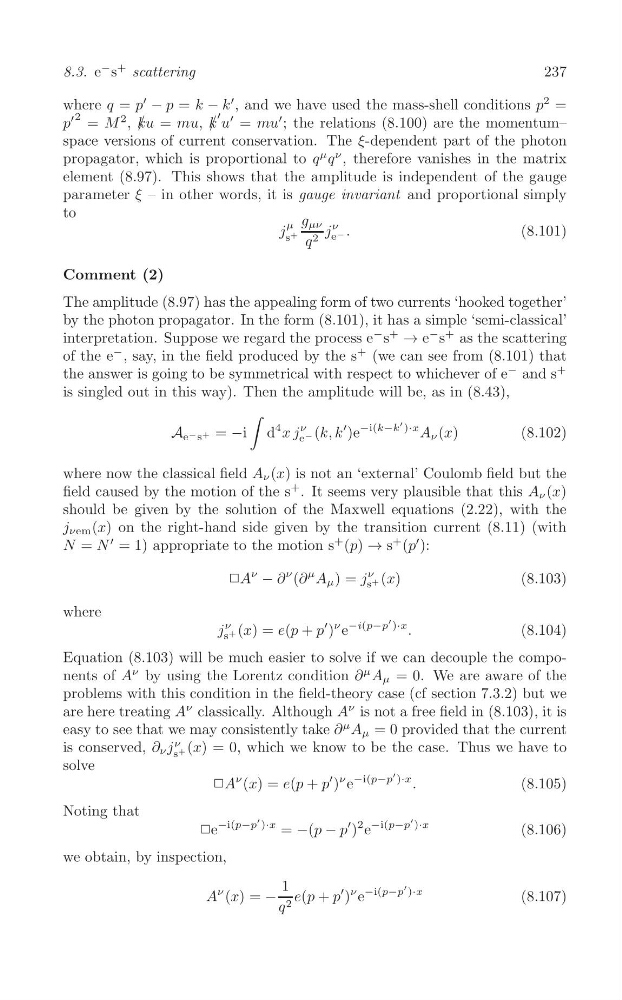
space versions of current conservation. The ξ-dependent part of the photon
μ
propagator, which is proportional to q q
ν , therefore vanishes in the matrix
element (8.97). This shows that the amplitude is independent of the gauge
parameter ξ – in other words, it is gauge invariant and proportional simply
to
μ g μν
j s +
j e
ν
− .
(8.101)
q 2
Comment (2)
The amplitude (8.97) has the appealing form of two currents ‘hooked together’
by the photon propagator. In the form (8.101), it has a simple ‘semi-classical’
−
− +
interpretation. Suppose we regard the process e s
+
→ e s as the scattering
of the e
− , say, in the field produced by the s
+ (we can see from (8.101) that
+
the answer is going to be symmetrical with respect to whichever of e
− and s
is singled out in this way). Then the amplitude will be, as in (8.43),
∫
A e − s + = −i d
4 x j
ν
− (k, k
′ )e
−i(k−k
' )·x A ν (x)
(8.102)
e
where now the classical field A ν (x) is not an ‘external’ Coulomb field but the
field caused by the motion of the s
+ . It seems very plausible that this A ν (x)
should be given by the solution of the Maxwell equations (2.22), with the
j νem (x) on the right-hand side given by the transition current (8.11) (with
′
N = N = 1) appropriate to the motion s
+ (p) → s
+ (p
′ ):
❗A
ν
− ∂
ν (∂
μ A μ ) = j s
ν
+ (x)
(8.103)
where
−i(p−p )·x
j s
ν
+ (x) = e(p + p
′ )
ν e
'
.
(8.104)
Equation (8.103) will be much easier to solve if we can decouple the components of A
ν by using the Lorentz condition ∂
μ A μ = 0. We are aware of the
problems with this condition in the field-theory case (cf section 7.3.2) but we
are here treating A
ν classically. Although A
ν is not a free field in (8.103), it is
easy to see that we may consistently take ∂
μ A μ = 0 provided that the current
is conserved, ∂ ν j
ν (x) = 0, which we know to be the case. Thus we have to
s +
solve
′ )
ν −i(p−p )·x
❗A
ν (x) = e(p + p e
'
.
(8.105)
Noting that
−i(p−p )·x
′ )
2 −i(p−p )·x
❗e
'
= −(p − p e
'
(8.106)
we obtain, by inspection,
1
′ )
ν −i(p−p
' )·x
A
ν (x) = − e(p + p e
(8.107)
q 2
− s
+ scattering
237
′
2
where q = p − p = k − k
′ , and we have used the mass-shell conditions p =
′
′ 2
′
, /
p = M
2 ku = mu, k / u = mu
′ ; the relations (8.100) are the momentum–
space versions of current conservation. The ξ-dependent part of the photon
μ
propagator, which is proportional to q q
ν , therefore vanishes in the matrix
element (8.97). This shows that the amplitude is independent of the gauge
parameter ξ – in other words, it is gauge invariant and proportional simply
to
μ g μν
j s +
j e
ν
− .
(8.101)
q 2
Comment (2)
The amplitude (8.97) has the appealing form of two currents ‘hooked together’
by the photon propagator. In the form (8.101), it has a simple ‘semi-classical’
−
− +
interpretation. Suppose we regard the process e s
+
→ e s as the scattering
of the e
− , say, in the field produced by the s
+ (we can see from (8.101) that
+
the answer is going to be symmetrical with respect to whichever of e
− and s
is singled out in this way). Then the amplitude will be, as in (8.43),
∫
A e − s + = −i d
4 x j
ν
− (k, k
′ )e
−i(k−k
' )·x A ν (x)
(8.102)
e
where now the classical field A ν (x) is not an ‘external’ Coulomb field but the
field caused by the motion of the s
+ . It seems very plausible that this A ν (x)
should be given by the solution of the Maxwell equations (2.22), with the
j νem (x) on the right-hand side given by the transition current (8.11) (with
′
N = N = 1) appropriate to the motion s
+ (p) → s
+ (p
′ ):
❗A
ν
− ∂
ν (∂
μ A μ ) = j s
ν
+ (x)
(8.103)
where
−i(p−p )·x
j s
ν
+ (x) = e(p + p
′ )
ν e
'
.
(8.104)
Equation (8.103) will be much easier to solve if we can decouple the components of A
ν by using the Lorentz condition ∂
μ A μ = 0. We are aware of the
problems with this condition in the field-theory case (cf section 7.3.2) but we
are here treating A
ν classically. Although A
ν is not a free field in (8.103), it is
easy to see that we may consistently take ∂
μ A μ = 0 provided that the current
is conserved, ∂ ν j
ν (x) = 0, which we know to be the case. Thus we have to
s +
solve
′ )
ν −i(p−p )·x
❗A
ν (x) = e(p + p e
'
.
(8.105)
Noting that
−i(p−p )·x
′ )
2 −i(p−p )·x
❗e
'
= −(p − p e
'
(8.106)
we obtain, by inspection,
1
′ )
ν −i(p−p
' )·x
A
ν (x) = − e(p + p e
(8.107)
q 2