

236
8. Elementary Processes in Scalar and Spinor Electrodynamics
as the A ˆ μ operators in (8.92) are concerned the only surviving contraction is
<0|T (A ˆ μ (x 1 )A ˆ ν (x 2 ))|0>
(8.93)
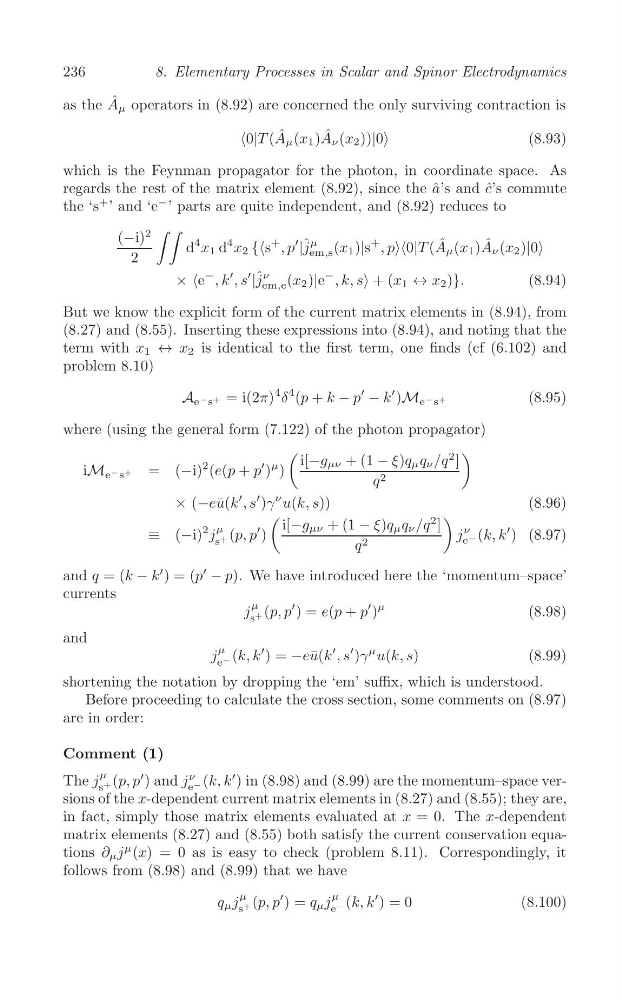
which is the Feynman propagator for the photon, in coordinate space. As
regards the rest of the matrix element (8.92), since the ˆ
a’s and ˆ
c’s commute
the ‘s
+ ’ and ‘e
− ’ parts are quite independent, and (8.92) reduces to
∫ ∫
(−i)
2
+
+
d
4 x 1 d
4 x 2 {
| ˆ j
μ
(x 1 )|s , p><0|T (A ˆ μ (x 1 )A ˆ ν (x 2 )|0>
2
em,s
×
′ , s
′
| ˆ j
ν
(x 2 )|e
− , k, s> + (x 1 ↔ x 2 )}.
(8.94)
em,e
But we know the explicit form of the current matrix elements in (8.94), from
(8.27) and (8.55). Inserting these expressions into (8.94), and noting that the
term with x 1 ↔ x 2 is identical to the first term, one finds (cf (6.102) and
problem 8.10)
′
A e − s + = i(2π)
4 δ
4 (p + k − p − k
′ )M e − s +
(8.95)
where (using the general form (7.122) of the photon propagator)
(
)
i[−g μν + (1 − ξ)q μ q ν /q
2 ]
iM e − s + = (−i)
2 (e(p + p
′ )
μ )
q 2
× (−eu ¯(k
′ , s
′ )γ
ν u(k, s))
(8.96)
(
)
i[−g μν + (1 − ξ)q μ q ν /q
2 ]
μ
≡ (−i)
2 j (p, p
′ )
j
ν
− (k, k
′ ) (8.97)
s +
e
q 2
′
and q = (k − k
′ ) = (p − p). We have introduced here the ‘momentum–space’
currents
μ
j s + (p, p
′ ) = e(p + p
′ )
μ
(8.98)
and
μ
j (k, k
′ ) = −eu ¯(k
′ , s
′ )γ
μ u(k, s)
(8.99)
e −
shortening the notation by dropping the ‘em’ suffix, which is understood.
Before proceeding to calculate the cross section, some comments on (8.97)
are in order:
Comment (1)
μ
The j (p, p
′ ) and j e
ν
− (k, k
′ ) in (8.98) and (8.99) are the momentum–space vers +
sions of the x-dependent current matrix elements in (8.27) and (8.55); they are,
in fact, simply those matrix elements evaluated at x = 0. The x-dependent
matrix elements (8.27) and (8.55) both satisfy the current conservation equations ∂ μ j
μ (x) = 0 as is easy to check (problem 8.11). Correspondingly, it
follows from (8.98) and (8.99) that we have
μ
μ
q μ j s + (p, p
′ ) = q μ j − (k, k
′ ) = 0
(8.100)
e
8. Elementary Processes in Scalar and Spinor Electrodynamics
as the A ˆ μ operators in (8.92) are concerned the only surviving contraction is
<0|T (A ˆ μ (x 1 )A ˆ ν (x 2 ))|0>
(8.93)
which is the Feynman propagator for the photon, in coordinate space. As
regards the rest of the matrix element (8.92), since the ˆ
a’s and ˆ
c’s commute
the ‘s
+ ’ and ‘e
− ’ parts are quite independent, and (8.92) reduces to
∫ ∫
(−i)
2
+
+
d
4 x 1 d
4 x 2 {
| ˆ j
μ
(x 1 )|s , p><0|T (A ˆ μ (x 1 )A ˆ ν (x 2 )|0>
2
em,s
×
′ , s
′
| ˆ j
ν
(x 2 )|e
− , k, s> + (x 1 ↔ x 2 )}.
(8.94)
em,e
But we know the explicit form of the current matrix elements in (8.94), from
(8.27) and (8.55). Inserting these expressions into (8.94), and noting that the
term with x 1 ↔ x 2 is identical to the first term, one finds (cf (6.102) and
problem 8.10)
′
A e − s + = i(2π)
4 δ
4 (p + k − p − k
′ )M e − s +
(8.95)
where (using the general form (7.122) of the photon propagator)
(
)
i[−g μν + (1 − ξ)q μ q ν /q
2 ]
iM e − s + = (−i)
2 (e(p + p
′ )
μ )
q 2
× (−eu ¯(k
′ , s
′ )γ
ν u(k, s))
(8.96)
(
)
i[−g μν + (1 − ξ)q μ q ν /q
2 ]
μ
≡ (−i)
2 j (p, p
′ )
j
ν
− (k, k
′ ) (8.97)
s +
e
q 2
′
and q = (k − k
′ ) = (p − p). We have introduced here the ‘momentum–space’
currents
μ
j s + (p, p
′ ) = e(p + p
′ )
μ
(8.98)
and
μ
j (k, k
′ ) = −eu ¯(k
′ , s
′ )γ
μ u(k, s)
(8.99)
e −
shortening the notation by dropping the ‘em’ suffix, which is understood.
Before proceeding to calculate the cross section, some comments on (8.97)
are in order:
Comment (1)
μ
The j (p, p
′ ) and j e
ν
− (k, k
′ ) in (8.98) and (8.99) are the momentum–space vers +
sions of the x-dependent current matrix elements in (8.27) and (8.55); they are,
in fact, simply those matrix elements evaluated at x = 0. The x-dependent
matrix elements (8.27) and (8.55) both satisfy the current conservation equations ∂ μ j
μ (x) = 0 as is easy to check (problem 8.11). Correspondingly, it
follows from (8.98) and (8.99) that we have
μ
μ
q μ j s + (p, p
′ ) = q μ j − (k, k
′ ) = 0
(8.100)
e