

8.3. e
− s
+ scattering
239
(v) Multiplying these factors together gives the quantity iM; multiplying the result by an overall 4-momentum-conserving δ-function
′
factor (2π)
4 δ(p + k
′ + · · · − p − k − · · ·) gives the quantity A.
Comment (4)
We know that our amplitude is proportional to
μ g μν
j
j e
ν
− .
(8.110)
s + q 2
0
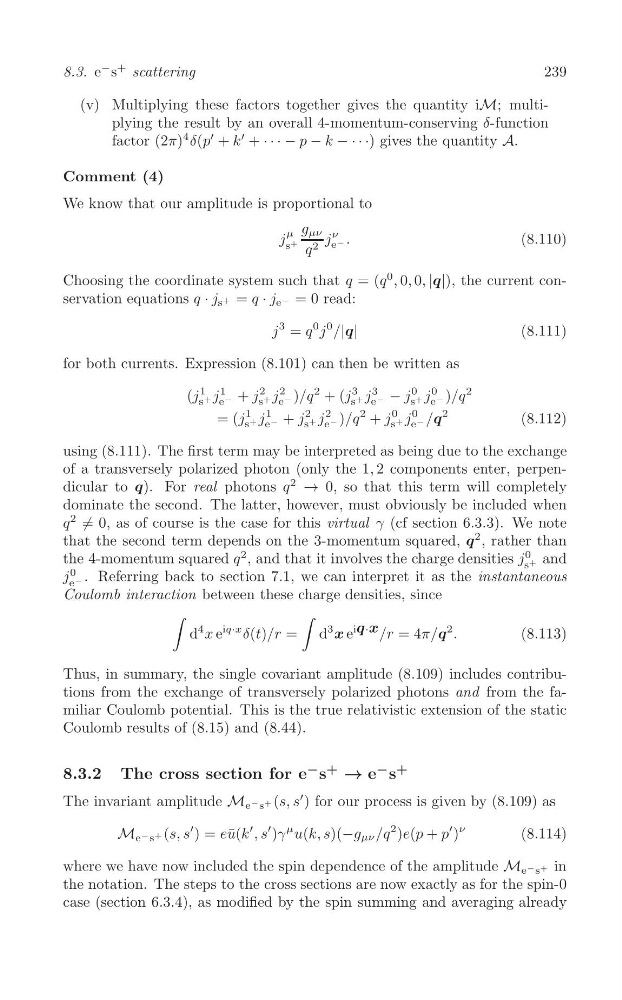
Choosing the coordinate system such that q = (q , 0, 0, |q|), the current conservation equations q · j s + = q · j e − = 0 read:
j
3 = q
0 j
0 /|q|
(8.111)
for both currents. Expression (8.101) can then be written as
(j s
1
+ j
1 + j s
2
+ j e
2
− )/q
2 + (j s
3
+ j
3
− j s
0
+ j e
0
− )/q
2
2
e −
e −
= (j s
1
+ j
1
− + j s
2
+ j
2
− )/q
2 + j s
0
+ j
0
− /q
(8.112)
e
e
e
using (8.111). The first term may be interpreted as being due to the exchange
of a transversely polarized photon (only the 1, 2 components enter, perpen2
dicular to q). For real photons q → 0, so that this term will completely
dominate the second. The latter, however, must obviously be included when
2
q / 0, as of course is the case for this virtual γ (cf section 6.3.3). We note
=
that the second term depends on the 3-momentum squared, q
2 , rather than
2
the 4-momentum squared q , and that it involves the charge densities j
0 and
s +
j
0
Referring back to section 7.1, we can interpret it as the instantaneous
− .
e
Coulomb interaction between these charge densities, since
∫
∫
2
d
4 x e
iq·x δ(t)/r = d
3
x e
iq·x /r = 4π/q .
(8.113)
Thus, in summary, the single covariant amplitude (8.109) includes contributions from the exchange of transversely polarized photons and from the familiar Coulomb potential. This is the true relativistic extension of the static
Coulomb results of (8.15) and (8.44).
8.3.2 The cross section for e − s + → e − s +
The invariant amplitude M − s + (s, s
′ ) for our process is given by (8.109) as
e
M − s + (s, s
′ ) = eu ¯(k
′ , s
′ )γ
μ u(k, s)(−g μν /q
2 )e(p + p
′ )
ν
(8.114)
e
where we have now included the spin dependence of the amplitude M e − s + in
the notation. The steps to the cross sections are now exactly as for the spin-0
case (section 6.3.4), as modified by the spin summing and averaging already
− s
+ scattering
239
(v) Multiplying these factors together gives the quantity iM; multiplying the result by an overall 4-momentum-conserving δ-function
′
factor (2π)
4 δ(p + k
′ + · · · − p − k − · · ·) gives the quantity A.
Comment (4)
We know that our amplitude is proportional to
μ g μν
j
j e
ν
− .
(8.110)
s + q 2
0
Choosing the coordinate system such that q = (q , 0, 0, |q|), the current conservation equations q · j s + = q · j e − = 0 read:
j
3 = q
0 j
0 /|q|
(8.111)
for both currents. Expression (8.101) can then be written as
(j s
1
+ j
1 + j s
2
+ j e
2
− )/q
2 + (j s
3
+ j
3
− j s
0
+ j e
0
− )/q
2
2
e −
e −
= (j s
1
+ j
1
− + j s
2
+ j
2
− )/q
2 + j s
0
+ j
0
− /q
(8.112)
e
e
e
using (8.111). The first term may be interpreted as being due to the exchange
of a transversely polarized photon (only the 1, 2 components enter, perpen2
dicular to q). For real photons q → 0, so that this term will completely
dominate the second. The latter, however, must obviously be included when
2
q / 0, as of course is the case for this virtual γ (cf section 6.3.3). We note
=
that the second term depends on the 3-momentum squared, q
2 , rather than
2
the 4-momentum squared q , and that it involves the charge densities j
0 and
s +
j
0
Referring back to section 7.1, we can interpret it as the instantaneous
− .
e
Coulomb interaction between these charge densities, since
∫
∫
2
d
4 x e
iq·x δ(t)/r = d
3
x e
iq·x /r = 4π/q .
(8.113)
Thus, in summary, the single covariant amplitude (8.109) includes contributions from the exchange of transversely polarized photons and from the familiar Coulomb potential. This is the true relativistic extension of the static
Coulomb results of (8.15) and (8.44).
8.3.2 The cross section for e − s + → e − s +
The invariant amplitude M − s + (s, s
′ ) for our process is given by (8.109) as
e
M − s + (s, s
′ ) = eu ¯(k
′ , s
′ )γ
μ u(k, s)(−g μν /q
2 )e(p + p
′ )
ν
(8.114)
e
where we have now included the spin dependence of the amplitude M e − s + in
the notation. The steps to the cross sections are now exactly as for the spin-0
case (section 6.3.4), as modified by the spin summing and averaging already