

188
7. Quantum Field Theory III
this later); the complex field φ ˆ would be suitable (in respect of strangeness)
¯
for describing the (K
0 , K
0 ) pair.
The symmetry operator N ˆ φ has a number of further important properties.
First of all, we have shown that d N ˆ φ /dt = 0 from the general (Noether)
argument, but we ought also to check that
[N ˆ φ , H ˆ ] = 0
(7.25)
as is required for consistency, and expected for a symmetry operator. This is
indeed true (see problem 7.2(a)). We can also show
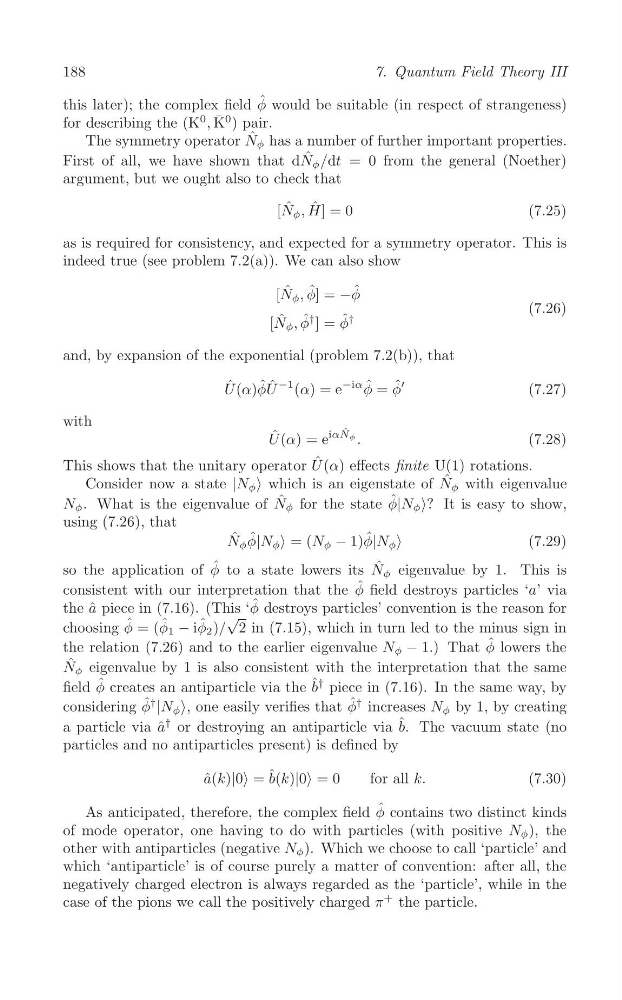
[N ˆ φ , φ ˆ ] = −φ ˆ
(7.26)
[N ˆ φ , φ ˆ† ] = φ ˆ†
and, by expansion of the exponential (problem 7.2(b)), that
−iα ˆ
U ˆ (α)φ ˆ U ˆ −1 (α) = e φ = φ ˆ ′
(7.27)
with
iαN ˆ φ
ˆ
U (α) = e
.
(7.28)
This shows that the unitary operator U ˆ (α) effects finite U(1) rotations.
Consider now a state |N φ > which is an eigenstate of N ˆ φ with eigenvalue
N φ . What is the eigenvalue of N ˆ φ for the state φ ˆ |N φ >? It is easy to show,
using (7.26), that
ˆ ˆ
N φ φ|N φ > = (N φ − 1)φ ˆ |N φ >
(7.29)
so the application of φ ˆ to a state lowers its N ˆ φ eigenvalue by 1. This is
consistent with our interpretation that the φ ˆ field destroys particles ‘a’ via
ˆ
the ˆ
a piece in (7.16). (This ‘φ destroys particles’ convention is the reason for
√
choosing φ ˆ = (φ ˆ 1 − iφ ˆ 2 )/ 2 in (7.15), which in turn led to the minus sign in
the relation (7.26) and to the earlier eigenvalue N φ − 1.) That φ ˆ lowers the
ˆ
N φ eigenvalue by 1 is also consistent with the interpretation that the same
field φ ˆ creates an antiparticle via the ˆ b
† piece in (7.16). In the same way, by
considering φ ˆ† |N φ >, one easily verifies that φ ˆ† increases N φ by 1, by creating
†
a particle via ˆ
a or destroying an antiparticle via ˆ b. The vacuum state (no
particles and no antiparticles present) is defined by
ˆ
a ˆ(k)|0> = b(k)|0> = 0
for all k.
(7.30)
As anticipated, therefore, the complex field φ ˆ contains two distinct kinds
of mode operator, one having to do with particles (with positive N φ ), the
other with antiparticles (negative N φ ). Which we choose to call ‘particle’ and
which ‘antiparticle’ is of course purely a matter of convention: after all, the
negatively charged electron is always regarded as the ‘particle’, while in the
case of the pions we call the positively charged π
+ the particle.
7. Quantum Field Theory III
this later); the complex field φ ˆ would be suitable (in respect of strangeness)
¯
for describing the (K
0 , K
0 ) pair.
The symmetry operator N ˆ φ has a number of further important properties.
First of all, we have shown that d N ˆ φ /dt = 0 from the general (Noether)
argument, but we ought also to check that
[N ˆ φ , H ˆ ] = 0
(7.25)
as is required for consistency, and expected for a symmetry operator. This is
indeed true (see problem 7.2(a)). We can also show
[N ˆ φ , φ ˆ ] = −φ ˆ
(7.26)
[N ˆ φ , φ ˆ† ] = φ ˆ†
and, by expansion of the exponential (problem 7.2(b)), that
−iα ˆ
U ˆ (α)φ ˆ U ˆ −1 (α) = e φ = φ ˆ ′
(7.27)
with
iαN ˆ φ
ˆ
U (α) = e
.
(7.28)
This shows that the unitary operator U ˆ (α) effects finite U(1) rotations.
Consider now a state |N φ > which is an eigenstate of N ˆ φ with eigenvalue
N φ . What is the eigenvalue of N ˆ φ for the state φ ˆ |N φ >? It is easy to show,
using (7.26), that
ˆ ˆ
N φ φ|N φ > = (N φ − 1)φ ˆ |N φ >
(7.29)
so the application of φ ˆ to a state lowers its N ˆ φ eigenvalue by 1. This is
consistent with our interpretation that the φ ˆ field destroys particles ‘a’ via
ˆ
the ˆ
a piece in (7.16). (This ‘φ destroys particles’ convention is the reason for
√
choosing φ ˆ = (φ ˆ 1 − iφ ˆ 2 )/ 2 in (7.15), which in turn led to the minus sign in
the relation (7.26) and to the earlier eigenvalue N φ − 1.) That φ ˆ lowers the
ˆ
N φ eigenvalue by 1 is also consistent with the interpretation that the same
field φ ˆ creates an antiparticle via the ˆ b
† piece in (7.16). In the same way, by
considering φ ˆ† |N φ >, one easily verifies that φ ˆ† increases N φ by 1, by creating
†
a particle via ˆ
a or destroying an antiparticle via ˆ b. The vacuum state (no
particles and no antiparticles present) is defined by
ˆ
a ˆ(k)|0> = b(k)|0> = 0
for all k.
(7.30)
As anticipated, therefore, the complex field φ ˆ contains two distinct kinds
of mode operator, one having to do with particles (with positive N φ ), the
other with antiparticles (negative N φ ). Which we choose to call ‘particle’ and
which ‘antiparticle’ is of course purely a matter of convention: after all, the
negatively charged electron is always regarded as the ‘particle’, while in the
case of the pions we call the positively charged π
+ the particle.