

187
7.1. The complex scalar field
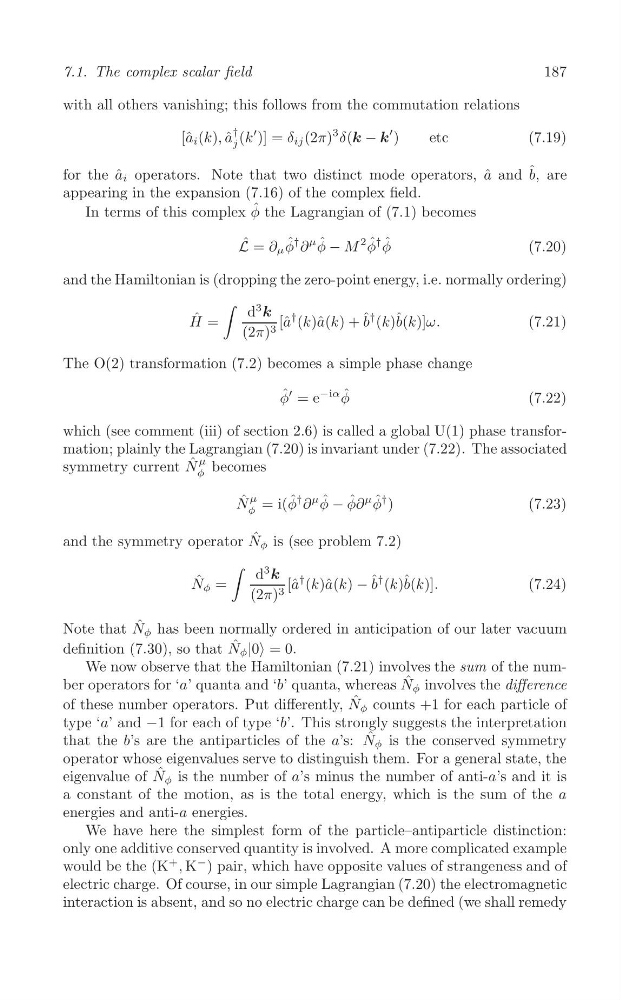
with all others vanishing; this follows from the commutation relations
†
[ˆ a i (k), a ˆ (k
′ )] = δ ij (2π)
3 δ(k − k
′ )
etc
(7.19)
j
for the ˆ
a i operators. Note that two distinct mode operators, ˆ
a and ˆ b, are
appearing in the expansion (7.16) of the complex field.
In terms of this complex φ ˆ the Lagrangian of (7.1) becomes
L ˆ = ∂ μ φ ˆ † ∂
μ φ ˆ − M
2 φ ˆ † φ ˆ
(7.20)
and the Hamiltonian is (dropping the zero-point energy, i.e. normally ordering)
∫ d
3
k
ˆ
H =
(2π) 3 [ˆ a
† (k)ˆ a(k) + ˆ b
† (k) ˆ b(k)]ω.
(7.21)
The O(2) transformation (7.2) becomes a simple phase change
ˆ
φ
′ = e
−iα ˆ
φ
(7.22)
which (see comment (iii) of section 2.6) is called a global U(1) phase transformation; plainly the Lagrangian (7.20) is invariant under (7.22). The associated
symmetry current N ˆ μ becomes
φ
N ˆ μ = i(φ ˆ † ∂
μ φ ˆ − ˆ φ
† )
φ∂
μ ˆ
(7.23)
φ
and the symmetry operator N ˆ φ is (see problem 7.2)
∫ d
3
k
N ˆ φ =
[ˆ a
† (k)ˆ a(k) − ˆ b
† (k) ˆ b(k)].
(7.24)
(2π) 3
Note that N ˆ φ has been normally ordered in anticipation of our later vacuum
definition (7.30), so that N ˆ φ |0> = 0.
We now observe that the Hamiltonian (7.21) involves the sum of the number operators for ‘a’ quanta and ‘b’ quanta, whereas N ˆ φ involves the difference
of these number operators. Put differently, N ˆ φ counts +1 for each particle of
type ‘a’ and −1 for each of type ‘b’. This strongly suggests the interpretation
ˆ
that the b’s are the antiparticles of the a’s: N φ is the conserved symmetry
operator whose eigenvalues serve to distinguish them. For a general state, the
eigenvalue of N ˆ φ is the number of a’s minus the number of anti-a’s and it is
a constant of the motion, as is the total energy, which is the sum of the a
energies and anti-a energies.
We have here the simplest form of the particle–antiparticle distinction:
only one additive conserved quantity is involved. A more complicated example
would be the (K
+ , K
− ) pair, which have opposite values of strangeness and of
electric charge. Of course, in our simple Lagrangian (7.20) the electromagnetic
interaction is absent, and so no electric charge can be defined (we shall remedy
7.1. The complex scalar field
with all others vanishing; this follows from the commutation relations
†
[ˆ a i (k), a ˆ (k
′ )] = δ ij (2π)
3 δ(k − k
′ )
etc
(7.19)
j
for the ˆ
a i operators. Note that two distinct mode operators, ˆ
a and ˆ b, are
appearing in the expansion (7.16) of the complex field.
In terms of this complex φ ˆ the Lagrangian of (7.1) becomes
L ˆ = ∂ μ φ ˆ † ∂
μ φ ˆ − M
2 φ ˆ † φ ˆ
(7.20)
and the Hamiltonian is (dropping the zero-point energy, i.e. normally ordering)
∫ d
3
k
ˆ
H =
(2π) 3 [ˆ a
† (k)ˆ a(k) + ˆ b
† (k) ˆ b(k)]ω.
(7.21)
The O(2) transformation (7.2) becomes a simple phase change
ˆ
φ
′ = e
−iα ˆ
φ
(7.22)
which (see comment (iii) of section 2.6) is called a global U(1) phase transformation; plainly the Lagrangian (7.20) is invariant under (7.22). The associated
symmetry current N ˆ μ becomes
φ
N ˆ μ = i(φ ˆ † ∂
μ φ ˆ − ˆ φ
† )
φ∂
μ ˆ
(7.23)
φ
and the symmetry operator N ˆ φ is (see problem 7.2)
∫ d
3
k
N ˆ φ =
[ˆ a
† (k)ˆ a(k) − ˆ b
† (k) ˆ b(k)].
(7.24)
(2π) 3
Note that N ˆ φ has been normally ordered in anticipation of our later vacuum
definition (7.30), so that N ˆ φ |0> = 0.
We now observe that the Hamiltonian (7.21) involves the sum of the number operators for ‘a’ quanta and ‘b’ quanta, whereas N ˆ φ involves the difference
of these number operators. Put differently, N ˆ φ counts +1 for each particle of
type ‘a’ and −1 for each of type ‘b’. This strongly suggests the interpretation
ˆ
that the b’s are the antiparticles of the a’s: N φ is the conserved symmetry
operator whose eigenvalues serve to distinguish them. For a general state, the
eigenvalue of N ˆ φ is the number of a’s minus the number of anti-a’s and it is
a constant of the motion, as is the total energy, which is the sum of the a
energies and anti-a energies.
We have here the simplest form of the particle–antiparticle distinction:
only one additive conserved quantity is involved. A more complicated example
would be the (K
+ , K
− ) pair, which have opposite values of strangeness and of
electric charge. Of course, in our simple Lagrangian (7.20) the electromagnetic
interaction is absent, and so no electric charge can be defined (we shall remedy