

173
6.3. Applications to the ‘ABC’ theory
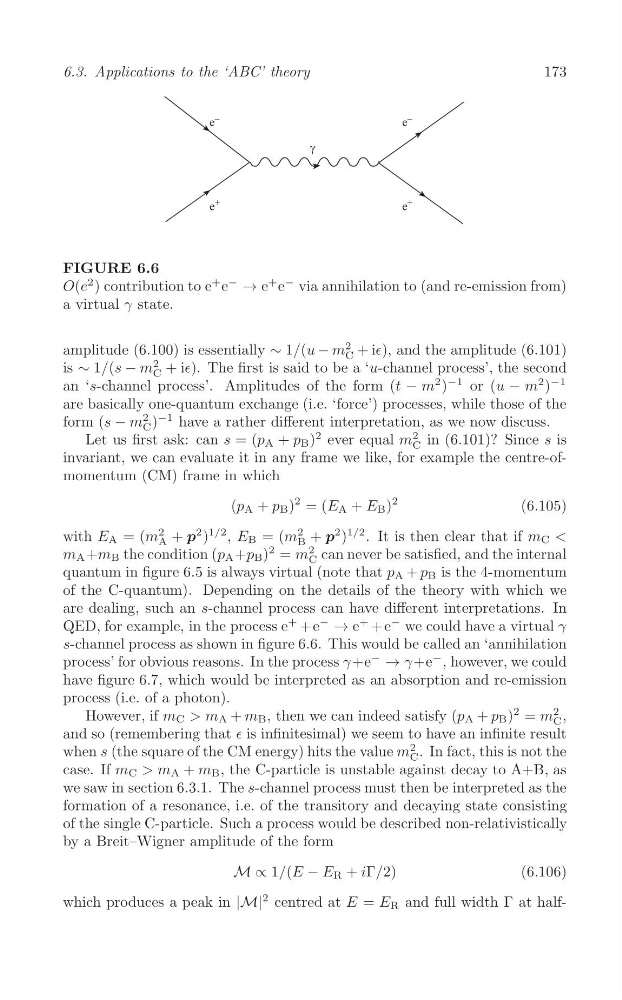
FIGURE 6.6
+
+
O(e
2 ) contribution to e e
−
→ e e
− via annihilation to (and re-emission from)
a virtual γ state.
2
amplitude (6.100) is essentially ∼ 1/(u − m + i∈), and the amplitude (6.101)
C
2
is ∼ 1/(s − m + i∈). The first is said to be a ‘u-channel process’, the second
C
2 )
−1
2 )
−1
an ‘s-channel process’. Amplitudes of the form (t − m
or (u − m
are basically one-quantum exchange (i.e. ‘force’) processes, while those of the
2
form (s − m )
−1 have a rather different interpretation, as we now discuss.
C
2
Let us first ask: can s = (p A + p B )
2 ever equal m in (6.101)? Since s is
C
invariant, we can evaluate it in any frame we like, for example the centre-ofmomentum (CM) frame in which
(p A + p B )
2 = (E A + E B )
2
(6.105)
2
2 )
1/2
2
with E A = (m A + p
, E B = (m B + p
2 )
1/2 . It is then clear that if m C <
2
m A +m B the condition (p A +p B )
2 = m C can never be satisfied, and the internal
quantum in figure 6.5 is always virtual (note that p A + p B is the 4-momentum
of the C-quantum). Depending on the details of the theory with which we
are dealing, such an s-channel process can have different interpretations. In
+
+
QED, for example, in the process e + e
−
→ e + e
− we could have a virtual γ
s-channel process as shown in figure 6.6. This would be called an ‘annihilation
process’ for obvious reasons. In the process γ+e
−
→ γ+e
− , however, we could
have figure 6.7, which would be interpreted as an absorption and re-emission
process (i.e. of a photon).
2
However, if m C > m A + m B , then we can indeed satisfy (p A + p B )
2 = m C ,
and so (remembering that ∈ is infinitesimal) we seem to have an infinite result
2
when s (the square of the CM energy) hits the value m . In fact, this is not the
C
case. If m C > m A + m B , the C-particle is unstable against decay to A+B, as
we saw in section 6.3.1. The s-channel process must then be interpreted as the
formation of a resonance, i.e. of the transitory and decaying state consisting
of the single C-particle. Such a process would be described non-relativistically
by a Breit–Wigner amplitude of the form
M ∝ 1/(E − E R + iΓ/2)
(6.106)
which produces a peak in |M|
2 centred at E = E R and full width Γ at half
6.3. Applications to the ‘ABC’ theory
FIGURE 6.6
+
+
O(e
2 ) contribution to e e
−
→ e e
− via annihilation to (and re-emission from)
a virtual γ state.
2
amplitude (6.100) is essentially ∼ 1/(u − m + i∈), and the amplitude (6.101)
C
2
is ∼ 1/(s − m + i∈). The first is said to be a ‘u-channel process’, the second
C
2 )
−1
2 )
−1
an ‘s-channel process’. Amplitudes of the form (t − m
or (u − m
are basically one-quantum exchange (i.e. ‘force’) processes, while those of the
2
form (s − m )
−1 have a rather different interpretation, as we now discuss.
C
2
Let us first ask: can s = (p A + p B )
2 ever equal m in (6.101)? Since s is
C
invariant, we can evaluate it in any frame we like, for example the centre-ofmomentum (CM) frame in which
(p A + p B )
2 = (E A + E B )
2
(6.105)
2
2 )
1/2
2
with E A = (m A + p
, E B = (m B + p
2 )
1/2 . It is then clear that if m C <
2
m A +m B the condition (p A +p B )
2 = m C can never be satisfied, and the internal
quantum in figure 6.5 is always virtual (note that p A + p B is the 4-momentum
of the C-quantum). Depending on the details of the theory with which we
are dealing, such an s-channel process can have different interpretations. In
+
+
QED, for example, in the process e + e
−
→ e + e
− we could have a virtual γ
s-channel process as shown in figure 6.6. This would be called an ‘annihilation
process’ for obvious reasons. In the process γ+e
−
→ γ+e
− , however, we could
have figure 6.7, which would be interpreted as an absorption and re-emission
process (i.e. of a photon).
2
However, if m C > m A + m B , then we can indeed satisfy (p A + p B )
2 = m C ,
and so (remembering that ∈ is infinitesimal) we seem to have an infinite result
2
when s (the square of the CM energy) hits the value m . In fact, this is not the
C
case. If m C > m A + m B , the C-particle is unstable against decay to A+B, as
we saw in section 6.3.1. The s-channel process must then be interpreted as the
formation of a resonance, i.e. of the transitory and decaying state consisting
of the single C-particle. Such a process would be described non-relativistically
by a Breit–Wigner amplitude of the form
M ∝ 1/(E − E R + iΓ/2)
(6.106)
which produces a peak in |M|
2 centred at E = E R and full width Γ at half