

172
6. Quantum Field Theory II: Interacting Scalar Fields
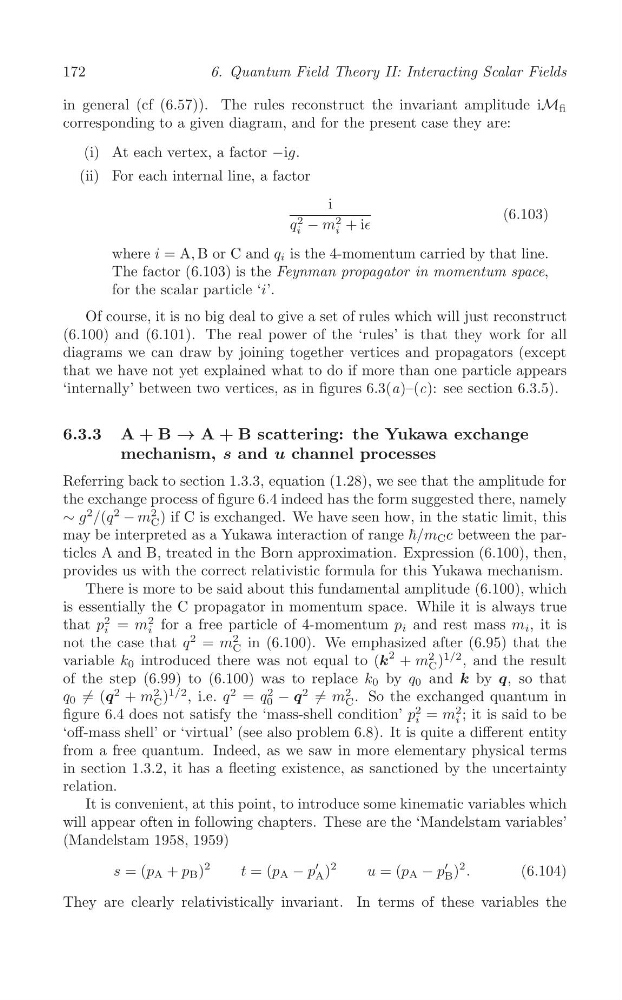
in general (cf (6.57)). The rules reconstruct the invariant amplitude iM fi
corresponding to a given diagram, and for the present case they are:
(i) At each vertex, a factor −ig.
(ii) For each internal line, a factor
i
(6.103)
2
2
q − m + i∈
i
i
where i = A, B or C and q i is the 4-momentum carried by that line.
The factor (6.103) is the Feynman propagator in momentum space,
for the scalar particle ‘i’.
Of course, it is no big deal to give a set of rules which will just reconstruct
(6.100) and (6.101). The real power of the ‘rules’ is that they work for all
diagrams we can draw by joining together vertices and propagators (except
that we have not yet explained what to do if more than one particle appears
‘internally’ between two vertices, as in figures 6.3(a)–(c): see section 6.3.5).
6.3.3 A + B → A + B scattering: the Yukawa exchange
mechanism, s and u channel processes
Referring back to section 1.3.3, equation (1.28), we see that the amplitude for
the exchange process of figure 6.4 indeed has the form suggested there, namely
2
∼ g
2 /(q
2
− m ) if C is exchanged. We have seen how, in the static limit, this
C
may be interpreted as a Yukawa interaction of range ħ/m C c between the particles A and B, treated in the Born approximation. Expression (6.100), then,
provides us with the correct relativistic formula for this Yukawa mechanism.
There is more to be said about this fundamental amplitude (6.100), which
is essentially the C propagator in momentum space. While it is always true
2
2
that p = m for a free particle of 4-momentum p i and rest mass m i , it is
i
i
2
2
not the case that q = m in (6.100). We emphasized after (6.95) that the
C
2
variable k 0 introduced there was not equal to (k
2 + m )
1/2 , and the result
C
of the step (6.99) to (6.100) was to replace k 0 by q 0 and k by q, so that
2
2
2
2
2
2
q 0 /
+ m )
1/2 , i.e. q = q 0 − q = m . So the exchanged quantum in
= (q
/
C
C
2
2
figure 6.4 does not satisfy the ‘mass-shell condition’ p = m ; it is said to be
i
i
‘off-mass shell’ or ‘virtual’ (see also problem 6.8). It is quite a different entity
from a free quantum. Indeed, as we saw in more elementary physical terms
in section 1.3.2, it has a fleeting existence, as sanctioned by the uncertainty
relation.
It is convenient, at this point, to introduce some kinematic variables which
will appear often in following chapters. These are the ‘Mandelstam variables’
(Mandelstam 1958, 1959)
′
′
s = (p A + p B )
2
t = (p A − p A )
2
u = (p A − p B )
2 .
(6.104)
They are clearly relativistically invariant. In terms of these variables the
6. Quantum Field Theory II: Interacting Scalar Fields
in general (cf (6.57)). The rules reconstruct the invariant amplitude iM fi
corresponding to a given diagram, and for the present case they are:
(i) At each vertex, a factor −ig.
(ii) For each internal line, a factor
i
(6.103)
2
2
q − m + i∈
i
i
where i = A, B or C and q i is the 4-momentum carried by that line.
The factor (6.103) is the Feynman propagator in momentum space,
for the scalar particle ‘i’.
Of course, it is no big deal to give a set of rules which will just reconstruct
(6.100) and (6.101). The real power of the ‘rules’ is that they work for all
diagrams we can draw by joining together vertices and propagators (except
that we have not yet explained what to do if more than one particle appears
‘internally’ between two vertices, as in figures 6.3(a)–(c): see section 6.3.5).
6.3.3 A + B → A + B scattering: the Yukawa exchange
mechanism, s and u channel processes
Referring back to section 1.3.3, equation (1.28), we see that the amplitude for
the exchange process of figure 6.4 indeed has the form suggested there, namely
2
∼ g
2 /(q
2
− m ) if C is exchanged. We have seen how, in the static limit, this
C
may be interpreted as a Yukawa interaction of range ħ/m C c between the particles A and B, treated in the Born approximation. Expression (6.100), then,
provides us with the correct relativistic formula for this Yukawa mechanism.
There is more to be said about this fundamental amplitude (6.100), which
is essentially the C propagator in momentum space. While it is always true
2
2
that p = m for a free particle of 4-momentum p i and rest mass m i , it is
i
i
2
2
not the case that q = m in (6.100). We emphasized after (6.95) that the
C
2
variable k 0 introduced there was not equal to (k
2 + m )
1/2 , and the result
C
of the step (6.99) to (6.100) was to replace k 0 by q 0 and k by q, so that
2
2
2
2
2
2
q 0 /
+ m )
1/2 , i.e. q = q 0 − q = m . So the exchanged quantum in
= (q
/
C
C
2
2
figure 6.4 does not satisfy the ‘mass-shell condition’ p = m ; it is said to be
i
i
‘off-mass shell’ or ‘virtual’ (see also problem 6.8). It is quite a different entity
from a free quantum. Indeed, as we saw in more elementary physical terms
in section 1.3.2, it has a fleeting existence, as sanctioned by the uncertainty
relation.
It is convenient, at this point, to introduce some kinematic variables which
will appear often in following chapters. These are the ‘Mandelstam variables’
(Mandelstam 1958, 1959)
′
′
s = (p A + p B )
2
t = (p A − p A )
2
u = (p A − p B )
2 .
(6.104)
They are clearly relativistically invariant. In terms of these variables the