

161
6.3. Applications to the ‘ABC’ theory
where (cf (6.55))
A
(1) = (2π)
4 δ
4 (p A + p B − p C )iM fi
(6.57)
fi
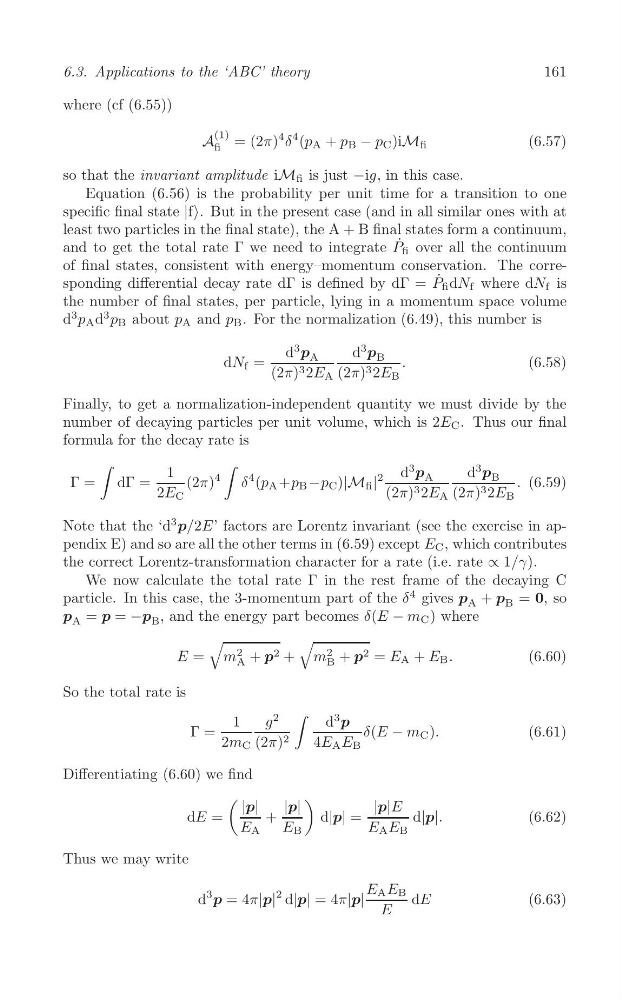
so that the invariant amplitude iM fi is just −ig, in this case.
Equation (6.56) is the probability per unit time for a transition to one
specific final state |f>. But in the present case (and in all similar ones with at
least two particles in the final state), the A + B final states form a continuum,
and to get the total rate Γ we need to integrate P ˙ fi over all the continuum
of final states, consistent with energy–momentum conservation. The corre˙
sponding differential decay rate dΓ is defined by dΓ = P fi dN f where dN f is
the number of final states, per particle, lying in a momentum space volume
d
3 p A d
3 p B about p A and p B . For the normalization (6.49), this number is
d
3
d
3
p A
p B
dN f =
.
(6.58)
(2π) 3 2E A (2π) 3 2E B
Finally, to get a normalization-independent quantity we must divide by the
number of decaying particles per unit volume, which is 2E C . Thus our final
formula for the decay rate is
∫
∫
1
d
3
p A
d
3
p B
Γ = dΓ =
(2π)
4
δ
4 (p A +p B −p C )|M fi |
2
. (6.59)
2E C
(2π) 3 2E A (2π) 3 2E B
Note that the ‘d
3
p/2E’ factors are Lorentz invariant (see the exercise in appendix E) and so are all the other terms in (6.59) except E C , which contributes
the correct Lorentz-transformation character for a rate (i.e. rate ∝ 1/γ).
We now calculate the total rate Γ in the rest frame of the decaying C
particle. In this case, the 3-momentum part of the δ
4 gives p A + p B = 0, so
p A = p = −p B , and the energy part becomes δ(E − m C ) where
√
√
2
2
E = m + p 2 + m + p 2 = E A + E B .
(6.60)
A
B
So the total rate is
∫
2
d
3
1
g
p
Γ =
δ(E − m C ).
(6.61)
2m C (2π) 2
4E A E B
Differentiating (6.60) we find
(
)
|p|
|p|
|p|E
dE =
+
d|p| =
d|p|.
(6.62)
E A
E B
E A E B
Thus we may write
E A E B
d
3
p = 4π|p|
2 d|p| = 4π|p|
dE
(6.63)
E
6.3. Applications to the ‘ABC’ theory
where (cf (6.55))
A
(1) = (2π)
4 δ
4 (p A + p B − p C )iM fi
(6.57)
fi
so that the invariant amplitude iM fi is just −ig, in this case.
Equation (6.56) is the probability per unit time for a transition to one
specific final state |f>. But in the present case (and in all similar ones with at
least two particles in the final state), the A + B final states form a continuum,
and to get the total rate Γ we need to integrate P ˙ fi over all the continuum
of final states, consistent with energy–momentum conservation. The corre˙
sponding differential decay rate dΓ is defined by dΓ = P fi dN f where dN f is
the number of final states, per particle, lying in a momentum space volume
d
3 p A d
3 p B about p A and p B . For the normalization (6.49), this number is
d
3
d
3
p A
p B
dN f =
.
(6.58)
(2π) 3 2E A (2π) 3 2E B
Finally, to get a normalization-independent quantity we must divide by the
number of decaying particles per unit volume, which is 2E C . Thus our final
formula for the decay rate is
∫
∫
1
d
3
p A
d
3
p B
Γ = dΓ =
(2π)
4
δ
4 (p A +p B −p C )|M fi |
2
. (6.59)
2E C
(2π) 3 2E A (2π) 3 2E B
Note that the ‘d
3
p/2E’ factors are Lorentz invariant (see the exercise in appendix E) and so are all the other terms in (6.59) except E C , which contributes
the correct Lorentz-transformation character for a rate (i.e. rate ∝ 1/γ).
We now calculate the total rate Γ in the rest frame of the decaying C
particle. In this case, the 3-momentum part of the δ
4 gives p A + p B = 0, so
p A = p = −p B , and the energy part becomes δ(E − m C ) where
√
√
2
2
E = m + p 2 + m + p 2 = E A + E B .
(6.60)
A
B
So the total rate is
∫
2
d
3
1
g
p
Γ =
δ(E − m C ).
(6.61)
2m C (2π) 2
4E A E B
Differentiating (6.60) we find
(
)
|p|
|p|
|p|E
dE =
+
d|p| =
d|p|.
(6.62)
E A
E B
E A E B
Thus we may write
E A E B
d
3
p = 4π|p|
2 d|p| = 4π|p|
dE
(6.63)
E