

162
6. Quantum Field Theory II: Interacting Scalar Fields
and use the energy δ-function in (6.61) to do the dE integral yielding finally
2
g |p|
Γ =
.
(6.64)
2
8π m C
The quantity |p| is actually determined from (6.60) now with E = m C ; after
some algebra, we find (problem 5.2)
4
4
4
2
2
2
2
2
2
|p| = [m A + m B + m C − 2m A m B − 2m B m C − 2m C m A ]
1/2 /2m C . (6.65)
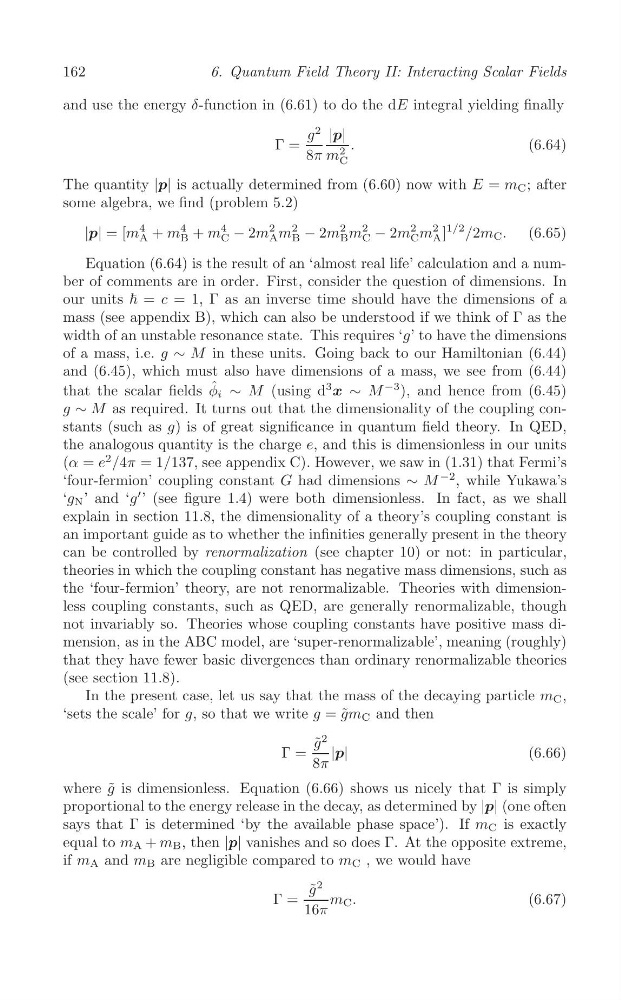
Equation (6.64) is the result of an ‘almost real life’ calculation and a number of comments are in order. First, consider the question of dimensions. In
our units ħ = c = 1, Γ as an inverse time should have the dimensions of a
mass (see appendix B), which can also be understood if we think of Γ as the
width of an unstable resonance state. This requires ‘g’ to have the dimensions
of a mass, i.e. g ∼ M in these units. Going back to our Hamiltonian (6.44)
and (6.45), which must also have dimensions of a mass, we see from (6.44)
that the scalar fields φ ˆ i ∼ M (using d
3
x ∼ M
−3 ), and hence from (6.45)
g ∼ M as required. It turns out that the dimensionality of the coupling constants (such as g) is of great significance in quantum field theory. In QED,
the analogous quantity is the charge e, and this is dimensionless in our units
(α = e
2 /4π = 1/137, see appendix C). However, we saw in (1.31) that Fermi’s
‘four-fermion’ coupling constant G had dimensions ∼ M
−2 , while Yukawa’s
‘g N ’ and ‘g
′ ’ (see figure 1.4) were both dimensionless. In fact, as we shall
explain in section 11.8, the dimensionality of a theory’s coupling constant is
an important guide as to whether the infinities generally present in the theory
can be controlled by renormalization (see chapter 10) or not: in particular,
theories in which the coupling constant has negative mass dimensions, such as
the ‘four-fermion’ theory, are not renormalizable. Theories with dimensionless coupling constants, such as QED, are generally renormalizable, though
not invariably so. Theories whose coupling constants have positive mass dimension, as in the ABC model, are ‘super-renormalizable’, meaning (roughly)
that they have fewer basic divergences than ordinary renormalizable theories
(see section 11.8).
In the present case, let us say that the mass of the decaying particle m C ,
‘sets the scale’ for g, so that we write g = ˜
gm C and then
2
Γ =
g ˜ |p|
(6.66)
8π
where ˜
g is dimensionless. Equation (6.66) shows us nicely that Γ is simply
proportional to the energy release in the decay, as determined by |p| (one often
says that Γ is determined ‘by the available phase space’). If m C is exactly
equal to m A + m B , then |p| vanishes and so does Γ. At the opposite extreme,
if m A and m B are negligible compared to m C , we would have
2
g ˜
Γ =
m C .
(6.67)
16π
6. Quantum Field Theory II: Interacting Scalar Fields
and use the energy δ-function in (6.61) to do the dE integral yielding finally
2
g |p|
Γ =
.
(6.64)
2
8π m C
The quantity |p| is actually determined from (6.60) now with E = m C ; after
some algebra, we find (problem 5.2)
4
4
4
2
2
2
2
2
2
|p| = [m A + m B + m C − 2m A m B − 2m B m C − 2m C m A ]
1/2 /2m C . (6.65)
Equation (6.64) is the result of an ‘almost real life’ calculation and a number of comments are in order. First, consider the question of dimensions. In
our units ħ = c = 1, Γ as an inverse time should have the dimensions of a
mass (see appendix B), which can also be understood if we think of Γ as the
width of an unstable resonance state. This requires ‘g’ to have the dimensions
of a mass, i.e. g ∼ M in these units. Going back to our Hamiltonian (6.44)
and (6.45), which must also have dimensions of a mass, we see from (6.44)
that the scalar fields φ ˆ i ∼ M (using d
3
x ∼ M
−3 ), and hence from (6.45)
g ∼ M as required. It turns out that the dimensionality of the coupling constants (such as g) is of great significance in quantum field theory. In QED,
the analogous quantity is the charge e, and this is dimensionless in our units
(α = e
2 /4π = 1/137, see appendix C). However, we saw in (1.31) that Fermi’s
‘four-fermion’ coupling constant G had dimensions ∼ M
−2 , while Yukawa’s
‘g N ’ and ‘g
′ ’ (see figure 1.4) were both dimensionless. In fact, as we shall
explain in section 11.8, the dimensionality of a theory’s coupling constant is
an important guide as to whether the infinities generally present in the theory
can be controlled by renormalization (see chapter 10) or not: in particular,
theories in which the coupling constant has negative mass dimensions, such as
the ‘four-fermion’ theory, are not renormalizable. Theories with dimensionless coupling constants, such as QED, are generally renormalizable, though
not invariably so. Theories whose coupling constants have positive mass dimension, as in the ABC model, are ‘super-renormalizable’, meaning (roughly)
that they have fewer basic divergences than ordinary renormalizable theories
(see section 11.8).
In the present case, let us say that the mass of the decaying particle m C ,
‘sets the scale’ for g, so that we write g = ˜
gm C and then
2
Γ =
g ˜ |p|
(6.66)
8π
where ˜
g is dimensionless. Equation (6.66) shows us nicely that Γ is simply
proportional to the energy release in the decay, as determined by |p| (one often
says that Γ is determined ‘by the available phase space’). If m C is exactly
equal to m A + m B , then |p| vanishes and so does Γ. At the opposite extreme,
if m A and m B are negligible compared to m C , we would have
2
g ˜
Γ =
m C .
(6.67)
16π