

101
4.2. Discrete transformations: P, C and T
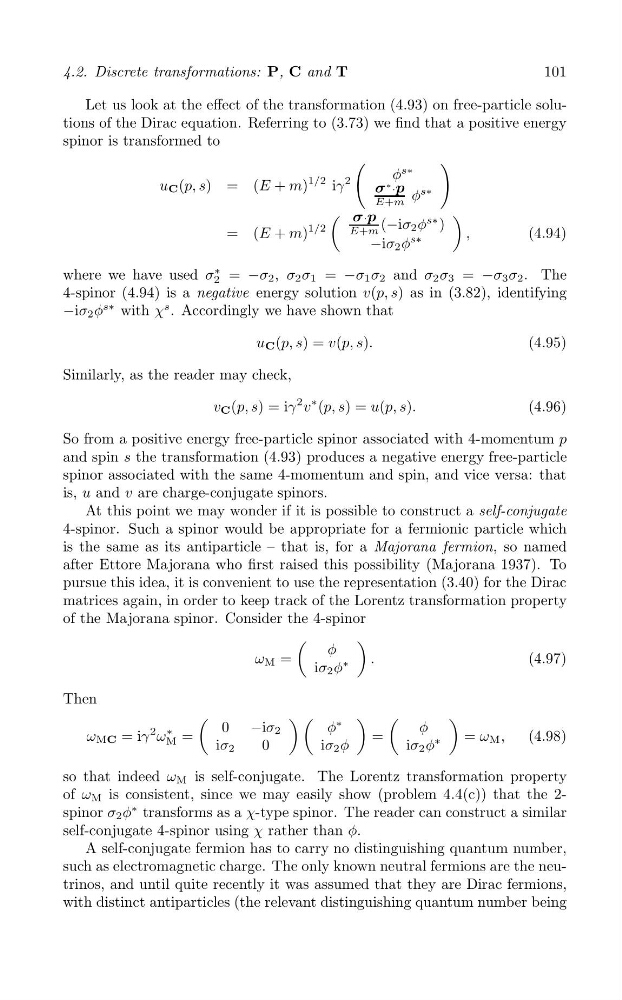
Let us look at the effect of the transformation (4.93) on free-particle solutions of the Dirac equation. Referring to (3.73) we find that a positive energy
spinor is transformed to
(
)
φ
s∗
u C (p, s) = (E + m)
1/2 iγ
2
σ
∗ ·p φ
s∗
E+m
(
)
σ·p (−iσ 2 φ
s∗ )
E+m
= (E + m)
1/2
,
(4.94)
−iσ 2 φ
s∗
where we have used σ 2
∗ = −σ 2 , σ 2 σ 1 = −σ 1 σ 2 and σ 2 σ 3 = −σ 3 σ 2 . The
4-spinor (4.94) is a negative energy solution v(p, s) as in (3.82), identifying
−iσ 2 φ
s∗ with χ
s . Accordingly we have shown that
u C (p, s) = v(p, s).
(4.95)
Similarly, as the reader may check,
v C (p, s) = iγ
2 v
∗ (p, s) = u(p, s).
(4.96)
So from a positive energy free-particle spinor associated with 4-momentum p
and spin s the transformation (4.93) produces a negative energy free-particle
spinor associated with the same 4-momentum and spin, and vice versa: that
is, u and v are charge-conjugate spinors.
At this point we may wonder if it is possible to construct a self-conjugate
4-spinor. Such a spinor would be appropriate for a fermionic particle which
is the same as its antiparticle – that is, for a Majorana fermion, so named
after Ettore Majorana who first raised this possibility (Majorana 1937). To
pursue this idea, it is convenient to use the representation (3.40) for the Dirac
matrices again, in order to keep track of the Lorentz transformation property
of the Majorana spinor. Consider the 4-spinor
(
)
φ
ω M =
.
(4.97)
iσ 2 φ
∗
Then
(
) (
) (
)
0 −iσ 2
φ
∗
φ
ω MC = iγ
2 ω M
∗ =
=
= ω M ,
(4.98)
iσ 2
0
iσ 2 φ
iσ 2 φ
∗
so that indeed ω M is self-conjugate. The Lorentz transformation property
of ω M is consistent, since we may easily show (problem 4.4(c)) that the 2spinor σ 2 φ
∗ transforms as a χ-type spinor. The reader can construct a similar
self-conjugate 4-spinor using χ rather than φ.
A self-conjugate fermion has to carry no distinguishing quantum number,
such as electromagnetic charge. The only known neutral fermions are the neutrinos, and until quite recently it was assumed that they are Dirac fermions,
with distinct antiparticles (the relevant distinguishing quantum number being
4.2. Discrete transformations: P, C and T
Let us look at the effect of the transformation (4.93) on free-particle solutions of the Dirac equation. Referring to (3.73) we find that a positive energy
spinor is transformed to
(
)
φ
s∗
u C (p, s) = (E + m)
1/2 iγ
2
σ
∗ ·p φ
s∗
E+m
(
)
σ·p (−iσ 2 φ
s∗ )
E+m
= (E + m)
1/2
,
(4.94)
−iσ 2 φ
s∗
where we have used σ 2
∗ = −σ 2 , σ 2 σ 1 = −σ 1 σ 2 and σ 2 σ 3 = −σ 3 σ 2 . The
4-spinor (4.94) is a negative energy solution v(p, s) as in (3.82), identifying
−iσ 2 φ
s∗ with χ
s . Accordingly we have shown that
u C (p, s) = v(p, s).
(4.95)
Similarly, as the reader may check,
v C (p, s) = iγ
2 v
∗ (p, s) = u(p, s).
(4.96)
So from a positive energy free-particle spinor associated with 4-momentum p
and spin s the transformation (4.93) produces a negative energy free-particle
spinor associated with the same 4-momentum and spin, and vice versa: that
is, u and v are charge-conjugate spinors.
At this point we may wonder if it is possible to construct a self-conjugate
4-spinor. Such a spinor would be appropriate for a fermionic particle which
is the same as its antiparticle – that is, for a Majorana fermion, so named
after Ettore Majorana who first raised this possibility (Majorana 1937). To
pursue this idea, it is convenient to use the representation (3.40) for the Dirac
matrices again, in order to keep track of the Lorentz transformation property
of the Majorana spinor. Consider the 4-spinor
(
)
φ
ω M =
.
(4.97)
iσ 2 φ
∗
Then
(
) (
) (
)
0 −iσ 2
φ
∗
φ
ω MC = iγ
2 ω M
∗ =
=
= ω M ,
(4.98)
iσ 2
0
iσ 2 φ
iσ 2 φ
∗
so that indeed ω M is self-conjugate. The Lorentz transformation property
of ω M is consistent, since we may easily show (problem 4.4(c)) that the 2spinor σ 2 φ
∗ transforms as a χ-type spinor. The reader can construct a similar
self-conjugate 4-spinor using χ rather than φ.
A self-conjugate fermion has to carry no distinguishing quantum number,
such as electromagnetic charge. The only known neutral fermions are the neutrinos, and until quite recently it was assumed that they are Dirac fermions,
with distinct antiparticles (the relevant distinguishing quantum number being