

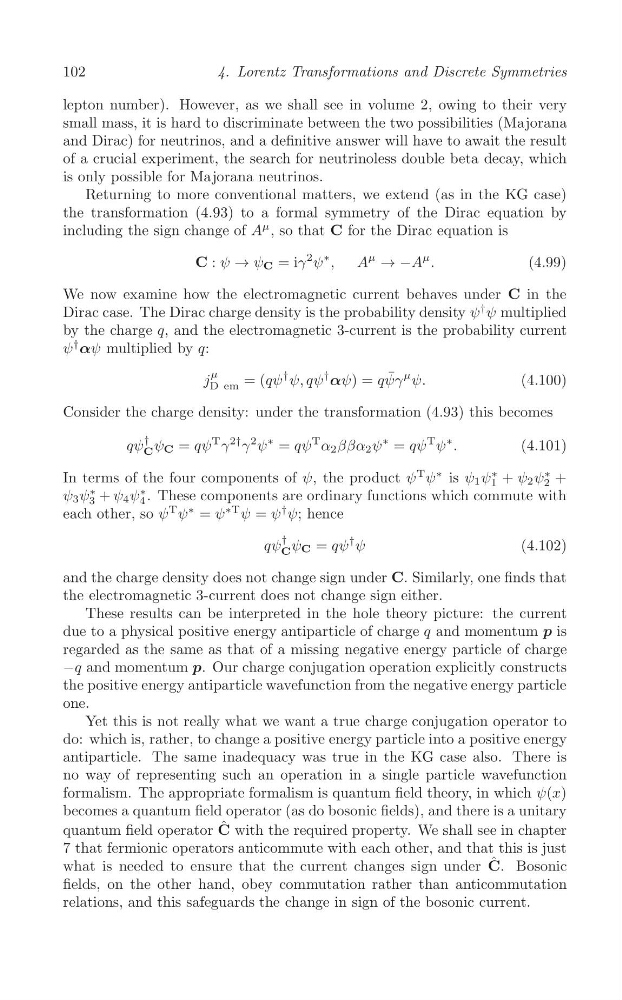
102
4. Lorentz Transformations and Discrete Symmetries
lepton number). However, as we shall see in volume 2, owing to their very
small mass, it is hard to discriminate between the two possibilities (Majorana
and Dirac) for neutrinos, and a definitive answer will have to await the result
of a crucial experiment, the search for neutrinoless double beta decay, which
is only possible for Majorana neutrinos.
Returning to more conventional matters, we extend (as in the KG case)
the transformation (4.93) to a formal symmetry of the Dirac equation by
including the sign change of A
μ , so that C for the Dirac equation is
C : ψ → ψ C = iγ
2 ψ
∗ ,
A
μ
→ −A
μ .
(4.99)
We now examine how the electromagnetic current behaves under C in the
Dirac case. The Dirac charge density is the probability density ψ
† ψ multiplied
by the charge q, and the electromagnetic 3-current is the probability current
ψ
†
αψ multiplied by q:
μ
¯
j
= (qψ
† ψ, qψ
†
αψ) = qψγ
μ ψ.
(4.100)
D em
Consider the charge density: under the transformation (4.93) this becomes
†
γ
2
ψ
∗
ψ
∗
qψ ψ C = qψ
T † γ
2
= qψ
T
ββα 2 ψ
∗ = qψ
T
.
(4.101)
C
α 2
In terms of the four components of ψ, the product ψ
T ψ
∗ is ψ 1 ψ 1
∗ + ψ 2 ψ 2
∗ +
ψ 3 ψ 3
∗ + ψ 4 ψ
∗ . These components are ordinary functions which commute with
4
each other, so ψ
T ψ
∗ = ψ
∗T ψ = ψ
† ψ; hence
†
qψ C ψ C = qψ
† ψ
(4.102)
and the charge density does not change sign under C. Similarly, one finds that
the electromagnetic 3-current does not change sign either.
These results can be interpreted in the hole theory picture: the current
due to a physical positive energy antiparticle of charge q and momentum p is
regarded as the same as that of a missing negative energy particle of charge
−q and momentum p. Our charge conjugation operation explicitly constructs
the positive energy antiparticle wavefunction from the negative energy particle
one.
Yet this is not really what we want a true charge conjugation operator to
do: which is, rather, to change a positive energy particle into a positive energy
antiparticle. The same inadequacy was true in the KG case also. There is
no way of representing such an operation in a single particle wavefunction
formalism. The appropriate formalism is quantum field theory, in which ψ(x)
becomes a quantum field operator (as do bosonic fields), and there is a unitary
quantum field operator C ˆ with the required property. We shall see in chapter
7 that fermionic operators anticommute with each other, and that this is just
what is needed to ensure that the current changes sign under C ˆ . Bosonic
fields, on the other hand, obey commutation rather than anticommutation
relations, and this safeguards the change in sign of the bosonic current.
4. Lorentz Transformations and Discrete Symmetries
lepton number). However, as we shall see in volume 2, owing to their very
small mass, it is hard to discriminate between the two possibilities (Majorana
and Dirac) for neutrinos, and a definitive answer will have to await the result
of a crucial experiment, the search for neutrinoless double beta decay, which
is only possible for Majorana neutrinos.
Returning to more conventional matters, we extend (as in the KG case)
the transformation (4.93) to a formal symmetry of the Dirac equation by
including the sign change of A
μ , so that C for the Dirac equation is
C : ψ → ψ C = iγ
2 ψ
∗ ,
A
μ
→ −A
μ .
(4.99)
We now examine how the electromagnetic current behaves under C in the
Dirac case. The Dirac charge density is the probability density ψ
† ψ multiplied
by the charge q, and the electromagnetic 3-current is the probability current
ψ
†
αψ multiplied by q:
μ
¯
j
= (qψ
† ψ, qψ
†
αψ) = qψγ
μ ψ.
(4.100)
D em
Consider the charge density: under the transformation (4.93) this becomes
†
γ
2
ψ
∗
ψ
∗
qψ ψ C = qψ
T † γ
2
= qψ
T
ββα 2 ψ
∗ = qψ
T
.
(4.101)
C
α 2
In terms of the four components of ψ, the product ψ
T ψ
∗ is ψ 1 ψ 1
∗ + ψ 2 ψ 2
∗ +
ψ 3 ψ 3
∗ + ψ 4 ψ
∗ . These components are ordinary functions which commute with
4
each other, so ψ
T ψ
∗ = ψ
∗T ψ = ψ
† ψ; hence
†
qψ C ψ C = qψ
† ψ
(4.102)
and the charge density does not change sign under C. Similarly, one finds that
the electromagnetic 3-current does not change sign either.
These results can be interpreted in the hole theory picture: the current
due to a physical positive energy antiparticle of charge q and momentum p is
regarded as the same as that of a missing negative energy particle of charge
−q and momentum p. Our charge conjugation operation explicitly constructs
the positive energy antiparticle wavefunction from the negative energy particle
one.
Yet this is not really what we want a true charge conjugation operator to
do: which is, rather, to change a positive energy particle into a positive energy
antiparticle. The same inadequacy was true in the KG case also. There is
no way of representing such an operation in a single particle wavefunction
formalism. The appropriate formalism is quantum field theory, in which ψ(x)
becomes a quantum field operator (as do bosonic fields), and there is a unitary
quantum field operator C ˆ with the required property. We shall see in chapter
7 that fermionic operators anticommute with each other, and that this is just
what is needed to ensure that the current changes sign under C ˆ . Bosonic
fields, on the other hand, obey commutation rather than anticommutation
relations, and this safeguards the change in sign of the bosonic current.