

74
M. Rz˛ etała
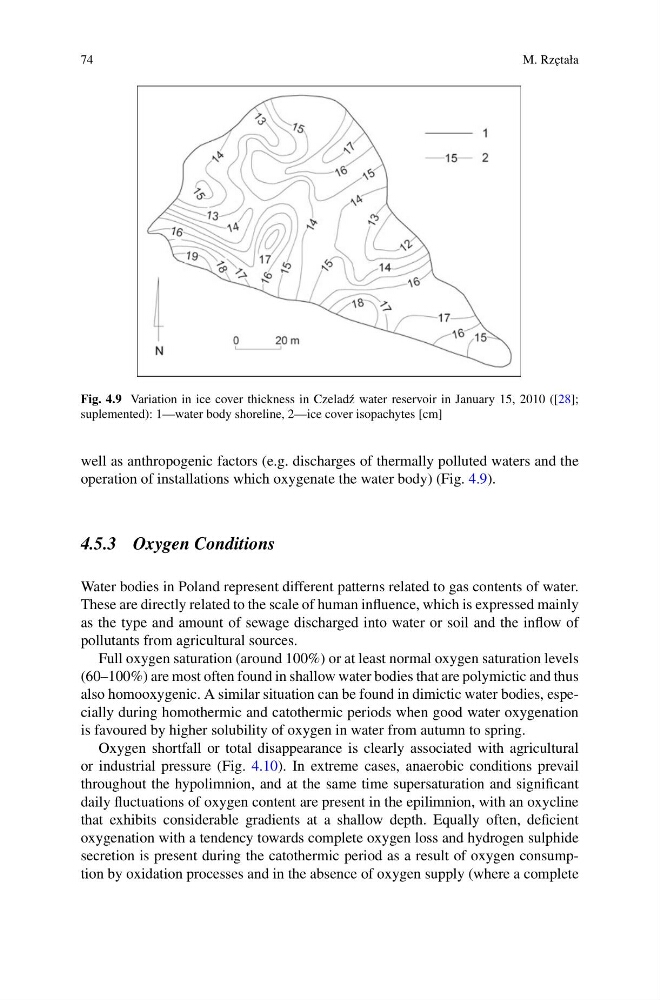
Fig. 4.9 Variation in ice cover thickness in Czelad´ z water reservoir in January 15, 2010 ([28];
suplemented): 1—water body shoreline, 2—ice cover isopachytes [cm]
well as anthropogenic factors (e.g. discharges of thermally polluted waters and the
operation of installations which oxygenate the water body) (Fig. 4.9).
4.5.3 Oxygen Conditions
Water bodies in Poland represent different patterns related to gas contents of water.
These are directly related to the scale of human influence, which is expressed mainly
as the type and amount of sewage discharged into water or soil and the inflow of
pollutants from agricultural sources.
Full oxygen saturation (around 100%) or at least normal oxygen saturation levels
(60–100%) are most often found in shallow water bodies that are polymictic and thus
also homooxygenic. A similar situation can be found in dimictic water bodies, especially during homothermic and catothermic periods when good water oxygenation
is favoured by higher solubility of oxygen in water from autumn to spring.
Oxygen shortfall or total disappearance is clearly associated with agricultural
or industrial pressure (Fig. 4.10). In extreme cases, anaerobic conditions prevail
throughout the hypolimnion, and at the same time supersaturation and significant
daily fluctuations of oxygen content are present in the epilimnion, with an oxycline
that exhibits considerable gradients at a shallow depth. Equally often, deficient
oxygenation with a tendency towards complete oxygen loss and hydrogen sulphide
secretion is present during the catothermic period as a result of oxygen consumption by oxidation processes and in the absence of oxygen supply (where a complete
M. Rz˛ etała
Fig. 4.9 Variation in ice cover thickness in Czelad´ z water reservoir in January 15, 2010 ([28];
suplemented): 1—water body shoreline, 2—ice cover isopachytes [cm]
well as anthropogenic factors (e.g. discharges of thermally polluted waters and the
operation of installations which oxygenate the water body) (Fig. 4.9).
4.5.3 Oxygen Conditions
Water bodies in Poland represent different patterns related to gas contents of water.
These are directly related to the scale of human influence, which is expressed mainly
as the type and amount of sewage discharged into water or soil and the inflow of
pollutants from agricultural sources.
Full oxygen saturation (around 100%) or at least normal oxygen saturation levels
(60–100%) are most often found in shallow water bodies that are polymictic and thus
also homooxygenic. A similar situation can be found in dimictic water bodies, especially during homothermic and catothermic periods when good water oxygenation
is favoured by higher solubility of oxygen in water from autumn to spring.
Oxygen shortfall or total disappearance is clearly associated with agricultural
or industrial pressure (Fig. 4.10). In extreme cases, anaerobic conditions prevail
throughout the hypolimnion, and at the same time supersaturation and significant
daily fluctuations of oxygen content are present in the epilimnion, with an oxycline
that exhibits considerable gradients at a shallow depth. Equally often, deficient
oxygenation with a tendency towards complete oxygen loss and hydrogen sulphide
secretion is present during the catothermic period as a result of oxygen consumption by oxidation processes and in the absence of oxygen supply (where a complete