

4 Anthropogenic Water Reservoirs in Poland
75
A
B
C
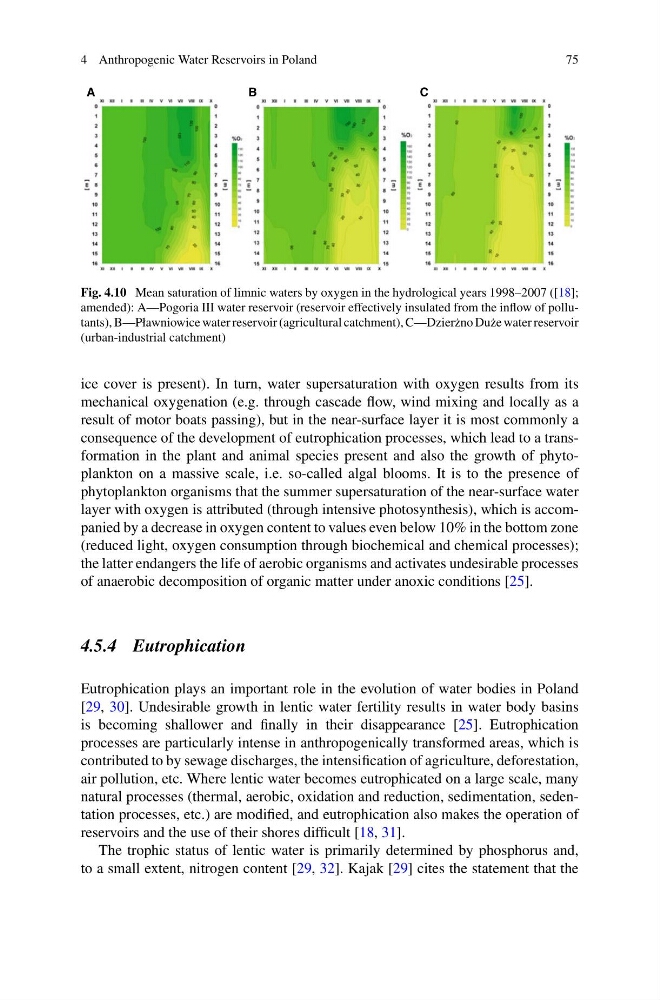
Fig. 4.10 Mean saturation of limnic waters by oxygen in the hydrological years 1998–2007 ([18];
amended): A—Pogoria III water reservoir (reservoir effectively insulated from the inflow of pollutants), B—Pławniowice water reservoir (agricultural catchment), C—Dzier˙ zno Du˙ ze water reservoir
(urban-industrial catchment)
ice cover is present). In turn, water supersaturation with oxygen results from its
mechanical oxygenation (e.g. through cascade flow, wind mixing and locally as a
result of motor boats passing), but in the near-surface layer it is most commonly a
consequence of the development of eutrophication processes, which lead to a transformation in the plant and animal species present and also the growth of phytoplankton on a massive scale, i.e. so-called algal blooms. It is to the presence of
phytoplankton organisms that the summer supersaturation of the near-surface water
layer with oxygen is attributed (through intensive photosynthesis), which is accompanied by a decrease in oxygen content to values even below 10% in the bottom zone
(reduced light, oxygen consumption through biochemical and chemical processes);
the latter endangers the life of aerobic organisms and activates undesirable processes
of anaerobic decomposition of organic matter under anoxic conditions [25].
4.5.4 Eutrophication
Eutrophication plays an important role in the evolution of water bodies in Poland
[29, 30]. Undesirable growth in lentic water fertility results in water body basins
is becoming shallower and finally in their disappearance [25]. Eutrophication
processes are particularly intense in anthropogenically transformed areas, which is
contributed to by sewage discharges, the intensification of agriculture, deforestation,
air pollution, etc. Where lentic water becomes eutrophicated on a large scale, many
natural processes (thermal, aerobic, oxidation and reduction, sedimentation, sedentation processes, etc.) are modified, and eutrophication also makes the operation of
reservoirs and the use of their shores difficult [18, 31].
The trophic status of lentic water is primarily determined by phosphorus and,
to a small extent, nitrogen content [29, 32]. Kajak [29] cites the statement that the
75
A
B
C
Fig. 4.10 Mean saturation of limnic waters by oxygen in the hydrological years 1998–2007 ([18];
amended): A—Pogoria III water reservoir (reservoir effectively insulated from the inflow of pollutants), B—Pławniowice water reservoir (agricultural catchment), C—Dzier˙ zno Du˙ ze water reservoir
(urban-industrial catchment)
ice cover is present). In turn, water supersaturation with oxygen results from its
mechanical oxygenation (e.g. through cascade flow, wind mixing and locally as a
result of motor boats passing), but in the near-surface layer it is most commonly a
consequence of the development of eutrophication processes, which lead to a transformation in the plant and animal species present and also the growth of phytoplankton on a massive scale, i.e. so-called algal blooms. It is to the presence of
phytoplankton organisms that the summer supersaturation of the near-surface water
layer with oxygen is attributed (through intensive photosynthesis), which is accompanied by a decrease in oxygen content to values even below 10% in the bottom zone
(reduced light, oxygen consumption through biochemical and chemical processes);
the latter endangers the life of aerobic organisms and activates undesirable processes
of anaerobic decomposition of organic matter under anoxic conditions [25].
4.5.4 Eutrophication
Eutrophication plays an important role in the evolution of water bodies in Poland
[29, 30]. Undesirable growth in lentic water fertility results in water body basins
is becoming shallower and finally in their disappearance [25]. Eutrophication
processes are particularly intense in anthropogenically transformed areas, which is
contributed to by sewage discharges, the intensification of agriculture, deforestation,
air pollution, etc. Where lentic water becomes eutrophicated on a large scale, many
natural processes (thermal, aerobic, oxidation and reduction, sedimentation, sedentation processes, etc.) are modified, and eutrophication also makes the operation of
reservoirs and the use of their shores difficult [18, 31].
The trophic status of lentic water is primarily determined by phosphorus and,
to a small extent, nitrogen content [29, 32]. Kajak [29] cites the statement that the