

4 Anthropogenic Water Reservoirs in Poland
73
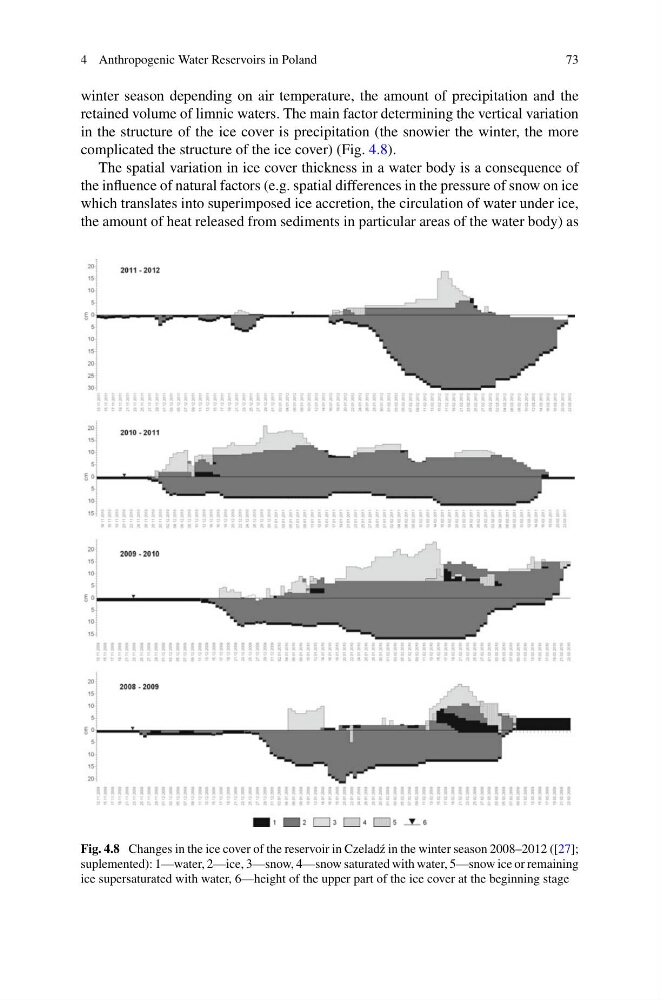
winter season depending on air temperature, the amount of precipitation and the
retained volume of limnic waters. The main factor determining the vertical variation
in the structure of the ice cover is precipitation (the snowier the winter, the more
complicated the structure of the ice cover) (Fig. 4.8).
The spatial variation in ice cover thickness in a water body is a consequence of
the influence of natural factors (e.g. spatial differences in the pressure of snow on ice
which translates into superimposed ice accretion, the circulation of water under ice,
the amount of heat released from sediments in particular areas of the water body) as
Fig. 4.8 Changes in the ice cover of the reservoir in Czelad´ z in the winter season 2008–2012 ([27];
suplemented): 1—water, 2—ice, 3—snow, 4—snow saturated with water, 5—snow ice or remaining
ice supersaturated with water, 6—height of the upper part of the ice cover at the beginning stage
73
winter season depending on air temperature, the amount of precipitation and the
retained volume of limnic waters. The main factor determining the vertical variation
in the structure of the ice cover is precipitation (the snowier the winter, the more
complicated the structure of the ice cover) (Fig. 4.8).
The spatial variation in ice cover thickness in a water body is a consequence of
the influence of natural factors (e.g. spatial differences in the pressure of snow on ice
which translates into superimposed ice accretion, the circulation of water under ice,
the amount of heat released from sediments in particular areas of the water body) as
Fig. 4.8 Changes in the ice cover of the reservoir in Czelad´ z in the winter season 2008–2012 ([27];
suplemented): 1—water, 2—ice, 3—snow, 4—snow saturated with water, 5—snow ice or remaining
ice supersaturated with water, 6—height of the upper part of the ice cover at the beginning stage