

66
M. Rz˛ etała
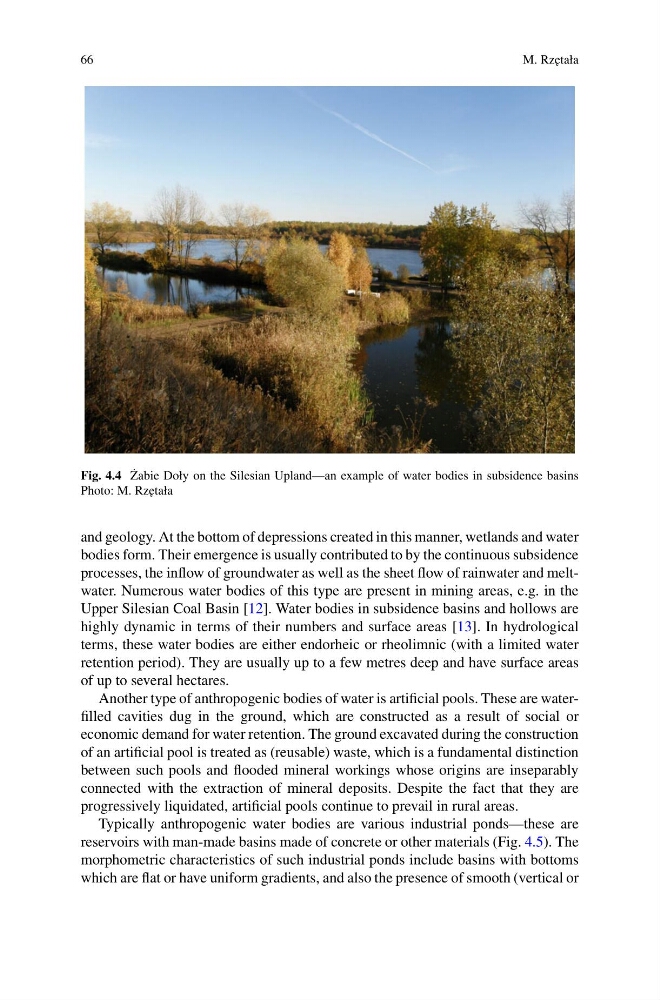
Fig. 4.4 ˙
Zabie Doły on the Silesian Upland—an example of water bodies in subsidence basins
Photo: M. Rz˛ etała
and geology. At the bottom of depressions created in this manner, wetlands and water
bodies form. Their emergence is usually contributed to by the continuous subsidence
processes, the inflow of groundwater as well as the sheet flow of rainwater and meltwater. Numerous water bodies of this type are present in mining areas, e.g. in the
Upper Silesian Coal Basin [12]. Water bodies in subsidence basins and hollows are
highly dynamic in terms of their numbers and surface areas [13]. In hydrological
terms, these water bodies are either endorheic or rheolimnic (with a limited water
retention period). They are usually up to a few metres deep and have surface areas
of up to several hectares.
Another type of anthropogenic bodies of water is artificial pools. These are waterfilled cavities dug in the ground, which are constructed as a result of social or
economic demand for water retention. The ground excavated during the construction
of an artificial pool is treated as (reusable) waste, which is a fundamental distinction
between such pools and flooded mineral workings whose origins are inseparably
connected with the extraction of mineral deposits. Despite the fact that they are
progressively liquidated, artificial pools continue to prevail in rural areas.
Typically anthropogenic water bodies are various industrial ponds—these are
reservoirs with man-made basins made of concrete or other materials (Fig. 4.5). The
morphometric characteristics of such industrial ponds include basins with bottoms
which are flat or have uniform gradients, and also the presence of smooth (vertical or
M. Rz˛ etała
Fig. 4.4 ˙
Zabie Doły on the Silesian Upland—an example of water bodies in subsidence basins
Photo: M. Rz˛ etała
and geology. At the bottom of depressions created in this manner, wetlands and water
bodies form. Their emergence is usually contributed to by the continuous subsidence
processes, the inflow of groundwater as well as the sheet flow of rainwater and meltwater. Numerous water bodies of this type are present in mining areas, e.g. in the
Upper Silesian Coal Basin [12]. Water bodies in subsidence basins and hollows are
highly dynamic in terms of their numbers and surface areas [13]. In hydrological
terms, these water bodies are either endorheic or rheolimnic (with a limited water
retention period). They are usually up to a few metres deep and have surface areas
of up to several hectares.
Another type of anthropogenic bodies of water is artificial pools. These are waterfilled cavities dug in the ground, which are constructed as a result of social or
economic demand for water retention. The ground excavated during the construction
of an artificial pool is treated as (reusable) waste, which is a fundamental distinction
between such pools and flooded mineral workings whose origins are inseparably
connected with the extraction of mineral deposits. Despite the fact that they are
progressively liquidated, artificial pools continue to prevail in rural areas.
Typically anthropogenic water bodies are various industrial ponds—these are
reservoirs with man-made basins made of concrete or other materials (Fig. 4.5). The
morphometric characteristics of such industrial ponds include basins with bottoms
which are flat or have uniform gradients, and also the presence of smooth (vertical or