

16 The State of Water and Sewage …
391
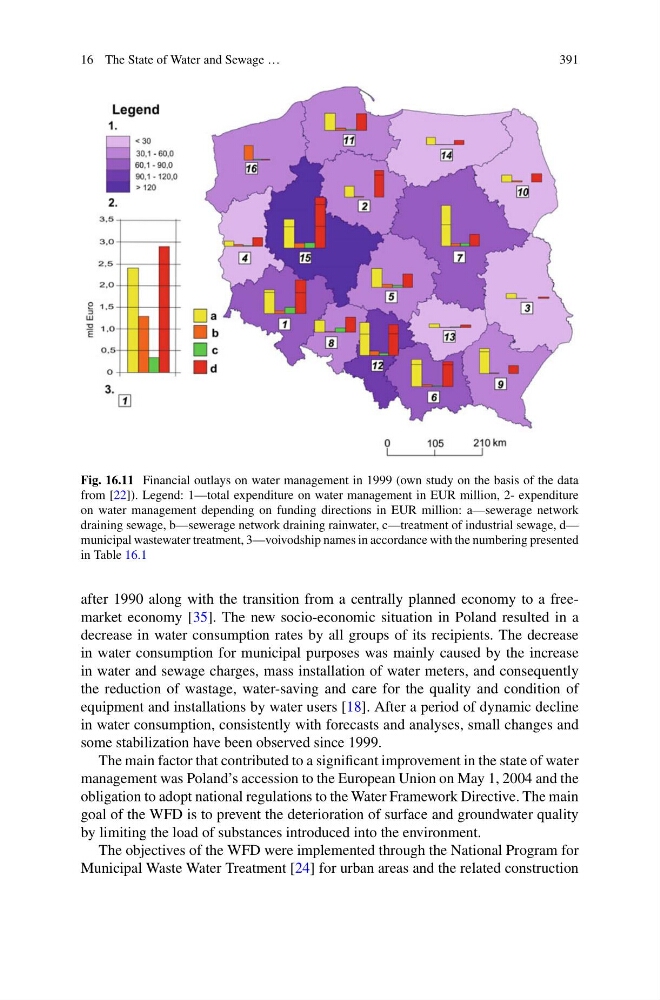
Fig. 16.11 Financial outlays on water management in 1999 (own study on the basis of the data
from [22]). Legend: 1—total expenditure on water management in EUR million, 2- expenditure
on water management depending on funding directions in EUR million: a—sewerage network
draining sewage, b—sewerage network draining rainwater, c—treatment of industrial sewage, d—
municipal wastewater treatment, 3—voivodship names in accordance with the numbering presented
in Table 16.1
after 1990 along with the transition from a centrally planned economy to a freemarket economy [35]. The new socio-economic situation in Poland resulted in a
decrease in water consumption rates by all groups of its recipients. The decrease
in water consumption for municipal purposes was mainly caused by the increase
in water and sewage charges, mass installation of water meters, and consequently
the reduction of wastage, water-saving and care for the quality and condition of
equipment and installations by water users [18]. After a period of dynamic decline
in water consumption, consistently with forecasts and analyses, small changes and
some stabilization have been observed since 1999.
The main factor that contributed to a significant improvement in the state of water
management was Poland’s accession to the European Union on May 1, 2004 and the
obligation to adopt national regulations to the Water Framework Directive. The main
goal of the WFD is to prevent the deterioration of surface and groundwater quality
by limiting the load of substances introduced into the environment.
The objectives of the WFD were implemented through the National Program for
Municipal Waste Water Treatment [24] for urban areas and the related construction
391
Fig. 16.11 Financial outlays on water management in 1999 (own study on the basis of the data
from [22]). Legend: 1—total expenditure on water management in EUR million, 2- expenditure
on water management depending on funding directions in EUR million: a—sewerage network
draining sewage, b—sewerage network draining rainwater, c—treatment of industrial sewage, d—
municipal wastewater treatment, 3—voivodship names in accordance with the numbering presented
in Table 16.1
after 1990 along with the transition from a centrally planned economy to a freemarket economy [35]. The new socio-economic situation in Poland resulted in a
decrease in water consumption rates by all groups of its recipients. The decrease
in water consumption for municipal purposes was mainly caused by the increase
in water and sewage charges, mass installation of water meters, and consequently
the reduction of wastage, water-saving and care for the quality and condition of
equipment and installations by water users [18]. After a period of dynamic decline
in water consumption, consistently with forecasts and analyses, small changes and
some stabilization have been observed since 1999.
The main factor that contributed to a significant improvement in the state of water
management was Poland’s accession to the European Union on May 1, 2004 and the
obligation to adopt national regulations to the Water Framework Directive. The main
goal of the WFD is to prevent the deterioration of surface and groundwater quality
by limiting the load of substances introduced into the environment.
The objectives of the WFD were implemented through the National Program for
Municipal Waste Water Treatment [24] for urban areas and the related construction