

382
K. Kubiak-Wójcicka and M. Kielik
0%
10%
20%
30%
40%
50%
60%
70%
80%
90%
100%
1999
2000
2001
2002
2003
2004
2005
2006
2007
2008
2009
2010
2011
2012
2013
2014
2015
Exploitation of water supply network
Irrigation in agriculture and forestry
Production purposes
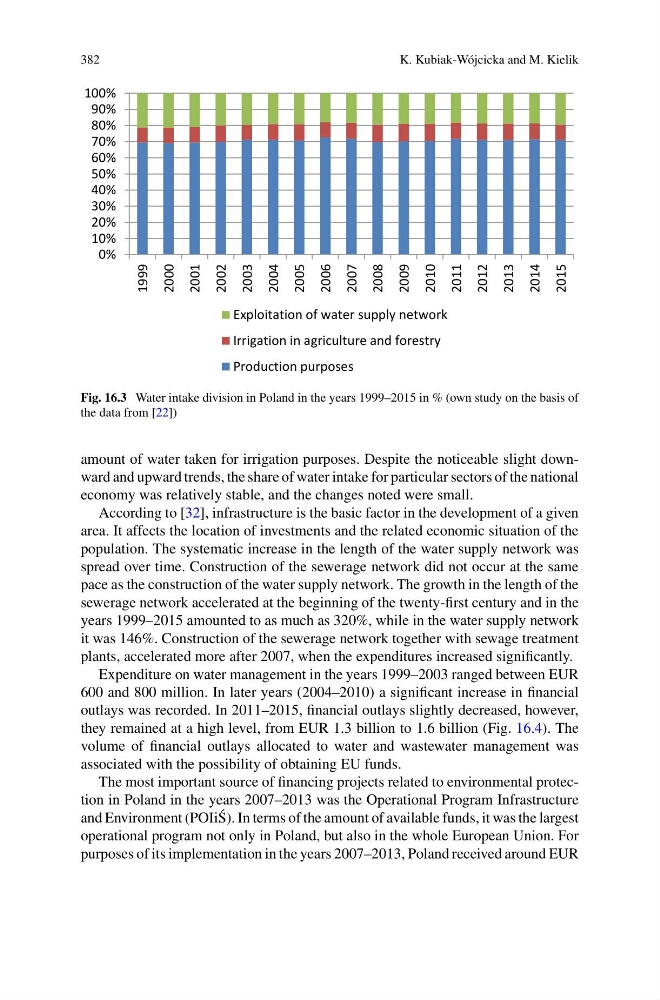
Fig. 16.3 Water intake division in Poland in the years 1999–2015 in % (own study on the basis of
the data from [22])
amount of water taken for irrigation purposes. Despite the noticeable slight downward and upward trends, the share of water intake for particular sectors of the national
economy was relatively stable, and the changes noted were small.
According to [32], infrastructure is the basic factor in the development of a given
area. It affects the location of investments and the related economic situation of the
population. The systematic increase in the length of the water supply network was
spread over time. Construction of the sewerage network did not occur at the same
pace as the construction of the water supply network. The growth in the length of the
sewerage network accelerated at the beginning of the twenty-first century and in the
years 1999–2015 amounted to as much as 320%, while in the water supply network
it was 146%. Construction of the sewerage network together with sewage treatment
plants, accelerated more after 2007, when the expenditures increased significantly.
Expenditure on water management in the years 1999–2003 ranged between EUR
600 and 800 million. In later years (2004–2010) a significant increase in financial
outlays was recorded. In 2011–2015, financial outlays slightly decreased, however,
they remained at a high level, from EUR 1.3 billion to 1.6 billion (Fig. 16.4). The
volume of financial outlays allocated to water and wastewater management was
associated with the possibility of obtaining EU funds.
The most important source of financing projects related to environmental protection in Poland in the years 2007–2013 was the Operational Program Infrastructure
and Environment (POIi ´
S). In terms of the amount of available funds, it was the largest
operational program not only in Poland, but also in the whole European Union. For
purposes of its implementation in the years 2007–2013, Poland received around EUR
K. Kubiak-Wójcicka and M. Kielik
0%
10%
20%
30%
40%
50%
60%
70%
80%
90%
100%
1999
2000
2001
2002
2003
2004
2005
2006
2007
2008
2009
2010
2011
2012
2013
2014
2015
Exploitation of water supply network
Irrigation in agriculture and forestry
Production purposes
Fig. 16.3 Water intake division in Poland in the years 1999–2015 in % (own study on the basis of
the data from [22])
amount of water taken for irrigation purposes. Despite the noticeable slight downward and upward trends, the share of water intake for particular sectors of the national
economy was relatively stable, and the changes noted were small.
According to [32], infrastructure is the basic factor in the development of a given
area. It affects the location of investments and the related economic situation of the
population. The systematic increase in the length of the water supply network was
spread over time. Construction of the sewerage network did not occur at the same
pace as the construction of the water supply network. The growth in the length of the
sewerage network accelerated at the beginning of the twenty-first century and in the
years 1999–2015 amounted to as much as 320%, while in the water supply network
it was 146%. Construction of the sewerage network together with sewage treatment
plants, accelerated more after 2007, when the expenditures increased significantly.
Expenditure on water management in the years 1999–2003 ranged between EUR
600 and 800 million. In later years (2004–2010) a significant increase in financial
outlays was recorded. In 2011–2015, financial outlays slightly decreased, however,
they remained at a high level, from EUR 1.3 billion to 1.6 billion (Fig. 16.4). The
volume of financial outlays allocated to water and wastewater management was
associated with the possibility of obtaining EU funds.
The most important source of financing projects related to environmental protection in Poland in the years 2007–2013 was the Operational Program Infrastructure
and Environment (POIi ´
S). In terms of the amount of available funds, it was the largest
operational program not only in Poland, but also in the whole European Union. For
purposes of its implementation in the years 2007–2013, Poland received around EUR