

10 Ingression and Ascension of Saline Waters on the Polish Coast of the Baltic Sea
225
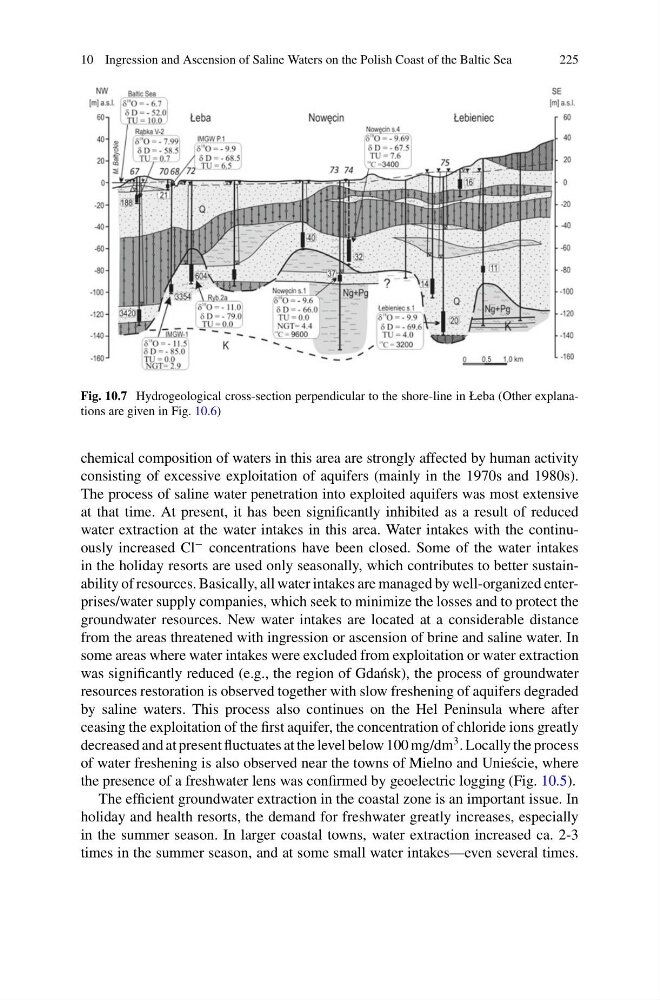
Fig. 10.7 Hydrogeological cross-section perpendicular to the shore-line in Łeba (Other explanations are given in Fig. 10.6)
chemical composition of waters in this area are strongly affected by human activity
consisting of excessive exploitation of aquifers (mainly in the 1970s and 1980s).
The process of saline water penetration into exploited aquifers was most extensive
at that time. At present, it has been significantly inhibited as a result of reduced
water extraction at the water intakes in this area. Water intakes with the continuously increased Cl
− concentrations have been closed. Some of the water intakes
in the holiday resorts are used only seasonally, which contributes to better sustainability of resources. Basically, all water intakes are managed by well-organized enterprises/water supply companies, which seek to minimize the losses and to protect the
groundwater resources. New water intakes are located at a considerable distance
from the areas threatened with ingression or ascension of brine and saline water. In
some areas where water intakes were excluded from exploitation or water extraction
was significantly reduced (e.g., the region of Gda´ nsk), the process of groundwater
resources restoration is observed together with slow freshening of aquifers degraded
by saline waters. This process also continues on the Hel Peninsula where after
ceasing the exploitation of the first aquifer, the concentration of chloride ions greatly
decreased and at present fluctuates at the level below 100 mg/dm
3 . Locally the process
of water freshening is also observed near the towns of Mielno and Unie´ scie, where
the presence of a freshwater lens was confirmed by geoelectric logging (Fig. 10.5).
The efficient groundwater extraction in the coastal zone is an important issue. In
holiday and health resorts, the demand for freshwater greatly increases, especially
in the summer season. In larger coastal towns, water extraction increased ca. 2-3
times in the summer season, and at some small water intakes—even several times.
225
Fig. 10.7 Hydrogeological cross-section perpendicular to the shore-line in Łeba (Other explanations are given in Fig. 10.6)
chemical composition of waters in this area are strongly affected by human activity
consisting of excessive exploitation of aquifers (mainly in the 1970s and 1980s).
The process of saline water penetration into exploited aquifers was most extensive
at that time. At present, it has been significantly inhibited as a result of reduced
water extraction at the water intakes in this area. Water intakes with the continuously increased Cl
− concentrations have been closed. Some of the water intakes
in the holiday resorts are used only seasonally, which contributes to better sustainability of resources. Basically, all water intakes are managed by well-organized enterprises/water supply companies, which seek to minimize the losses and to protect the
groundwater resources. New water intakes are located at a considerable distance
from the areas threatened with ingression or ascension of brine and saline water. In
some areas where water intakes were excluded from exploitation or water extraction
was significantly reduced (e.g., the region of Gda´ nsk), the process of groundwater
resources restoration is observed together with slow freshening of aquifers degraded
by saline waters. This process also continues on the Hel Peninsula where after
ceasing the exploitation of the first aquifer, the concentration of chloride ions greatly
decreased and at present fluctuates at the level below 100 mg/dm
3 . Locally the process
of water freshening is also observed near the towns of Mielno and Unie´ scie, where
the presence of a freshwater lens was confirmed by geoelectric logging (Fig. 10.5).
The efficient groundwater extraction in the coastal zone is an important issue. In
holiday and health resorts, the demand for freshwater greatly increases, especially
in the summer season. In larger coastal towns, water extraction increased ca. 2-3
times in the summer season, and at some small water intakes—even several times.