

226
A. Krawiec
Excessive exploitation of aquifers on the southern Baltic coast leads to the development of chloride anomalies and the closure of many groundwater intakes [3, 10, 21,
22]. Monitoring the volume and quality of freshwater extraction, as well as safely
assessing the admissible volume of extracted water for all water management areas
will prevent the future degradation of groundwater resources through salinity.
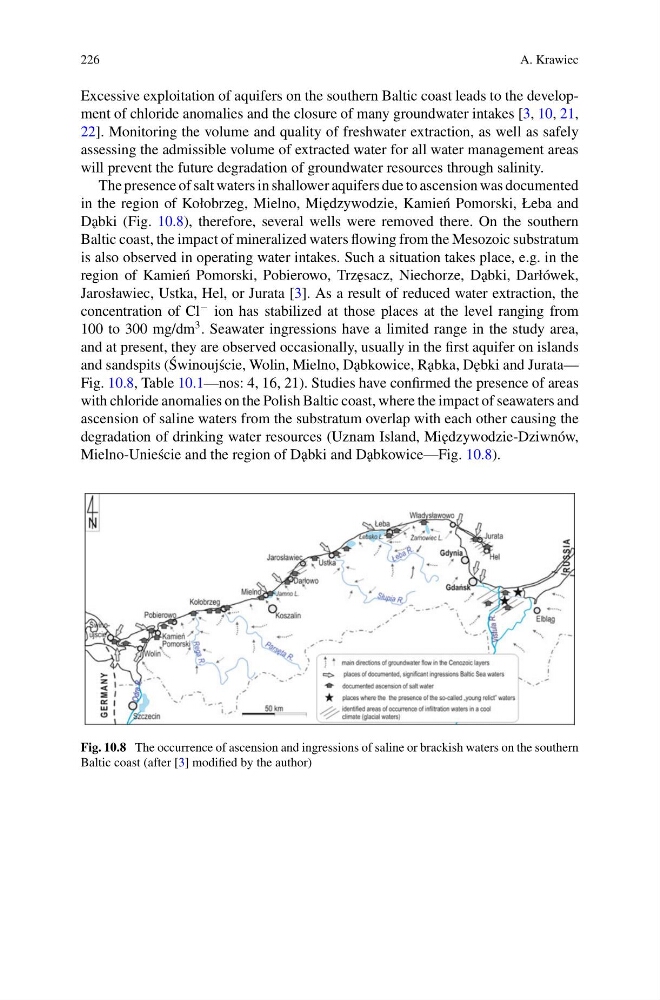
The presence of salt waters in shallower aquifers due to ascension was documented
in the region of Kołobrzeg, Mielno, Mi˛ edzywodzie, Kamie´ n Pomorski, Łeba and
D˛ abki (Fig. 10.8), therefore, several wells were removed there. On the southern
Baltic coast, the impact of mineralized waters flowing from the Mesozoic substratum
is also observed in operating water intakes. Such a situation takes place, e.g. in the
region of Kamie´ n Pomorski, Pobierowo, Trz˛ esacz, Niechorze, D˛ abki, Darłówek,
Jarosławiec, Ustka, Hel, or Jurata [3]. As a result of reduced water extraction, the
concentration of Cl
− ion has stabilized at those places at the level ranging from
100 to 300 mg/dm
3 . Seawater ingressions have a limited range in the study area,
and at present, they are observed occasionally, usually in the first aquifer on islands
and sandspits ( ´
Swinouj´ scie, Wolin, Mielno, D˛ abkowice, R˛ abka, D˛ ebki and Jurata—
Fig. 10.8, Table 10.1—nos: 4, 16, 21). Studies have confirmed the presence of areas
with chloride anomalies on the Polish Baltic coast, where the impact of seawaters and
ascension of saline waters from the substratum overlap with each other causing the
degradation of drinking water resources (Uznam Island, Mi˛ edzywodzie-Dziwnów,
Mielno-Unie´ scie and the region of D˛ abki and D˛ abkowice—Fig. 10.8).
Fig. 10.8 The occurrence of ascension and ingressions of saline or brackish waters on the southern
Baltic coast (after [3] modified by the author)
A. Krawiec
Excessive exploitation of aquifers on the southern Baltic coast leads to the development of chloride anomalies and the closure of many groundwater intakes [3, 10, 21,
22]. Monitoring the volume and quality of freshwater extraction, as well as safely
assessing the admissible volume of extracted water for all water management areas
will prevent the future degradation of groundwater resources through salinity.
The presence of salt waters in shallower aquifers due to ascension was documented
in the region of Kołobrzeg, Mielno, Mi˛ edzywodzie, Kamie´ n Pomorski, Łeba and
D˛ abki (Fig. 10.8), therefore, several wells were removed there. On the southern
Baltic coast, the impact of mineralized waters flowing from the Mesozoic substratum
is also observed in operating water intakes. Such a situation takes place, e.g. in the
region of Kamie´ n Pomorski, Pobierowo, Trz˛ esacz, Niechorze, D˛ abki, Darłówek,
Jarosławiec, Ustka, Hel, or Jurata [3]. As a result of reduced water extraction, the
concentration of Cl
− ion has stabilized at those places at the level ranging from
100 to 300 mg/dm
3 . Seawater ingressions have a limited range in the study area,
and at present, they are observed occasionally, usually in the first aquifer on islands
and sandspits ( ´
Swinouj´ scie, Wolin, Mielno, D˛ abkowice, R˛ abka, D˛ ebki and Jurata—
Fig. 10.8, Table 10.1—nos: 4, 16, 21). Studies have confirmed the presence of areas
with chloride anomalies on the Polish Baltic coast, where the impact of seawaters and
ascension of saline waters from the substratum overlap with each other causing the
degradation of drinking water resources (Uznam Island, Mi˛ edzywodzie-Dziwnów,
Mielno-Unie´ scie and the region of D˛ abki and D˛ abkowice—Fig. 10.8).
Fig. 10.8 The occurrence of ascension and ingressions of saline or brackish waters on the southern
Baltic coast (after [3] modified by the author)