

7 Water Quality in Main Dam Reservoirs in Poland
163
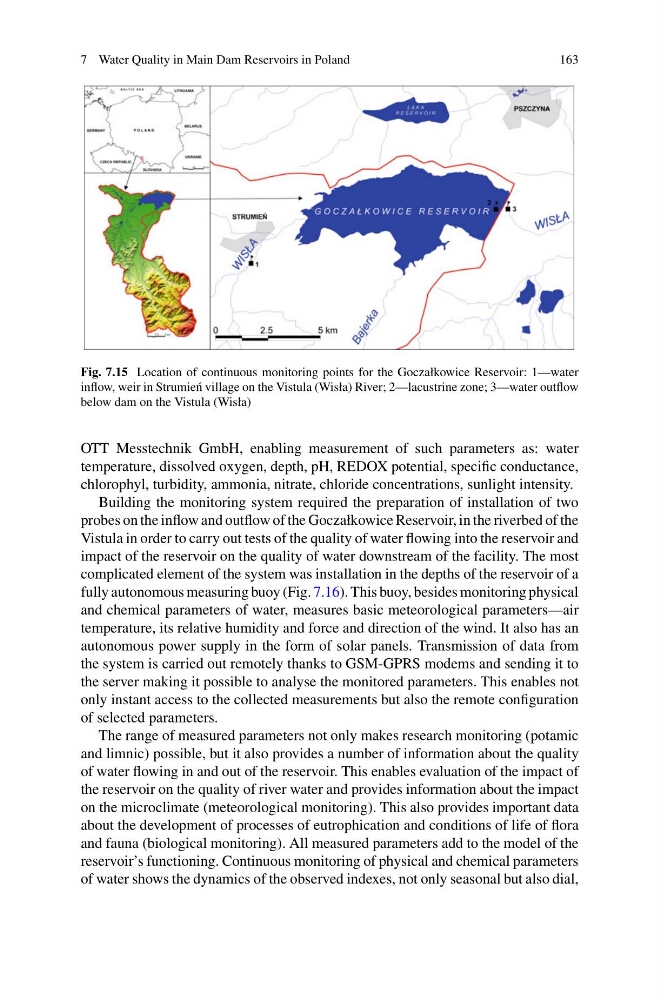
Fig. 7.15 Location of continuous monitoring points for the Goczałkowice Reservoir: 1—water
inflow, weir in Strumie´ n village on the Vistula (Wisła) River; 2—lacustrine zone; 3—water outflow
below dam on the Vistula (Wisła)
OTT Messtechnik GmbH, enabling measurement of such parameters as: water
temperature, dissolved oxygen, depth, pH, REDOX potential, specific conductance,
chlorophyl, turbidity, ammonia, nitrate, chloride concentrations, sunlight intensity.
Building the monitoring system required the preparation of installation of two
probes on the inflow and outflow of the Goczałkowice Reservoir, in the riverbed of the
Vistula in order to carry out tests of the quality of water flowing into the reservoir and
impact of the reservoir on the quality of water downstream of the facility. The most
complicated element of the system was installation in the depths of the reservoir of a
fully autonomous measuring buoy (Fig. 7.16). This buoy, besides monitoring physical
and chemical parameters of water, measures basic meteorological parameters—air
temperature, its relative humidity and force and direction of the wind. It also has an
autonomous power supply in the form of solar panels. Transmission of data from
the system is carried out remotely thanks to GSM-GPRS modems and sending it to
the server making it possible to analyse the monitored parameters. This enables not
only instant access to the collected measurements but also the remote configuration
of selected parameters.
The range of measured parameters not only makes research monitoring (potamic
and limnic) possible, but it also provides a number of information about the quality
of water flowing in and out of the reservoir. This enables evaluation of the impact of
the reservoir on the quality of river water and provides information about the impact
on the microclimate (meteorological monitoring). This also provides important data
about the development of processes of eutrophication and conditions of life of flora
and fauna (biological monitoring). All measured parameters add to the model of the
reservoir’s functioning. Continuous monitoring of physical and chemical parameters
of water shows the dynamics of the observed indexes, not only seasonal but also dial,
163
Fig. 7.15 Location of continuous monitoring points for the Goczałkowice Reservoir: 1—water
inflow, weir in Strumie´ n village on the Vistula (Wisła) River; 2—lacustrine zone; 3—water outflow
below dam on the Vistula (Wisła)
OTT Messtechnik GmbH, enabling measurement of such parameters as: water
temperature, dissolved oxygen, depth, pH, REDOX potential, specific conductance,
chlorophyl, turbidity, ammonia, nitrate, chloride concentrations, sunlight intensity.
Building the monitoring system required the preparation of installation of two
probes on the inflow and outflow of the Goczałkowice Reservoir, in the riverbed of the
Vistula in order to carry out tests of the quality of water flowing into the reservoir and
impact of the reservoir on the quality of water downstream of the facility. The most
complicated element of the system was installation in the depths of the reservoir of a
fully autonomous measuring buoy (Fig. 7.16). This buoy, besides monitoring physical
and chemical parameters of water, measures basic meteorological parameters—air
temperature, its relative humidity and force and direction of the wind. It also has an
autonomous power supply in the form of solar panels. Transmission of data from
the system is carried out remotely thanks to GSM-GPRS modems and sending it to
the server making it possible to analyse the monitored parameters. This enables not
only instant access to the collected measurements but also the remote configuration
of selected parameters.
The range of measured parameters not only makes research monitoring (potamic
and limnic) possible, but it also provides a number of information about the quality
of water flowing in and out of the reservoir. This enables evaluation of the impact of
the reservoir on the quality of river water and provides information about the impact
on the microclimate (meteorological monitoring). This also provides important data
about the development of processes of eutrophication and conditions of life of flora
and fauna (biological monitoring). All measured parameters add to the model of the
reservoir’s functioning. Continuous monitoring of physical and chemical parameters
of water shows the dynamics of the observed indexes, not only seasonal but also dial,