

6 Quality Assessment of Water Resources of River in Poland
137
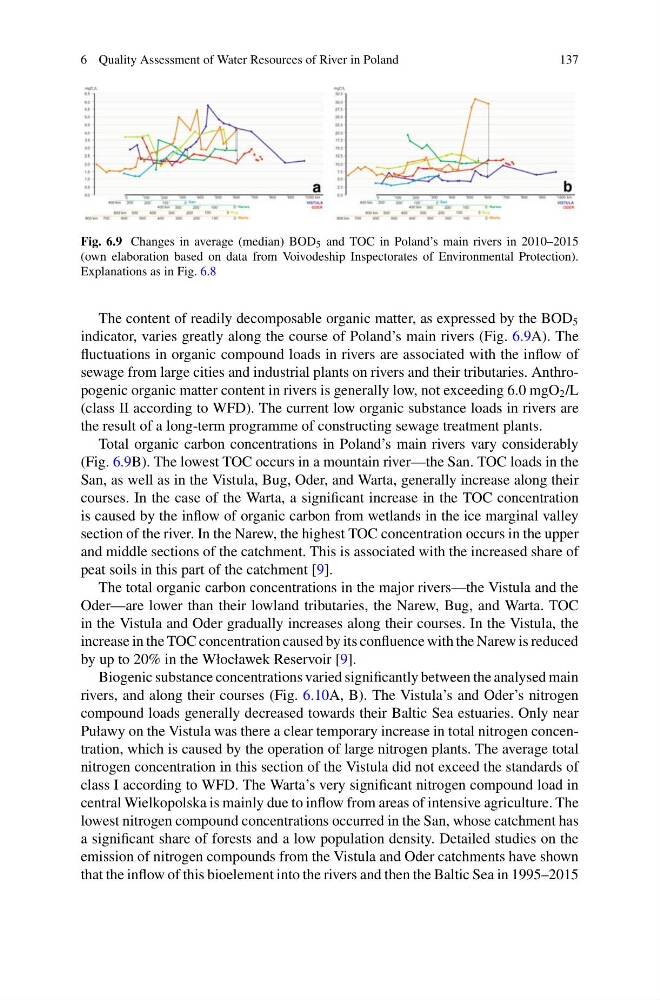
Fig. 6.9 Changes in average (median) BOD 5 and TOC in Poland’s main rivers in 2010–2015
(own elaboration based on data from Voivodeship Inspectorates of Environmental Protection).
Explanations as in Fig. 6.8
The content of readily decomposable organic matter, as expressed by the BOD 5
indicator, varies greatly along the course of Poland’s main rivers (Fig. 6.9A). The
fluctuations in organic compound loads in rivers are associated with the inflow of
sewage from large cities and industrial plants on rivers and their tributaries. Anthropogenic organic matter content in rivers is generally low, not exceeding 6.0 mgO 2 /L
(class II according to WFD). The current low organic substance loads in rivers are
the result of a long-term programme of constructing sewage treatment plants.
Total organic carbon concentrations in Poland’s main rivers vary considerably
(Fig. 6.9B). The lowest TOC occurs in a mountain river—the San. TOC loads in the
San, as well as in the Vistula, Bug, Oder, and Warta, generally increase along their
courses. In the case of the Warta, a significant increase in the TOC concentration
is caused by the inflow of organic carbon from wetlands in the ice marginal valley
section of the river. In the Narew, the highest TOC concentration occurs in the upper
and middle sections of the catchment. This is associated with the increased share of
peat soils in this part of the catchment [9].
The total organic carbon concentrations in the major rivers—the Vistula and the
Oder—are lower than their lowland tributaries, the Narew, Bug, and Warta. TOC
in the Vistula and Oder gradually increases along their courses. In the Vistula, the
increase in the TOC concentration caused by its confluence with the Narew is reduced
by up to 20% in the Włocławek Reservoir [9].
Biogenic substance concentrations varied significantly between the analysed main
rivers, and along their courses (Fig. 6.10A, B). The Vistula’s and Oder’s nitrogen
compound loads generally decreased towards their Baltic Sea estuaries. Only near
Puławy on the Vistula was there a clear temporary increase in total nitrogen concentration, which is caused by the operation of large nitrogen plants. The average total
nitrogen concentration in this section of the Vistula did not exceed the standards of
class I according to WFD. The Warta’s very significant nitrogen compound load in
central Wielkopolska is mainly due to inflow from areas of intensive agriculture. The
lowest nitrogen compound concentrations occurred in the San, whose catchment has
a significant share of forests and a low population density. Detailed studies on the
emission of nitrogen compounds from the Vistula and Oder catchments have shown
that the inflow of this bioelement into the rivers and then the Baltic Sea in 1995–2015
137
Fig. 6.9 Changes in average (median) BOD 5 and TOC in Poland’s main rivers in 2010–2015
(own elaboration based on data from Voivodeship Inspectorates of Environmental Protection).
Explanations as in Fig. 6.8
The content of readily decomposable organic matter, as expressed by the BOD 5
indicator, varies greatly along the course of Poland’s main rivers (Fig. 6.9A). The
fluctuations in organic compound loads in rivers are associated with the inflow of
sewage from large cities and industrial plants on rivers and their tributaries. Anthropogenic organic matter content in rivers is generally low, not exceeding 6.0 mgO 2 /L
(class II according to WFD). The current low organic substance loads in rivers are
the result of a long-term programme of constructing sewage treatment plants.
Total organic carbon concentrations in Poland’s main rivers vary considerably
(Fig. 6.9B). The lowest TOC occurs in a mountain river—the San. TOC loads in the
San, as well as in the Vistula, Bug, Oder, and Warta, generally increase along their
courses. In the case of the Warta, a significant increase in the TOC concentration
is caused by the inflow of organic carbon from wetlands in the ice marginal valley
section of the river. In the Narew, the highest TOC concentration occurs in the upper
and middle sections of the catchment. This is associated with the increased share of
peat soils in this part of the catchment [9].
The total organic carbon concentrations in the major rivers—the Vistula and the
Oder—are lower than their lowland tributaries, the Narew, Bug, and Warta. TOC
in the Vistula and Oder gradually increases along their courses. In the Vistula, the
increase in the TOC concentration caused by its confluence with the Narew is reduced
by up to 20% in the Włocławek Reservoir [9].
Biogenic substance concentrations varied significantly between the analysed main
rivers, and along their courses (Fig. 6.10A, B). The Vistula’s and Oder’s nitrogen
compound loads generally decreased towards their Baltic Sea estuaries. Only near
Puławy on the Vistula was there a clear temporary increase in total nitrogen concentration, which is caused by the operation of large nitrogen plants. The average total
nitrogen concentration in this section of the Vistula did not exceed the standards of
class I according to WFD. The Warta’s very significant nitrogen compound load in
central Wielkopolska is mainly due to inflow from areas of intensive agriculture. The
lowest nitrogen compound concentrations occurred in the San, whose catchment has
a significant share of forests and a low population density. Detailed studies on the
emission of nitrogen compounds from the Vistula and Oder catchments have shown
that the inflow of this bioelement into the rivers and then the Baltic Sea in 1995–2015