

2.4 Microplastic Sources and Fluxes in Greater Paris
and the Seine River
Between 2014 and 2016, an investigation of sources and fluxes of microplastics was
carried out on the Paris megacity. The following sources were investigated: atmospheric fallout, runoff water, grey water, wastewater outfall and CSO. Moreover,
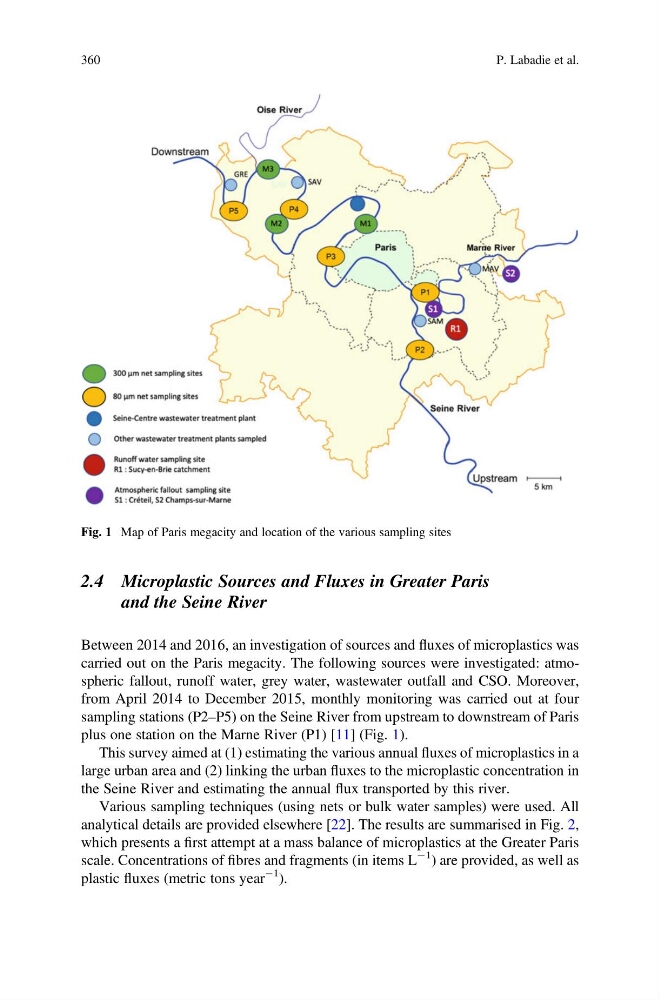
from April 2014 to December 2015, monthly monitoring was carried out at four
sampling stations (P2–P5) on the Seine River from upstream to downstream of Paris
plus one station on the Marne River (P1) [11] (Fig. 1).
This survey aimed at (1) estimating the various annual fluxes of microplastics in a
large urban area and (2) linking the urban fluxes to the microplastic concentration in
the Seine River and estimating the annual flux transported by this river.
Various sampling techniques (using nets or bulk water samples) were used. All
analytical details are provided elsewhere [22]. The results are summarised in Fig. 2,
which presents a first attempt at a mass balance of microplastics at the Greater Paris
scale. Concentrations of fibres and fragments (in items L
À1 ) are provided, as well as
plastic fluxes (metric tons year
À1 ).
Fig. 1 Map of Paris megacity and location of the various sampling sites
360
P. Labadie et al.
and the Seine River
Between 2014 and 2016, an investigation of sources and fluxes of microplastics was
carried out on the Paris megacity. The following sources were investigated: atmospheric fallout, runoff water, grey water, wastewater outfall and CSO. Moreover,
from April 2014 to December 2015, monthly monitoring was carried out at four
sampling stations (P2–P5) on the Seine River from upstream to downstream of Paris
plus one station on the Marne River (P1) [11] (Fig. 1).
This survey aimed at (1) estimating the various annual fluxes of microplastics in a
large urban area and (2) linking the urban fluxes to the microplastic concentration in
the Seine River and estimating the annual flux transported by this river.
Various sampling techniques (using nets or bulk water samples) were used. All
analytical details are provided elsewhere [22]. The results are summarised in Fig. 2,
which presents a first attempt at a mass balance of microplastics at the Greater Paris
scale. Concentrations of fibres and fragments (in items L
À1 ) are provided, as well as
plastic fluxes (metric tons year
À1 ).
Fig. 1 Map of Paris megacity and location of the various sampling sites
360
P. Labadie et al.