

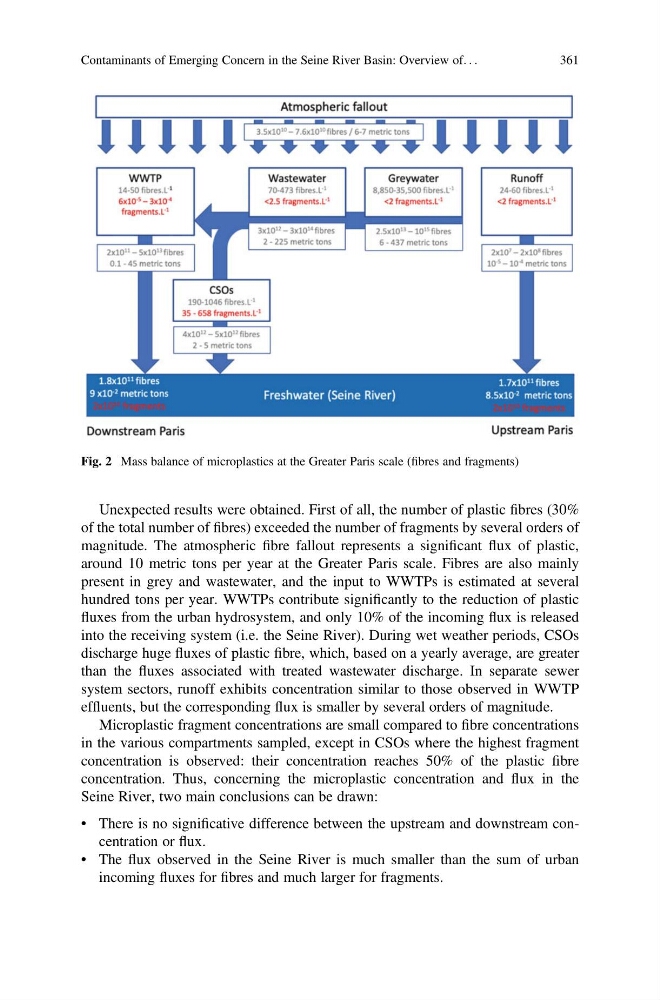
Unexpected results were obtained. First of all, the number of plastic fibres (30%
of the total number of fibres) exceeded the number of fragments by several orders of
magnitude. The atmospheric fibre fallout represents a significant flux of plastic,
around 10 metric tons per year at the Greater Paris scale. Fibres are also mainly
present in grey and wastewater, and the input to WWTPs is estimated at several
hundred tons per year. WWTPs contribute significantly to the reduction of plastic
fluxes from the urban hydrosystem, and only 10% of the incoming flux is released
into the receiving system (i.e. the Seine River). During wet weather periods, CSOs
discharge huge fluxes of plastic fibre, which, based on a yearly average, are greater
than the fluxes associated with treated wastewater discharge. In separate sewer
system sectors, runoff exhibits concentration similar to those observed in WWTP
effluents, but the corresponding flux is smaller by several orders of magnitude.
Microplastic fragment concentrations are small compared to fibre concentrations
in the various compartments sampled, except in CSOs where the highest fragment
concentration is observed: their concentration reaches 50% of the plastic fibre
concentration. Thus, concerning the microplastic concentration and flux in the
Seine River, two main conclusions can be drawn:
• There is no significative difference between the upstream and downstream concentration or flux.
• The flux observed in the Seine River is much smaller than the sum of urban
incoming fluxes for fibres and much larger for fragments.
Fig. 2 Mass balance of microplastics at the Greater Paris scale (fibres and fragments)
Contaminants of Emerging Concern in the Seine River Basin: Overview of. . .
361
of the total number of fibres) exceeded the number of fragments by several orders of
magnitude. The atmospheric fibre fallout represents a significant flux of plastic,
around 10 metric tons per year at the Greater Paris scale. Fibres are also mainly
present in grey and wastewater, and the input to WWTPs is estimated at several
hundred tons per year. WWTPs contribute significantly to the reduction of plastic
fluxes from the urban hydrosystem, and only 10% of the incoming flux is released
into the receiving system (i.e. the Seine River). During wet weather periods, CSOs
discharge huge fluxes of plastic fibre, which, based on a yearly average, are greater
than the fluxes associated with treated wastewater discharge. In separate sewer
system sectors, runoff exhibits concentration similar to those observed in WWTP
effluents, but the corresponding flux is smaller by several orders of magnitude.
Microplastic fragment concentrations are small compared to fibre concentrations
in the various compartments sampled, except in CSOs where the highest fragment
concentration is observed: their concentration reaches 50% of the plastic fibre
concentration. Thus, concerning the microplastic concentration and flux in the
Seine River, two main conclusions can be drawn:
• There is no significative difference between the upstream and downstream concentration or flux.
• The flux observed in the Seine River is much smaller than the sum of urban
incoming fluxes for fibres and much larger for fragments.
Fig. 2 Mass balance of microplastics at the Greater Paris scale (fibres and fragments)
Contaminants of Emerging Concern in the Seine River Basin: Overview of. . .
361