

the territory considered (World Bank data), (3) per capita plastic waste production
(ADEME and ORDIF reports) and (4) an estimated 2% of littering [20].
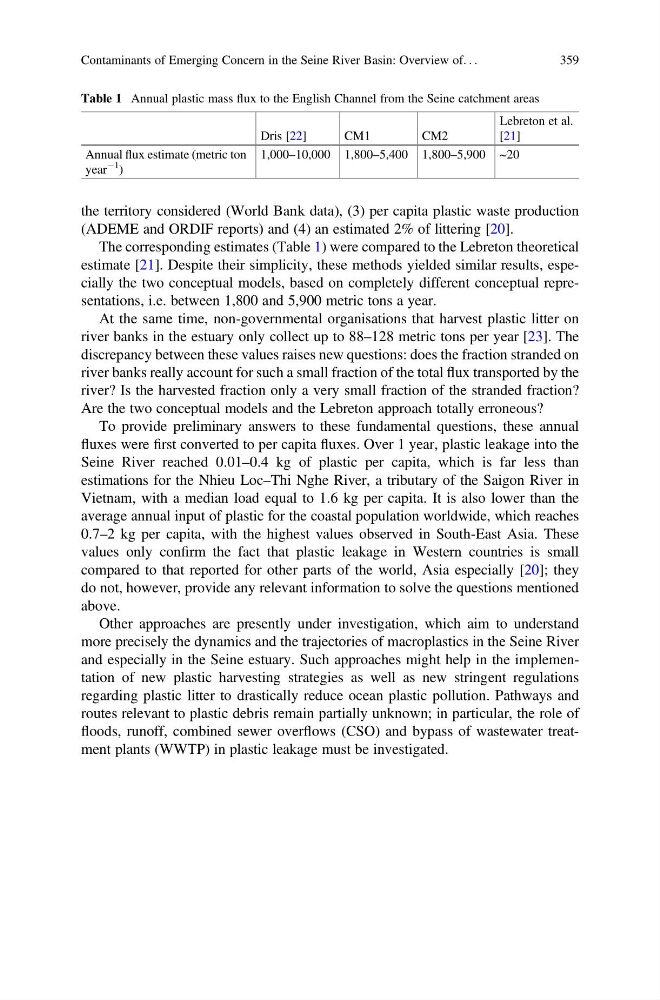
The corresponding estimates (Table 1) were compared to the Lebreton theoretical
estimate [21]. Despite their simplicity, these methods yielded similar results, especially the two conceptual models, based on completely different conceptual representations, i.e. between 1,800 and 5,900 metric tons a year.
At the same time, non-governmental organisations that harvest plastic litter on
river banks in the estuary only collect up to 88–128 metric tons per year [23]. The
discrepancy between these values raises new questions: does the fraction stranded on
river banks really account for such a small fraction of the total flux transported by the
river? Is the harvested fraction only a very small fraction of the stranded fraction?
Are the two conceptual models and the Lebreton approach totally erroneous?
To provide preliminary answers to these fundamental questions, these annual
fluxes were first converted to per capita fluxes. Over 1 year, plastic leakage into the
Seine River reached 0.01–0.4 kg of plastic per capita, which is far less than
estimations for the Nhieu Loc–Thi Nghe River, a tributary of the Saigon River in
Vietnam, with a median load equal to 1.6 kg per capita. It is also lower than the
average annual input of plastic for the coastal population worldwide, which reaches
0.7–2 kg per capita, with the highest values observed in South-East Asia. These
values only confirm the fact that plastic leakage in Western countries is small
compared to that reported for other parts of the world, Asia especially [20]; they
do not, however, provide any relevant information to solve the questions mentioned
above.
Other approaches are presently under investigation, which aim to understand
more precisely the dynamics and the trajectories of macroplastics in the Seine River
and especially in the Seine estuary. Such approaches might help in the implementation of new plastic harvesting strategies as well as new stringent regulations
regarding plastic litter to drastically reduce ocean plastic pollution. Pathways and
routes relevant to plastic debris remain partially unknown; in particular, the role of
floods, runoff, combined sewer overflows (CSO) and bypass of wastewater treatment plants (WWTP) in plastic leakage must be investigated.
Table 1 Annual plastic mass flux to the English Channel from the Seine catchment areas
Dris [22]
CM1
CM2
Lebreton et al.
[21]
Annual flux estimate (metric ton
year
À1
)
1,000–10,000 1,800–5,400 1,800–5,900 ~20
Contaminants of Emerging Concern in the Seine River Basin: Overview of. . .
359
(ADEME and ORDIF reports) and (4) an estimated 2% of littering [20].
The corresponding estimates (Table 1) were compared to the Lebreton theoretical
estimate [21]. Despite their simplicity, these methods yielded similar results, especially the two conceptual models, based on completely different conceptual representations, i.e. between 1,800 and 5,900 metric tons a year.
At the same time, non-governmental organisations that harvest plastic litter on
river banks in the estuary only collect up to 88–128 metric tons per year [23]. The
discrepancy between these values raises new questions: does the fraction stranded on
river banks really account for such a small fraction of the total flux transported by the
river? Is the harvested fraction only a very small fraction of the stranded fraction?
Are the two conceptual models and the Lebreton approach totally erroneous?
To provide preliminary answers to these fundamental questions, these annual
fluxes were first converted to per capita fluxes. Over 1 year, plastic leakage into the
Seine River reached 0.01–0.4 kg of plastic per capita, which is far less than
estimations for the Nhieu Loc–Thi Nghe River, a tributary of the Saigon River in
Vietnam, with a median load equal to 1.6 kg per capita. It is also lower than the
average annual input of plastic for the coastal population worldwide, which reaches
0.7–2 kg per capita, with the highest values observed in South-East Asia. These
values only confirm the fact that plastic leakage in Western countries is small
compared to that reported for other parts of the world, Asia especially [20]; they
do not, however, provide any relevant information to solve the questions mentioned
above.
Other approaches are presently under investigation, which aim to understand
more precisely the dynamics and the trajectories of macroplastics in the Seine River
and especially in the Seine estuary. Such approaches might help in the implementation of new plastic harvesting strategies as well as new stringent regulations
regarding plastic litter to drastically reduce ocean plastic pollution. Pathways and
routes relevant to plastic debris remain partially unknown; in particular, the role of
floods, runoff, combined sewer overflows (CSO) and bypass of wastewater treatment plants (WWTP) in plastic leakage must be investigated.
Table 1 Annual plastic mass flux to the English Channel from the Seine catchment areas
Dris [22]
CM1
CM2
Lebreton et al.
[21]
Annual flux estimate (metric ton
year
À1
)
1,000–10,000 1,800–5,400 1,800–5,900 ~20
Contaminants of Emerging Concern in the Seine River Basin: Overview of. . .
359