

The second strategy is to improve the management of urban runoff by increasing
infiltration or storage to reduce the impact of storm inputs into the river.
Simulation results are presented in Fig. 14 for station 7 M in the Marne River.
This station was chosen because of its symbolic value, because Joinville was one of
major bathing places in the Marne River at the beginning of the century, and because
its contamination level is representative of that of the whole area: 60% of all stations
studied in the Seine and Marne rivers have E. coli 90th percentiles lower than the
7 M station.
We hypothesize that the concentrations lower than the median value are mostly
representative of dry weather conditions and that the upper concentrations are
additionally influenced by wet weather inputs. The reduction of the dry weather
flux is simulated by a reduction factor globally simulating the efficiency of disinfection in WWTPs and of the necessary elimination of black water connections to the
urban runoff network. The improved urban runoff management is simulated by
additional storage or infiltration capacity expressed as a fraction of the maximum
wet weather additional impact.
Two situations were tested, with and without the existence of a reliable bathing
management plan making it possible to remove the 15% most degrading events to
compute the statistics, following the European Directive. These results show that for
a rather contaminated station, the required contamination level for bathing can be
reached for a reduction of 80% of the dry weather inputs and increased storage or
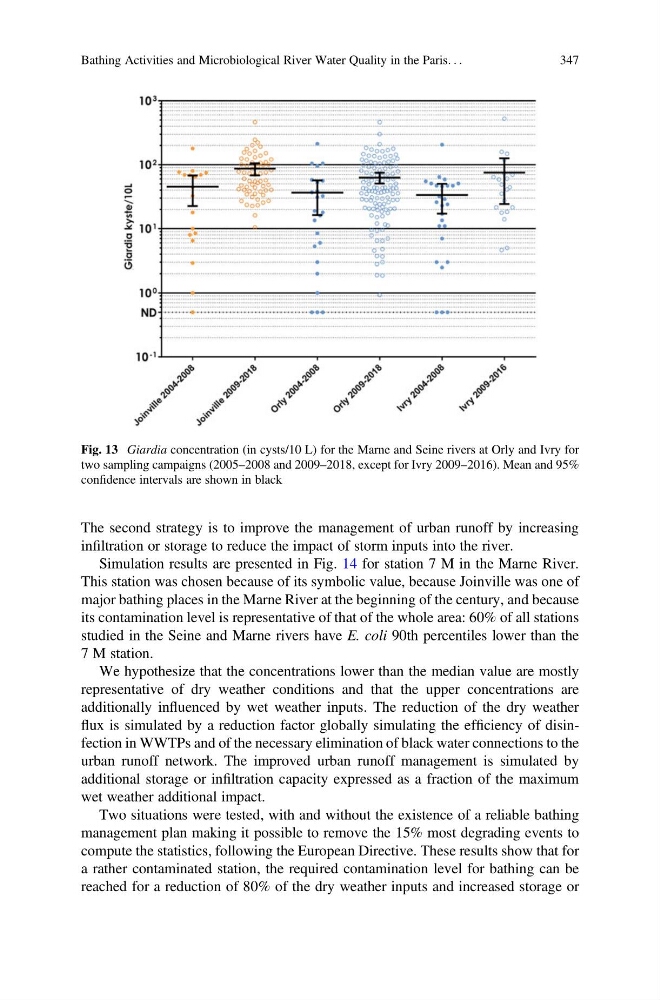
Fig. 13 Giardia concentration (in cysts/10 L) for the Marne and Seine rivers at Orly and Ivry for
two sampling campaigns (2005–2008 and 2009–2018, except for Ivry 2009–2016). Mean and 95%
confidence intervals are shown in black
Bathing Activities and Microbiological River Water Quality in the Paris. . .
347
infiltration or storage to reduce the impact of storm inputs into the river.
Simulation results are presented in Fig. 14 for station 7 M in the Marne River.
This station was chosen because of its symbolic value, because Joinville was one of
major bathing places in the Marne River at the beginning of the century, and because
its contamination level is representative of that of the whole area: 60% of all stations
studied in the Seine and Marne rivers have E. coli 90th percentiles lower than the
7 M station.
We hypothesize that the concentrations lower than the median value are mostly
representative of dry weather conditions and that the upper concentrations are
additionally influenced by wet weather inputs. The reduction of the dry weather
flux is simulated by a reduction factor globally simulating the efficiency of disinfection in WWTPs and of the necessary elimination of black water connections to the
urban runoff network. The improved urban runoff management is simulated by
additional storage or infiltration capacity expressed as a fraction of the maximum
wet weather additional impact.
Two situations were tested, with and without the existence of a reliable bathing
management plan making it possible to remove the 15% most degrading events to
compute the statistics, following the European Directive. These results show that for
a rather contaminated station, the required contamination level for bathing can be
reached for a reduction of 80% of the dry weather inputs and increased storage or
Fig. 13 Giardia concentration (in cysts/10 L) for the Marne and Seine rivers at Orly and Ivry for
two sampling campaigns (2005–2008 and 2009–2018, except for Ivry 2009–2016). Mean and 95%
confidence intervals are shown in black
Bathing Activities and Microbiological River Water Quality in the Paris. . .
347