

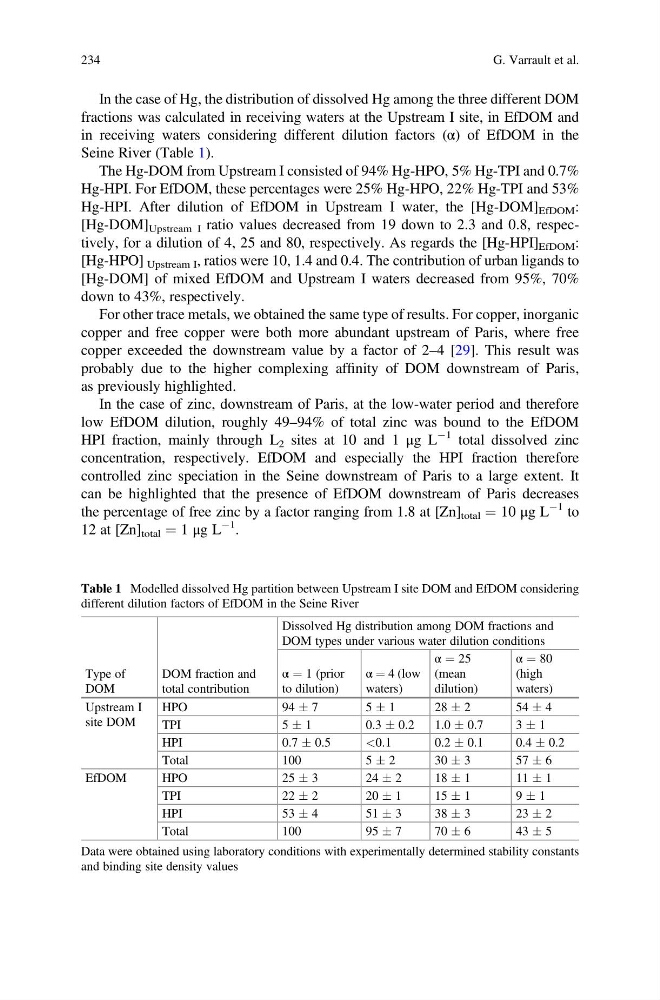
In the case of Hg, the distribution of dissolved Hg among the three different DOM
fractions was calculated in receiving waters at the Upstream I site, in EfDOM and
in receiving waters considering different dilution factors (α) of EfDOM in the
Seine River (Table 1).
The Hg-DOM from Upstream I consisted of 94% Hg-HPO, 5% Hg-TPI and 0.7%
Hg-HPI. For EfDOM, these percentages were 25% Hg-HPO, 22% Hg-TPI and 53%
Hg-HPI. After dilution of EfDOM in Upstream I water, the [Hg-DOM] EfDOM :
[Hg-DOM] Upstream I ratio values decreased from 19 down to 2.3 and 0.8, respectively, for a dilution of 4, 25 and 80, respectively. As regards the [Hg-HPI] EfDOM :
[Hg-HPO] Upstream I , ratios were 10, 1.4 and 0.4. The contribution of urban ligands to
[Hg-DOM] of mixed EfDOM and Upstream I waters decreased from 95%, 70%
down to 43%, respectively.
For other trace metals, we obtained the same type of results. For copper, inorganic
copper and free copper were both more abundant upstream of Paris, where free
copper exceeded the downstream value by a factor of 2–4 [29]. This result was
probably due to the higher complexing affinity of DOM downstream of Paris,
as previously highlighted.
In the case of zinc, downstream of Paris, at the low-water period and therefore
low EfDOM dilution, roughly 49–94% of total zinc was bound to the EfDOM
HPI fraction, mainly through L 2 sites at 10 and 1 μg L
À1 total dissolved zinc
concentration, respectively. EfDOM and especially the HPI fraction therefore
controlled zinc speciation in the Seine downstream of Paris to a large extent. It
can be highlighted that the presence of EfDOM downstream of Paris decreases
the percentage of free zinc by a factor ranging from 1.8 at [Zn] total ¼ 10 μg L
À1 to
12 at [Zn] total ¼ 1 μg L
À1 .
Table 1 Modelled dissolved Hg partition between Upstream I site DOM and EfDOM considering
different dilution factors of EfDOM in the Seine River
Type of
DOM
DOM fraction and
total contribution
Dissolved Hg distribution among DOM fractions and
DOM types under various water dilution conditions
α ¼ 1 (prior
to dilution)
α ¼ 4 (low
waters)
α ¼ 25
(mean
dilution)
α ¼ 80
(high
waters)
Upstream I
site DOM
HPO
94 Æ 7
5Æ 1
2 8Æ 2
5 4Æ 4
TPI
5 Æ 1
0.3 Æ 0.2
1.0 Æ 0.7
3 Æ 1
HPI
0.7 Æ 0.5
<0.1
0.2 Æ 0.1
0.4 Æ 0.2
Total
100
5 Æ 2
3 0Æ 3
5 7Æ 6
EfDOM
HPO
25 Æ 3
2 4Æ 2
1 8Æ 1
1 1Æ 1
TPI
22 Æ 2
2 0Æ 1
1 5Æ 1
9Æ 1
HPI
53 Æ 4
5 1Æ 3
3 8Æ 3
2 3Æ 2
Total
100
95 Æ 7
7 0Æ 6
4 3Æ 5
Data were obtained using laboratory conditions with experimentally determined stability constants
and binding site density values
234
G. Varrault et al.
fractions was calculated in receiving waters at the Upstream I site, in EfDOM and
in receiving waters considering different dilution factors (α) of EfDOM in the
Seine River (Table 1).
The Hg-DOM from Upstream I consisted of 94% Hg-HPO, 5% Hg-TPI and 0.7%
Hg-HPI. For EfDOM, these percentages were 25% Hg-HPO, 22% Hg-TPI and 53%
Hg-HPI. After dilution of EfDOM in Upstream I water, the [Hg-DOM] EfDOM :
[Hg-DOM] Upstream I ratio values decreased from 19 down to 2.3 and 0.8, respectively, for a dilution of 4, 25 and 80, respectively. As regards the [Hg-HPI] EfDOM :
[Hg-HPO] Upstream I , ratios were 10, 1.4 and 0.4. The contribution of urban ligands to
[Hg-DOM] of mixed EfDOM and Upstream I waters decreased from 95%, 70%
down to 43%, respectively.
For other trace metals, we obtained the same type of results. For copper, inorganic
copper and free copper were both more abundant upstream of Paris, where free
copper exceeded the downstream value by a factor of 2–4 [29]. This result was
probably due to the higher complexing affinity of DOM downstream of Paris,
as previously highlighted.
In the case of zinc, downstream of Paris, at the low-water period and therefore
low EfDOM dilution, roughly 49–94% of total zinc was bound to the EfDOM
HPI fraction, mainly through L 2 sites at 10 and 1 μg L
À1 total dissolved zinc
concentration, respectively. EfDOM and especially the HPI fraction therefore
controlled zinc speciation in the Seine downstream of Paris to a large extent. It
can be highlighted that the presence of EfDOM downstream of Paris decreases
the percentage of free zinc by a factor ranging from 1.8 at [Zn] total ¼ 10 μg L
À1 to
12 at [Zn] total ¼ 1 μg L
À1 .
Table 1 Modelled dissolved Hg partition between Upstream I site DOM and EfDOM considering
different dilution factors of EfDOM in the Seine River
Type of
DOM
DOM fraction and
total contribution
Dissolved Hg distribution among DOM fractions and
DOM types under various water dilution conditions
α ¼ 1 (prior
to dilution)
α ¼ 4 (low
waters)
α ¼ 25
(mean
dilution)
α ¼ 80
(high
waters)
Upstream I
site DOM
HPO
94 Æ 7
5Æ 1
2 8Æ 2
5 4Æ 4
TPI
5 Æ 1
0.3 Æ 0.2
1.0 Æ 0.7
3 Æ 1
HPI
0.7 Æ 0.5
<0.1
0.2 Æ 0.1
0.4 Æ 0.2
Total
100
5 Æ 2
3 0Æ 3
5 7Æ 6
EfDOM
HPO
25 Æ 3
2 4Æ 2
1 8Æ 1
1 1Æ 1
TPI
22 Æ 2
2 0Æ 1
1 5Æ 1
9Æ 1
HPI
53 Æ 4
5 1Æ 3
3 8Æ 3
2 3Æ 2
Total
100
95 Æ 7
7 0Æ 6
4 3Æ 5
Data were obtained using laboratory conditions with experimentally determined stability constants
and binding site density values
234
G. Varrault et al.