

Concerning lead, the results highlighted that between 82% and 90% of Pb is
bound to the EfDOM HPI fraction, overcoming by a wide margin the complexation
to the river HPO fraction (humic substances) [47].
Despite the uncertainties, it has been demonstrated in this work that dissolved
organic matter contained in WWTP-treated effluents and particularly its hydrophilic
fraction, due to their very high complexing properties, can control a large proportion
of the dissolved trace metal speciation downstream of the Paris conurbation, particularly in low-water periods because of low EfDOM dilution.
3.6 Evaluation of the Role of DOM on Copper Bioavailability
Toxicity to Daphnia magna
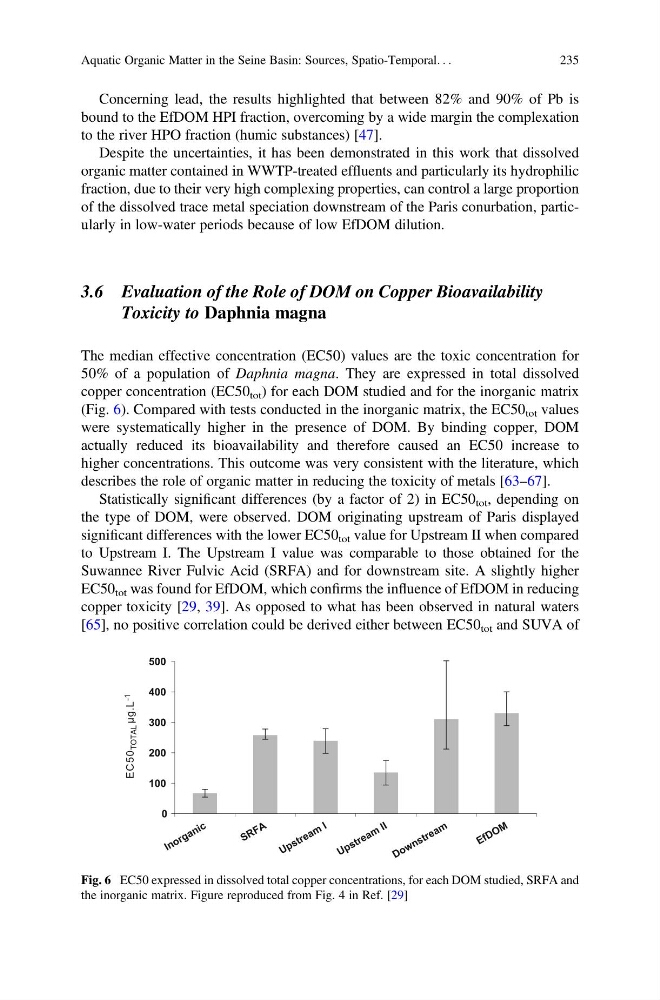
The median effective concentration (EC50) values are the toxic concentration for
50% of a population of Daphnia magna. They are expressed in total dissolved
copper concentration (EC50 tot ) for each DOM studied and for the inorganic matrix
(Fig. 6). Compared with tests conducted in the inorganic matrix, the EC50 tot values
were systematically higher in the presence of DOM. By binding copper, DOM
actually reduced its bioavailability and therefore caused an EC50 increase to
higher concentrations. This outcome was very consistent with the literature, which
describes the role of organic matter in reducing the toxicity of metals [63–67].
Statistically significant differences (by a factor of 2) in EC50 tot , depending on
the type of DOM, were observed. DOM originating upstream of Paris displayed
significant differences with the lower EC50 tot value for Upstream II when compared
to Upstream I. The Upstream I value was comparable to those obtained for the
Suwannee River Fulvic Acid (SRFA) and for downstream site. A slightly higher
EC50 tot was found for EfDOM, which confirms the influence of EfDOM in reducing
copper toxicity [29, 39]. As opposed to what has been observed in natural waters
[65], no positive correlation could be derived either between EC50 tot and SUVA of
0
100
200
300
400
500
0
5
C
E
L
A
T
O
T
L
.
g
µ
-1
Fig. 6 EC50 expressed in dissolved total copper concentrations, for each DOM studied, SRFA and
the inorganic matrix. Figure reproduced from Fig. 4 in Ref. [29]
Aquatic Organic Matter in the Seine Basin: Sources, Spatio-Temporal. . .
235
bound to the EfDOM HPI fraction, overcoming by a wide margin the complexation
to the river HPO fraction (humic substances) [47].
Despite the uncertainties, it has been demonstrated in this work that dissolved
organic matter contained in WWTP-treated effluents and particularly its hydrophilic
fraction, due to their very high complexing properties, can control a large proportion
of the dissolved trace metal speciation downstream of the Paris conurbation, particularly in low-water periods because of low EfDOM dilution.
3.6 Evaluation of the Role of DOM on Copper Bioavailability
Toxicity to Daphnia magna
The median effective concentration (EC50) values are the toxic concentration for
50% of a population of Daphnia magna. They are expressed in total dissolved
copper concentration (EC50 tot ) for each DOM studied and for the inorganic matrix
(Fig. 6). Compared with tests conducted in the inorganic matrix, the EC50 tot values
were systematically higher in the presence of DOM. By binding copper, DOM
actually reduced its bioavailability and therefore caused an EC50 increase to
higher concentrations. This outcome was very consistent with the literature, which
describes the role of organic matter in reducing the toxicity of metals [63–67].
Statistically significant differences (by a factor of 2) in EC50 tot , depending on
the type of DOM, were observed. DOM originating upstream of Paris displayed
significant differences with the lower EC50 tot value for Upstream II when compared
to Upstream I. The Upstream I value was comparable to those obtained for the
Suwannee River Fulvic Acid (SRFA) and for downstream site. A slightly higher
EC50 tot was found for EfDOM, which confirms the influence of EfDOM in reducing
copper toxicity [29, 39]. As opposed to what has been observed in natural waters
[65], no positive correlation could be derived either between EC50 tot and SUVA of
0
100
200
300
400
500
0
5
C
E
L
A
T
O
T
L
.
g
µ
-1
Fig. 6 EC50 expressed in dissolved total copper concentrations, for each DOM studied, SRFA and
the inorganic matrix. Figure reproduced from Fig. 4 in Ref. [29]
Aquatic Organic Matter in the Seine Basin: Sources, Spatio-Temporal. . .
235