

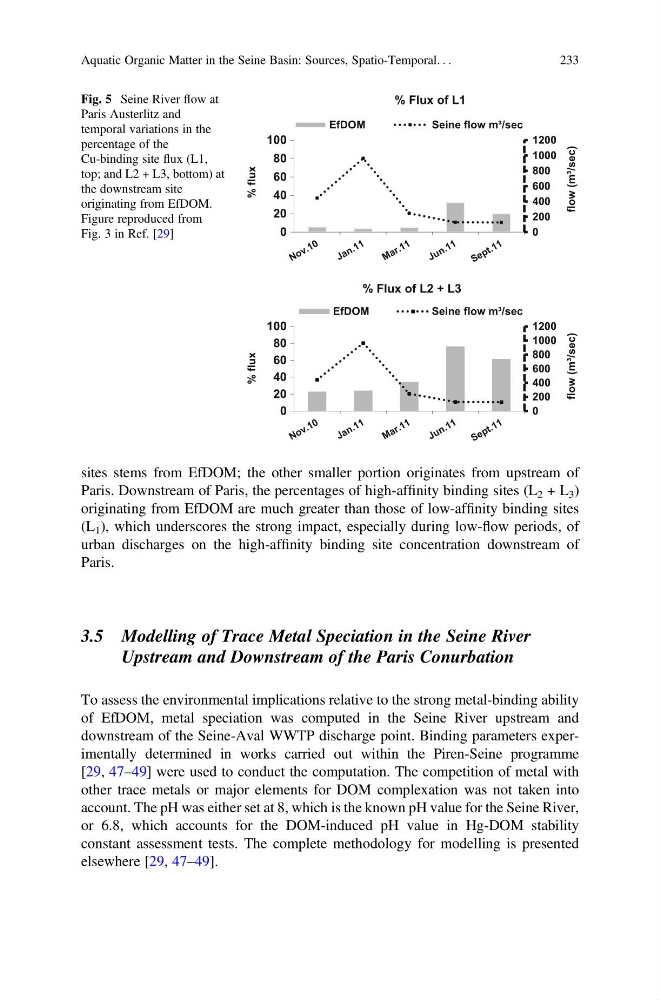
sites stems from EfDOM; the other smaller portion originates from upstream of
Paris. Downstream of Paris, the percentages of high-affinity binding sites (L 2 + L 3 )
originating from EfDOM are much greater than those of low-affinity binding sites
(L 1 ), which underscores the strong impact, especially during low-flow periods, of
urban discharges on the high-affinity binding site concentration downstream of
Paris.
3.5 Modelling of Trace Metal Speciation in the Seine River
Upstream and Downstream of the Paris Conurbation
To assess the environmental implications relative to the strong metal-binding ability
of EfDOM, metal speciation was computed in the Seine River upstream and
downstream of the Seine-Aval WWTP discharge point. Binding parameters experimentally determined in works carried out within the Piren-Seine programme
[29, 47–49] were used to conduct the computation. The competition of metal with
other trace metals or major elements for DOM complexation was not taken into
account. The pH was either set at 8, which is the known pH value for the Seine River,
or 6.8, which accounts for the DOM-induced pH value in Hg-DOM stability
constant assessment tests. The complete methodology for modelling is presented
elsewhere [29, 47–49].
0
200
400
600
800
1000
1200
0
20
40
60
80
100
flow (m³/sec)
% Flux of L1
EfDOM
Seine flow m³/sec
0
200
400
600
800
1000
1200
0
20
40
60
80
100
flow (m³/sec)
% Flux of L2 + L3
EfDOM
Seine flow m³/sec
% flux
% flux
Fig. 5 Seine River flow at
Paris Austerlitz and
temporal variations in the
percentage of the
Cu-binding site flux (L1,
top; and L2 + L3, bottom) at
the downstream site
originating from EfDOM.
Figure reproduced from
Fig. 3 in Ref. [29]
Aquatic Organic Matter in the Seine Basin: Sources, Spatio-Temporal. . .
233
Paris. Downstream of Paris, the percentages of high-affinity binding sites (L 2 + L 3 )
originating from EfDOM are much greater than those of low-affinity binding sites
(L 1 ), which underscores the strong impact, especially during low-flow periods, of
urban discharges on the high-affinity binding site concentration downstream of
Paris.
3.5 Modelling of Trace Metal Speciation in the Seine River
Upstream and Downstream of the Paris Conurbation
To assess the environmental implications relative to the strong metal-binding ability
of EfDOM, metal speciation was computed in the Seine River upstream and
downstream of the Seine-Aval WWTP discharge point. Binding parameters experimentally determined in works carried out within the Piren-Seine programme
[29, 47–49] were used to conduct the computation. The competition of metal with
other trace metals or major elements for DOM complexation was not taken into
account. The pH was either set at 8, which is the known pH value for the Seine River,
or 6.8, which accounts for the DOM-induced pH value in Hg-DOM stability
constant assessment tests. The complete methodology for modelling is presented
elsewhere [29, 47–49].
0
200
400
600
800
1000
1200
0
20
40
60
80
100
flow (m³/sec)
% Flux of L1
EfDOM
Seine flow m³/sec
0
200
400
600
800
1000
1200
0
20
40
60
80
100
flow (m³/sec)
% Flux of L2 + L3
EfDOM
Seine flow m³/sec
% flux
% flux
Fig. 5 Seine River flow at
Paris Austerlitz and
temporal variations in the
percentage of the
Cu-binding site flux (L1,
top; and L2 + L3, bottom) at
the downstream site
originating from EfDOM.
Figure reproduced from
Fig. 3 in Ref. [29]
Aquatic Organic Matter in the Seine Basin: Sources, Spatio-Temporal. . .
233