

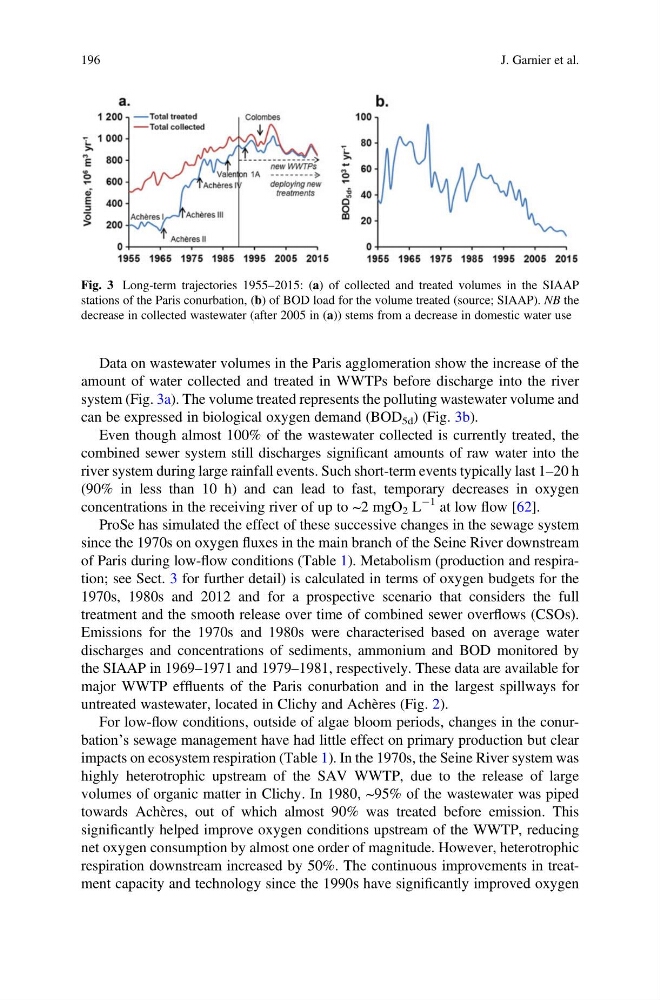
Data on wastewater volumes in the Paris agglomeration show the increase of the
amount of water collected and treated in WWTPs before discharge into the river
system (Fig. 3a). The volume treated represents the polluting wastewater volume and
can be expressed in biological oxygen demand (BOD 5d ) (Fig. 3b).
Even though almost 100% of the wastewater collected is currently treated, the
combined sewer system still discharges significant amounts of raw water into the
river system during large rainfall events. Such short-term events typically last 1–20 h
(90% in less than 10 h) and can lead to fast, temporary decreases in oxygen
concentrations in the receiving river of up to ~2 mgO 2 L
À1 at low flow [62].
ProSe has simulated the effect of these successive changes in the sewage system
since the 1970s on oxygen fluxes in the main branch of the Seine River downstream
of Paris during low-flow conditions (Table 1). Metabolism (production and respiration; see Sect. 3 for further detail) is calculated in terms of oxygen budgets for the
1970s, 1980s and 2012 and for a prospective scenario that considers the full
treatment and the smooth release over time of combined sewer overflows (CSOs).
Emissions for the 1970s and 1980s were characterised based on average water
discharges and concentrations of sediments, ammonium and BOD monitored by
the SIAAP in 1969–1971 and 1979–1981, respectively. These data are available for
major WWTP effluents of the Paris conurbation and in the largest spillways for
untreated wastewater, located in Clichy and Achères (Fig. 2).
For low-flow conditions, outside of algae bloom periods, changes in the conurbation’s sewage management have had little effect on primary production but clear
impacts on ecosystem respiration (Table 1). In the 1970s, the Seine River system was
highly heterotrophic upstream of the SAV WWTP, due to the release of large
volumes of organic matter in Clichy. In 1980, ~95% of the wastewater was piped
towards Achères, out of which almost 90% was treated before emission. This
significantly helped improve oxygen conditions upstream of the WWTP, reducing
net oxygen consumption by almost one order of magnitude. However, heterotrophic
respiration downstream increased by 50%. The continuous improvements in treatment capacity and technology since the 1990s have significantly improved oxygen
Fig. 3 Long-term trajectories 1955–2015: (a) of collected and treated volumes in the SIAAP
stations of the Paris conurbation, (b) of BOD load for the volume treated (source; SIAAP). NB the
decrease in collected wastewater (after 2005 in (a)) stems from a decrease in domestic water use
196
J. Garnier et al.
amount of water collected and treated in WWTPs before discharge into the river
system (Fig. 3a). The volume treated represents the polluting wastewater volume and
can be expressed in biological oxygen demand (BOD 5d ) (Fig. 3b).
Even though almost 100% of the wastewater collected is currently treated, the
combined sewer system still discharges significant amounts of raw water into the
river system during large rainfall events. Such short-term events typically last 1–20 h
(90% in less than 10 h) and can lead to fast, temporary decreases in oxygen
concentrations in the receiving river of up to ~2 mgO 2 L
À1 at low flow [62].
ProSe has simulated the effect of these successive changes in the sewage system
since the 1970s on oxygen fluxes in the main branch of the Seine River downstream
of Paris during low-flow conditions (Table 1). Metabolism (production and respiration; see Sect. 3 for further detail) is calculated in terms of oxygen budgets for the
1970s, 1980s and 2012 and for a prospective scenario that considers the full
treatment and the smooth release over time of combined sewer overflows (CSOs).
Emissions for the 1970s and 1980s were characterised based on average water
discharges and concentrations of sediments, ammonium and BOD monitored by
the SIAAP in 1969–1971 and 1979–1981, respectively. These data are available for
major WWTP effluents of the Paris conurbation and in the largest spillways for
untreated wastewater, located in Clichy and Achères (Fig. 2).
For low-flow conditions, outside of algae bloom periods, changes in the conurbation’s sewage management have had little effect on primary production but clear
impacts on ecosystem respiration (Table 1). In the 1970s, the Seine River system was
highly heterotrophic upstream of the SAV WWTP, due to the release of large
volumes of organic matter in Clichy. In 1980, ~95% of the wastewater was piped
towards Achères, out of which almost 90% was treated before emission. This
significantly helped improve oxygen conditions upstream of the WWTP, reducing
net oxygen consumption by almost one order of magnitude. However, heterotrophic
respiration downstream increased by 50%. The continuous improvements in treatment capacity and technology since the 1990s have significantly improved oxygen
Fig. 3 Long-term trajectories 1955–2015: (a) of collected and treated volumes in the SIAAP
stations of the Paris conurbation, (b) of BOD load for the volume treated (source; SIAAP). NB the
decrease in collected wastewater (after 2005 in (a)) stems from a decrease in domestic water use
196
J. Garnier et al.