

The history of domestic Paris wastewater management since the beginning of the
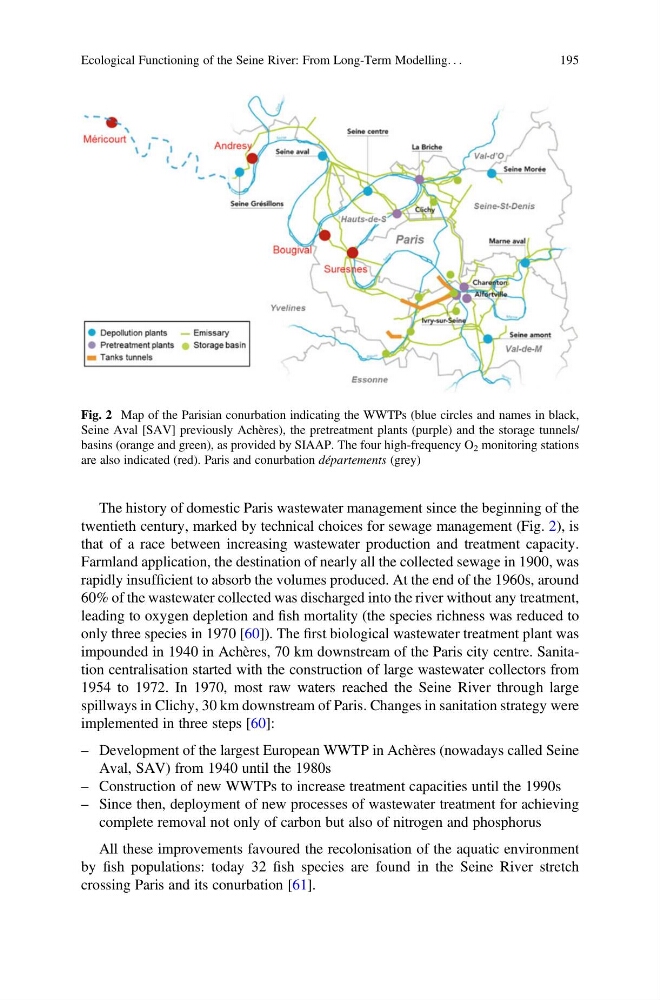
twentieth century, marked by technical choices for sewage management (Fig. 2), is
that of a race between increasing wastewater production and treatment capacity.
Farmland application, the destination of nearly all the collected sewage in 1900, was
rapidly insufficient to absorb the volumes produced. At the end of the 1960s, around
60% of the wastewater collected was discharged into the river without any treatment,
leading to oxygen depletion and fish mortality (the species richness was reduced to
only three species in 1970 [60]). The first biological wastewater treatment plant was
impounded in 1940 in Achères, 70 km downstream of the Paris city centre. Sanitation centralisation started with the construction of large wastewater collectors from
1954 to 1972. In 1970, most raw waters reached the Seine River through large
spillways in Clichy, 30 km downstream of Paris. Changes in sanitation strategy were
implemented in three steps [60]:
– Development of the largest European WWTP in Achères (nowadays called Seine
Aval, SAV) from 1940 until the 1980s
– Construction of new WWTPs to increase treatment capacities until the 1990s
– Since then, deployment of new processes of wastewater treatment for achieving
complete removal not only of carbon but also of nitrogen and phosphorus
All these improvements favoured the recolonisation of the aquatic environment
by fish populations: today 32 fish species are found in the Seine River stretch
crossing Paris and its conurbation [61].
Fig. 2 Map of the Parisian conurbation indicating the WWTPs (blue circles and names in black,
Seine Aval [SAV] previously Achères), the pretreatment plants (purple) and the storage tunnels/
basins (orange and green), as provided by SIAAP. The four high-frequency O 2 monitoring stations
are also indicated (red). Paris and conurbation départements (grey)
Ecological Functioning of the Seine River: From Long-Term Modelling. . .
195
twentieth century, marked by technical choices for sewage management (Fig. 2), is
that of a race between increasing wastewater production and treatment capacity.
Farmland application, the destination of nearly all the collected sewage in 1900, was
rapidly insufficient to absorb the volumes produced. At the end of the 1960s, around
60% of the wastewater collected was discharged into the river without any treatment,
leading to oxygen depletion and fish mortality (the species richness was reduced to
only three species in 1970 [60]). The first biological wastewater treatment plant was
impounded in 1940 in Achères, 70 km downstream of the Paris city centre. Sanitation centralisation started with the construction of large wastewater collectors from
1954 to 1972. In 1970, most raw waters reached the Seine River through large
spillways in Clichy, 30 km downstream of Paris. Changes in sanitation strategy were
implemented in three steps [60]:
– Development of the largest European WWTP in Achères (nowadays called Seine
Aval, SAV) from 1940 until the 1980s
– Construction of new WWTPs to increase treatment capacities until the 1990s
– Since then, deployment of new processes of wastewater treatment for achieving
complete removal not only of carbon but also of nitrogen and phosphorus
All these improvements favoured the recolonisation of the aquatic environment
by fish populations: today 32 fish species are found in the Seine River stretch
crossing Paris and its conurbation [61].
Fig. 2 Map of the Parisian conurbation indicating the WWTPs (blue circles and names in black,
Seine Aval [SAV] previously Achères), the pretreatment plants (purple) and the storage tunnels/
basins (orange and green), as provided by SIAAP. The four high-frequency O 2 monitoring stations
are also indicated (red). Paris and conurbation départements (grey)
Ecological Functioning of the Seine River: From Long-Term Modelling. . .
195