

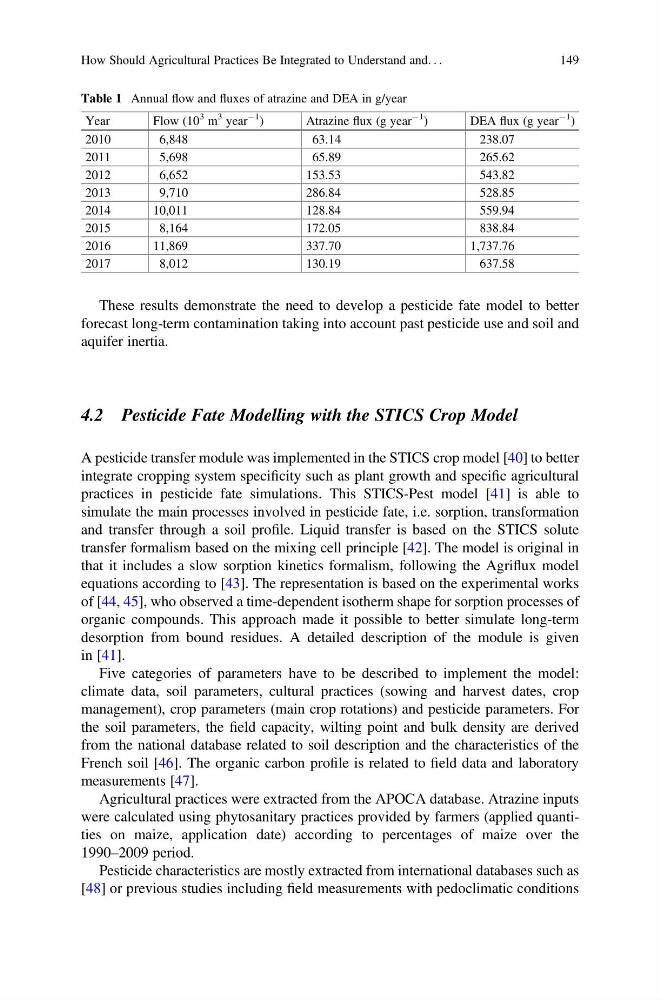
These results demonstrate the need to develop a pesticide fate model to better
forecast long-term contamination taking into account past pesticide use and soil and
aquifer inertia.
4.2 Pesticide Fate Modelling with the STICS Crop Model
A pesticide transfer module was implemented in the STICS crop model [40] to better
integrate cropping system specificity such as plant growth and specific agricultural
practices in pesticide fate simulations. This STICS-Pest model [41] is able to
simulate the main processes involved in pesticide fate, i.e. sorption, transformation
and transfer through a soil profile. Liquid transfer is based on the STICS solute
transfer formalism based on the mixing cell principle [42]. The model is original in
that it includes a slow sorption kinetics formalism, following the Agriflux model
equations according to [43]. The representation is based on the experimental works
of [44, 45], who observed a time-dependent isotherm shape for sorption processes of
organic compounds. This approach made it possible to better simulate long-term
desorption from bound residues. A detailed description of the module is given
in [41].
Five categories of parameters have to be described to implement the model:
climate data, soil parameters, cultural practices (sowing and harvest dates, crop
management), crop parameters (main crop rotations) and pesticide parameters. For
the soil parameters, the field capacity, wilting point and bulk density are derived
from the national database related to soil description and the characteristics of the
French soil [46]. The organic carbon profile is related to field data and laboratory
measurements [47].
Agricultural practices were extracted from the APOCA database. Atrazine inputs
were calculated using phytosanitary practices provided by farmers (applied quantities on maize, application date) according to percentages of maize over the
1990–2009 period.
Pesticide characteristics are mostly extracted from international databases such as
[48] or previous studies including field measurements with pedoclimatic conditions
Table 1 Annual flow and fluxes of atrazine and DEA in g/year
Year
Flow (10
3 m
3 year
À1
)
Atrazine flux (g year
À1
)
DEA flux (g year
À1
)
2010
6,848
63.14
238.07
2011
5,698
65.89
265.62
2012
6,652
153.53
543.82
2013
9,710
286.84
528.85
2014
10,011
128.84
559.94
2015
8,164
172.05
838.84
2016
11,869
337.70
1,737.76
2017
8,012
130.19
637.58
How Should Agricultural Practices Be Integrated to Understand and. . .
149
forecast long-term contamination taking into account past pesticide use and soil and
aquifer inertia.
4.2 Pesticide Fate Modelling with the STICS Crop Model
A pesticide transfer module was implemented in the STICS crop model [40] to better
integrate cropping system specificity such as plant growth and specific agricultural
practices in pesticide fate simulations. This STICS-Pest model [41] is able to
simulate the main processes involved in pesticide fate, i.e. sorption, transformation
and transfer through a soil profile. Liquid transfer is based on the STICS solute
transfer formalism based on the mixing cell principle [42]. The model is original in
that it includes a slow sorption kinetics formalism, following the Agriflux model
equations according to [43]. The representation is based on the experimental works
of [44, 45], who observed a time-dependent isotherm shape for sorption processes of
organic compounds. This approach made it possible to better simulate long-term
desorption from bound residues. A detailed description of the module is given
in [41].
Five categories of parameters have to be described to implement the model:
climate data, soil parameters, cultural practices (sowing and harvest dates, crop
management), crop parameters (main crop rotations) and pesticide parameters. For
the soil parameters, the field capacity, wilting point and bulk density are derived
from the national database related to soil description and the characteristics of the
French soil [46]. The organic carbon profile is related to field data and laboratory
measurements [47].
Agricultural practices were extracted from the APOCA database. Atrazine inputs
were calculated using phytosanitary practices provided by farmers (applied quantities on maize, application date) according to percentages of maize over the
1990–2009 period.
Pesticide characteristics are mostly extracted from international databases such as
[48] or previous studies including field measurements with pedoclimatic conditions
Table 1 Annual flow and fluxes of atrazine and DEA in g/year
Year
Flow (10
3 m
3 year
À1
)
Atrazine flux (g year
À1
)
DEA flux (g year
À1
)
2010
6,848
63.14
238.07
2011
5,698
65.89
265.62
2012
6,652
153.53
543.82
2013
9,710
286.84
528.85
2014
10,011
128.84
559.94
2015
8,164
172.05
838.84
2016
11,869
337.70
1,737.76
2017
8,012
130.19
637.58
How Should Agricultural Practices Be Integrated to Understand and. . .
149