

population in the watershed, the progress of wastewater collection and treatment and
the decline of industrial activity. In the case of P, the substitution period of soap with
polyphosphate-containing synthetic detergents in the 1970s and 1980s increased
domestic P loading by a factor of 3, before P was banned from washing powders in
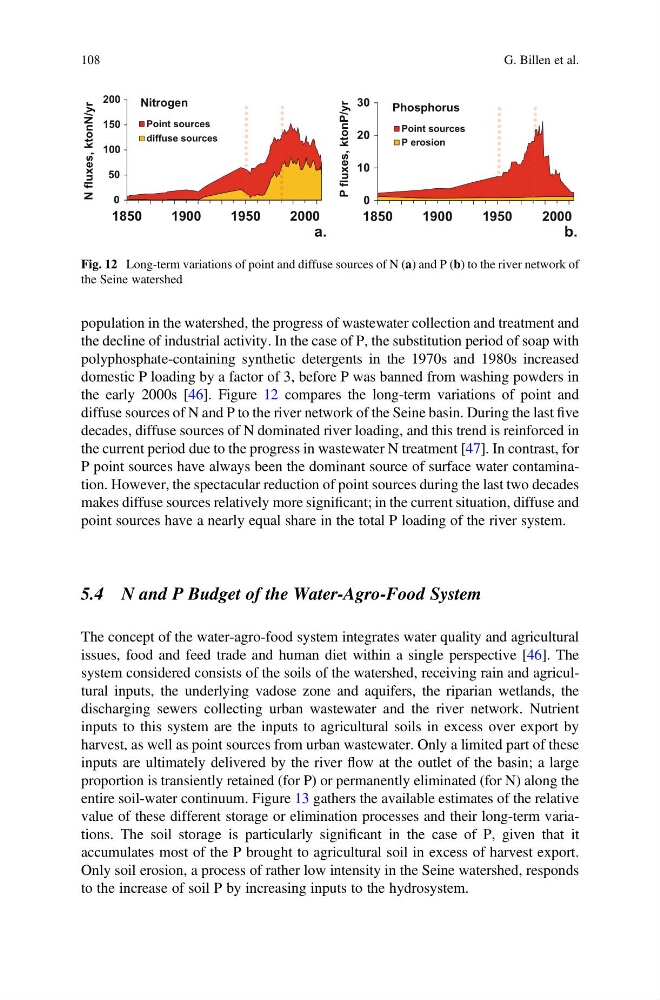
the early 2000s [46]. Figure 12 compares the long-term variations of point and
diffuse sources of N and P to the river network of the Seine basin. During the last five
decades, diffuse sources of N dominated river loading, and this trend is reinforced in
the current period due to the progress in wastewater N treatment [47]. In contrast, for
P point sources have always been the dominant source of surface water contamination. However, the spectacular reduction of point sources during the last two decades
makes diffuse sources relatively more significant; in the current situation, diffuse and
point sources have a nearly equal share in the total P loading of the river system.
5.4 N and P Budget of the Water-Agro-Food System
The concept of the water-agro-food system integrates water quality and agricultural
issues, food and feed trade and human diet within a single perspective [46]. The
system considered consists of the soils of the watershed, receiving rain and agricultural inputs, the underlying vadose zone and aquifers, the riparian wetlands, the
discharging sewers collecting urban wastewater and the river network. Nutrient
inputs to this system are the inputs to agricultural soils in excess over export by
harvest, as well as point sources from urban wastewater. Only a limited part of these
inputs are ultimately delivered by the river flow at the outlet of the basin; a large
proportion is transiently retained (for P) or permanently eliminated (for N) along the
entire soil-water continuum. Figure 13 gathers the available estimates of the relative
value of these different storage or elimination processes and their long-term variations. The soil storage is particularly significant in the case of P, given that it
accumulates most of the P brought to agricultural soil in excess of harvest export.
Only soil erosion, a process of rather low intensity in the Seine watershed, responds
to the increase of soil P by increasing inputs to the hydrosystem.
0
50
100
150
200
1850
1900
1950
2000
r
y
/
N
n
o
t
k
,
s
e
x
u
l
f
N
Point sources
diffuse sources
Nitrogen
a.
0
10
20
30
1850
1900
1950
2000
P fluxes, ktonP/yr
Point sources
P erosion
Phosphorus
b.
Fig. 12 Long-term variations of point and diffuse sources of N (a) and P (b) to the river network of
the Seine watershed
108
G. Billen et al.
the decline of industrial activity. In the case of P, the substitution period of soap with
polyphosphate-containing synthetic detergents in the 1970s and 1980s increased
domestic P loading by a factor of 3, before P was banned from washing powders in
the early 2000s [46]. Figure 12 compares the long-term variations of point and
diffuse sources of N and P to the river network of the Seine basin. During the last five
decades, diffuse sources of N dominated river loading, and this trend is reinforced in
the current period due to the progress in wastewater N treatment [47]. In contrast, for
P point sources have always been the dominant source of surface water contamination. However, the spectacular reduction of point sources during the last two decades
makes diffuse sources relatively more significant; in the current situation, diffuse and
point sources have a nearly equal share in the total P loading of the river system.
5.4 N and P Budget of the Water-Agro-Food System
The concept of the water-agro-food system integrates water quality and agricultural
issues, food and feed trade and human diet within a single perspective [46]. The
system considered consists of the soils of the watershed, receiving rain and agricultural inputs, the underlying vadose zone and aquifers, the riparian wetlands, the
discharging sewers collecting urban wastewater and the river network. Nutrient
inputs to this system are the inputs to agricultural soils in excess over export by
harvest, as well as point sources from urban wastewater. Only a limited part of these
inputs are ultimately delivered by the river flow at the outlet of the basin; a large
proportion is transiently retained (for P) or permanently eliminated (for N) along the
entire soil-water continuum. Figure 13 gathers the available estimates of the relative
value of these different storage or elimination processes and their long-term variations. The soil storage is particularly significant in the case of P, given that it
accumulates most of the P brought to agricultural soil in excess of harvest export.
Only soil erosion, a process of rather low intensity in the Seine watershed, responds
to the increase of soil P by increasing inputs to the hydrosystem.
0
50
100
150
200
1850
1900
1950
2000
r
y
/
N
n
o
t
k
,
s
e
x
u
l
f
N
Point sources
diffuse sources
Nitrogen
a.
0
10
20
30
1850
1900
1950
2000
P fluxes, ktonP/yr
Point sources
P erosion
Phosphorus
b.
Fig. 12 Long-term variations of point and diffuse sources of N (a) and P (b) to the river network of
the Seine watershed
108
G. Billen et al.