

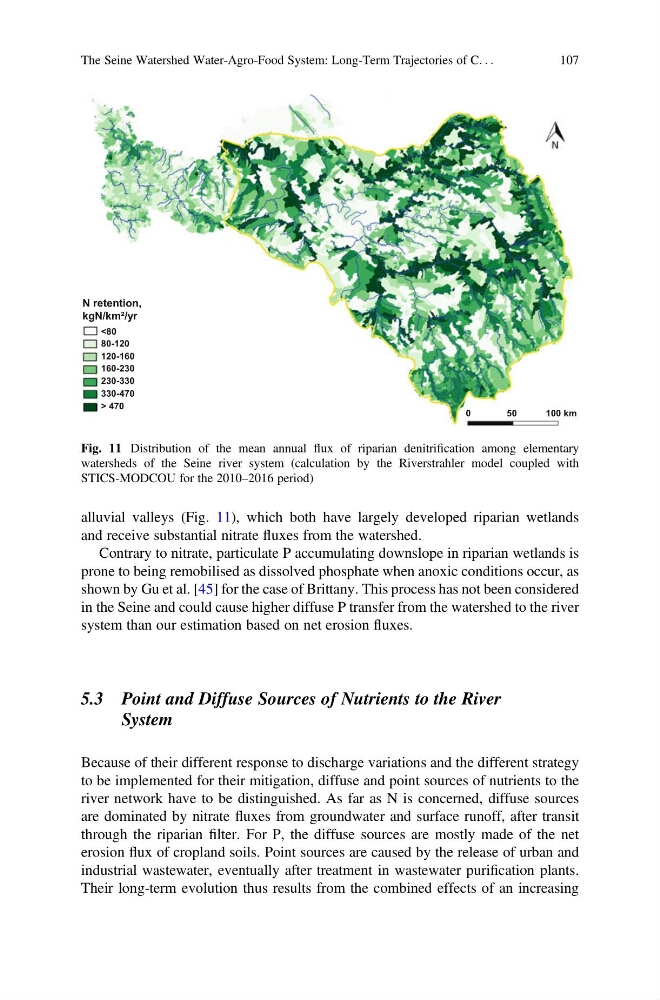
alluvial valleys (Fig. 11), which both have largely developed riparian wetlands
and receive substantial nitrate fluxes from the watershed.
Contrary to nitrate, particulate P accumulating downslope in riparian wetlands is
prone to being remobilised as dissolved phosphate when anoxic conditions occur, as
shown by Gu et al. [45] for the case of Brittany. This process has not been considered
in the Seine and could cause higher diffuse P transfer from the watershed to the river
system than our estimation based on net erosion fluxes.
5.3 Point and Diffuse Sources of Nutrients to the River
System
Because of their different response to discharge variations and the different strategy
to be implemented for their mitigation, diffuse and point sources of nutrients to the
river network have to be distinguished. As far as N is concerned, diffuse sources
are dominated by nitrate fluxes from groundwater and surface runoff, after transit
through the riparian filter. For P, the diffuse sources are mostly made of the net
erosion flux of cropland soils. Point sources are caused by the release of urban and
industrial wastewater, eventually after treatment in wastewater purification plants.
Their long-term evolution thus results from the combined effects of an increasing
N retention,
kgN/km²/yr
<80
80-120
120-160
160-230
230-330
330-470
> 470
0
50
100 km
Fig. 11 Distribution of the mean annual flux of riparian denitrification among elementary
watersheds of the Seine river system (calculation by the Riverstrahler model coupled with
STICS-MODCOU for the 2010–2016 period)
The Seine Watershed Water-Agro-Food System: Long-Term Trajectories of C. . .
107
and receive substantial nitrate fluxes from the watershed.
Contrary to nitrate, particulate P accumulating downslope in riparian wetlands is
prone to being remobilised as dissolved phosphate when anoxic conditions occur, as
shown by Gu et al. [45] for the case of Brittany. This process has not been considered
in the Seine and could cause higher diffuse P transfer from the watershed to the river
system than our estimation based on net erosion fluxes.
5.3 Point and Diffuse Sources of Nutrients to the River
System
Because of their different response to discharge variations and the different strategy
to be implemented for their mitigation, diffuse and point sources of nutrients to the
river network have to be distinguished. As far as N is concerned, diffuse sources
are dominated by nitrate fluxes from groundwater and surface runoff, after transit
through the riparian filter. For P, the diffuse sources are mostly made of the net
erosion flux of cropland soils. Point sources are caused by the release of urban and
industrial wastewater, eventually after treatment in wastewater purification plants.
Their long-term evolution thus results from the combined effects of an increasing
N retention,
kgN/km²/yr
<80
80-120
120-160
160-230
230-330
330-470
> 470
0
50
100 km
Fig. 11 Distribution of the mean annual flux of riparian denitrification among elementary
watersheds of the Seine river system (calculation by the Riverstrahler model coupled with
STICS-MODCOU for the 2010–2016 period)
The Seine Watershed Water-Agro-Food System: Long-Term Trajectories of C. . .
107